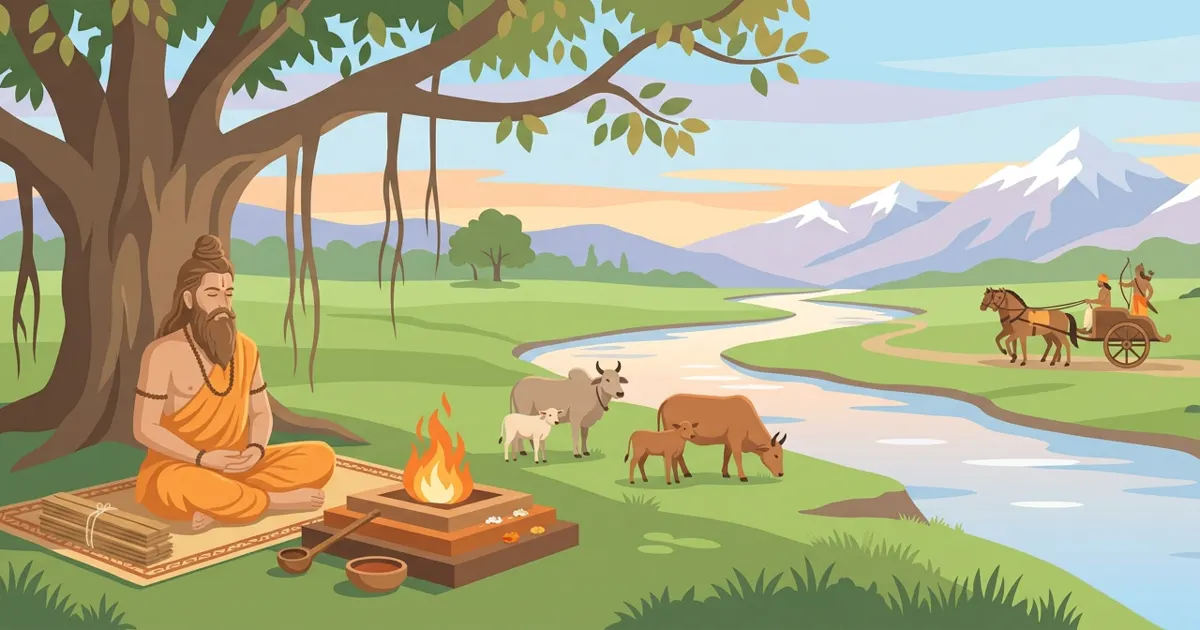
Vedic Period: Quick Answer
The Vedic period is divided into the Early (Rig Vedic) age, about 1500-1000 BCE, and the Later Vedic age, about 1000-600 BCE. Its main sources are the four Vedas: the Rig Veda (hymns, the oldest), the Sama Veda (melodies), the Yajur Veda (sacrificial formulas) and the Atharva Veda (charms and spells). The Rig Veda has 10 mandalas and 1,028 hymns; Indra is its most important god and the Sindhu its most mentioned river, while the Saraswati is the most sacred.
Key takeaway: SSC asks: which Veda has what (Gayatri Mantra in the Rig Veda's 3rd mandala, Purusha Sukta in the 10th, Soma hymns in the 9th), priests of each Veda, Rig Vedic river names (Parushni = Ravi, Vitasta = Jhelum), Sabha and Samiti, and early vs later Vedic differences (iron, varna, gods). This page puts all of them in tables.
Four Vedas and Their Features (Table)
| Veda | Content | Priest | Upaveda (linked) | Key facts |
|---|---|---|---|---|
| Rig Veda | Hymns of praise | Hotri | Ayurveda | Oldest; 10 mandalas, 1,028 hymns (suktas); Gayatri Mantra (Mandala III, to Savitri, by Vishvamitra); Purusha Sukta (Mandala X) first mentions the four varnas; Mandala IX is entirely on Soma |
| Sama Veda | Rig Vedic hymns set to melody | Udgatri | Gandharvaveda (music) | Called the origin of Indian classical music |
| Yajur Veda | Sacrificial formulas, in prose and verse | Adhvaryu | Dhanurveda | Two branches: Shukla (white) and Krishna (black) |
| Atharva Veda | Charms, spells, medicine, daily life | Brahma | Shilpaveda / Sthapatyaveda | Folk beliefs and cures; calls the Sabha and Samiti the "two daughters of Prajapati" |
Trick for priests: "Happy Uncle Ate Bread" → Rig Hotri, Sama Udgatri, Yajur Adhvaryu, Atharva Brahma (Vedas in the order R-S-Y-A).
Vedic Literature: Brahmanas, Aranyakas, Upanishads and Vedangas
| Text | What it is | Important examples |
|---|---|---|
| Brahmanas | Prose explanations of rituals | Aitareya and Kaushitaki (Rig), Shatapatha (Shukla Yajur; largest), Tandya/Panchavimsha (Sama), Gopatha (Atharva) |
| Aranyakas | "Forest texts" for hermits; link rituals and philosophy | Aitareya Aranyaka, Taittiriya Aranyaka |
| Upanishads | Philosophical texts; also called Vedanta (end of the Vedas); about 108 in tradition | Brihadaranyaka (largest; "Asato ma sadgamaya"), Chandogya, Katha (Yama and Nachiketa), Mundaka ("Satyameva Jayate"), Isha, Kena |
| Vedangas (6) | Limbs of the Vedas, auxiliary studies | Shiksha (phonetics), Kalpa (rituals), Vyakarana (grammar), Nirukta (etymology), Chhanda (metre), Jyotisha (astronomy) |
Shruti (heard, revealed) = Vedas, Brahmanas, Aranyakas, Upanishads. Smriti (remembered) = Vedangas, Dharmashastras, epics and Puranas.
Rig Vedic Rivers and Their Modern Names
| Rig Vedic name | Modern name |
|---|---|
| Sindhu | Indus (most mentioned river) |
| Saraswati | Saraswati (most sacred, "Naditama", best of rivers); linked with the Ghaggar-Hakra |
| Vitasta | Jhelum |
| Asikni | Chenab |
| Parushni | Ravi (site of the Battle of Ten Kings) |
| Vipas | Beas |
| Shutudri | Sutlej |
| Drishadvati | Ghaggar (Chautang) |
| Kubha | Kabul |
| Gomati (Gomal) | Gomal |
| Krumu | Kurram |
| Suvastu | Swat |
The Ganga is mentioned only once and the Yamuna three times in the Rig Veda, which shows the early Aryans lived mainly in the Sapta Sindhu (land of seven rivers, the Punjab region).
Rig Vedic Gods, Assemblies and Society
| Topic | Fact |
|---|---|
| Most important god | Indra (about 250 hymns), god of war and rain, called Purandara (breaker of forts) |
| Second | Agni (about 200 hymns), messenger between gods and humans |
| Keeper of cosmic order (rita) | Varuna |
| Soma | God of the sacred drink; all of Mandala IX |
| Assemblies | Sabha (council of elders), Samiti (general assembly of the people), Vidatha (oldest tribal assembly), Gana |
| King | Called Rajan or Gopati (protector of cattle); received Bali (voluntary tribute) |
| Officials | Purohita (priest), Senani (army chief), Gramani (village head) |
| Wealth | Measured in cattle; war was called Gavishti (search for cows) |
| Women composers of hymns | Apala, Ghosha, Lopamudra, Vishvavara |
| Battle of Ten Kings (Dasarajna) | King Sudas of the Bharata clan (priest Vasishtha) defeated ten tribes (advised by Vishvamitra) on the Parushni (Ravi) |
Early Vedic vs Later Vedic Age (Difference Table)
| Point | Early (Rig Vedic) age, c. 1500-1000 BCE | Later Vedic age, c. 1000-600 BCE |
|---|---|---|
| Area | Sapta Sindhu (Punjab, Afghanistan) | Ganga-Yamuna doab; Kuru-Panchala, Kosala, Videha |
| Economy | Mainly pastoral (cattle) | Mainly agricultural; settled villages |
| Metal | Copper/bronze (ayas) | Iron (krishna ayas or shyama ayas) |
| Pottery | Ochre Coloured Pottery (late phase) | Painted Grey Ware (PGW) |
| Society | Varna flexible, based on work | Varna rigid and hereditary; four ashramas first named together in the Jabala Upanishad |
| Women | Took part in assemblies and rituals | Status declined; no part in the Sabha |
| Gods | Indra, Agni, Varuna | Prajapati (creator), Vishnu, Rudra rose in importance |
| King | Tribal chief, limited power | Stronger king; big sacrifices like Rajasuya, Ashvamedha, Vajapeya |
| Taxes | Bali (voluntary) | Bali became regular; collector called Bhagadugha |
Original Home of the Aryans: Theories
| Theory | Proposed by |
|---|---|
| Central Asia | Max Müller |
| Arctic region (The Arctic Home in the Vedas) | Bal Gangadhar Tilak |
| Tibet | Swami Dayanand Saraswati |
| Sapta Sindhu (India itself) | A.C. Das and others |
Vedic Period: PYQ-Style Practice Questions with Answers
1. The Gayatri Mantra is found in which Veda? (a) Sama Veda (b) Rig Veda (c) Yajur Veda (d) Atharva Veda Answer: (b) Rig Veda, Mandala III, addressed to Savitri.
2. Which Veda is called the origin of Indian music? (a) Rig Veda (b) Sama Veda (c) Yajur Veda (d) Atharva Veda Answer: (b) Sama Veda.
3. "Satyameva Jayate" is taken from: (a) Katha Upanishad (b) Mundaka Upanishad (c) Isha Upanishad (d) Chandogya Upanishad Answer: (b) Mundaka Upanishad.
4. The Rig Vedic river Parushni is the modern: (a) Jhelum (b) Chenab (c) Ravi (d) Beas Answer: (c) Ravi.
5. Which god is mentioned most often in the Rig Veda? (a) Agni (b) Varuna (c) Indra (d) Soma Answer: (c) Indra.
6. How many mandalas are there in the Rig Veda? (a) 8 (b) 10 (c) 12 (d) 16 Answer: (b) 10, with 1,028 hymns.
7. The Purusha Sukta, which first mentions the four varnas, is in the Rig Veda's: (a) 1st mandala (b) 3rd mandala (c) 9th mandala (d) 10th mandala Answer: (d) 10th mandala.
8. The metal that came into wide use in the Later Vedic age was: (a) Copper (b) Bronze (c) Iron (d) Gold Answer: (c) Iron.
9. The priest associated with the Yajur Veda was the: (a) Hotri (b) Udgatri (c) Adhvaryu (d) Brahma Answer: (c) Adhvaryu.
10. Who wrote The Arctic Home in the Vedas? (a) Max Müller (b) Bal Gangadhar Tilak (c) Dayanand Saraswati (d) R.G. Bhandarkar Answer: (b) Bal Gangadhar Tilak.
11. Which of these is NOT one of the six Vedangas? (a) Shiksha (b) Nirukta (c) Jyotisha (d) Ayurveda Answer: (d) Ayurveda, which is an Upaveda.
12. The dialogue between Yama and Nachiketa is found in the: (a) Katha Upanishad (b) Mundaka Upanishad (c) Kena Upanishad (d) Brihadaranyaka Upanishad Answer: (a) Katha Upanishad.
Vedic Period FAQs
Which is the oldest Veda?
The Rig Veda, composed in the Early Vedic age (around 1500-1000 BCE).
How many Upanishads are there?
Tradition counts 108 Upanishads, of which about 10-13 are considered the principal (major) ones.
What were Sabha and Samiti?
Popular assemblies of the Vedic age. The Sabha was a smaller council of elders and nobles; the Samiti was the general assembly of the people. The Atharva Veda calls them the two daughters of Prajapati.
Which Rig Vedic river is the most sacred?
The Saraswati, called "Naditama" (the best of rivers). The Sindhu (Indus) is the most mentioned.
What is the difference between Shruti and Smriti?
Shruti ("heard") are revealed texts: the Vedas, Brahmanas, Aranyakas and Upanishads. Smriti ("remembered") are human-authored texts: Vedangas, Dharmashastras, epics and Puranas.
Which Upanishad is the largest?
The Brihadaranyaka Upanishad, which contains the prayer "Asato ma sadgamaya".
Practice Next
- History mock tests: SSC CGL History Mock Test 01, SSC CGL History Mock Test 02, SSC CHSL History Mock Test 01, RRB NTPC History Mock Test 01.
- Related notes: Indus Valley Civilization sites list, 16 Mahajanapadas and their capitals, Mauryan empire rulers list, Indian rivers origin and end list.
- Exam updates: SSC CGL 2026, RRB NTPC 2026.
- Browse all study notes.