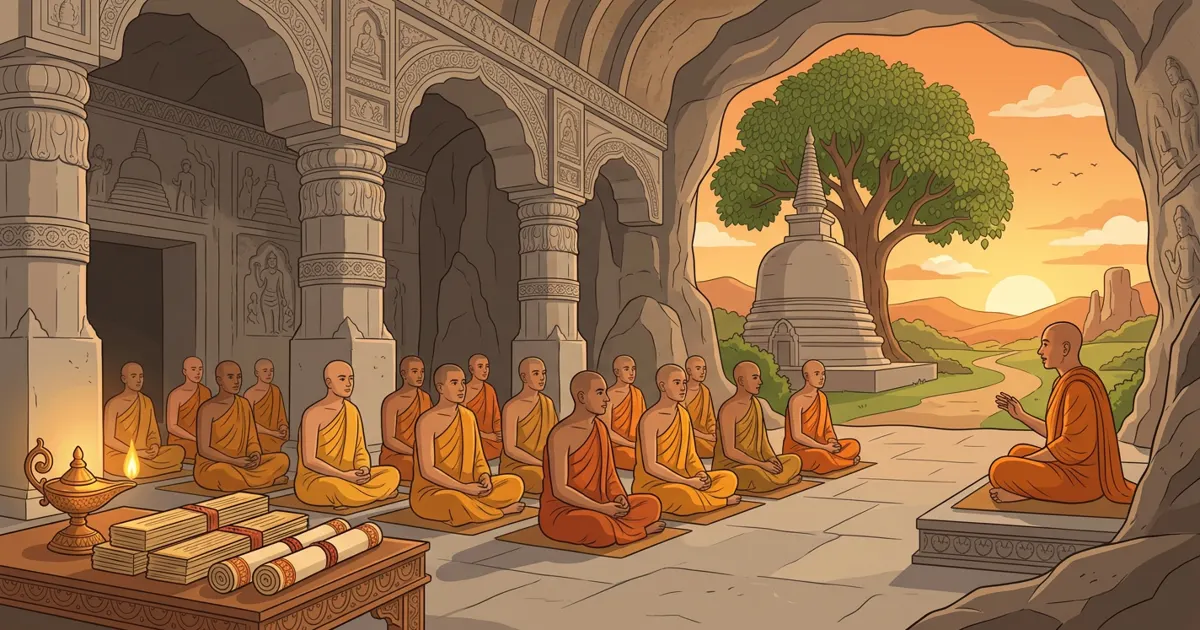
Buddhist Councils: Quick Answer
Four Buddhist councils were held in ancient India: Rajagriha (c. 483 BCE, under Ajatashatru), Vaishali (c. 383 BCE, under Kalashoka), Pataliputra (c. 250 BCE, under Ashoka) and Kundalvana in Kashmir (1st century CE, under Kanishka). The first compiled the Buddha's teachings (Sutta and Vinaya Pitakas), the second split the Sangha into Sthaviravadins and Mahasanghikas, the third added the Abhidhamma Pitaka, and the fourth divided Buddhism into Hinayana and Mahayana.
Key takeaway: Trick for the places: "Raja Vaishali Pata Kashmir" = R-V-P-K and kings "A-K-A-K" = Ajatashatru, Kalashoka, Ashoka, Kanishka. The dates are traditional and approximate; exams use the ones in this table.
Buddhist Councils List (Table)
| Council | Year (approx.) | Place | King (patron) | President | Outcome |
|---|---|---|---|---|---|
| First | c. 483 BCE | Rajagriha (Saptaparni cave), Bihar | Ajatashatru (Haryanka dynasty) | Mahakassapa | Teachings compiled: Sutta Pitaka (recited by Ananda) and Vinaya Pitaka (recited by Upali) |
| Second | c. 383 BCE | Vaishali, Bihar | Kalashoka (Shishunaga dynasty) | Sabakami | Dispute over monastic rules; split into Sthaviravadins and Mahasanghikas |
| Third | c. 250 BCE | Pataliputra, Bihar | Ashoka (Maurya dynasty) | Moggaliputta Tissa | Abhidhamma Pitaka added; missionaries sent to other lands |
| Fourth | 1st century CE (often given as 72 CE) | Kundalvana, Kashmir | Kanishka (Kushan dynasty) | Vasumitra, with Ashvaghosha as vice-president | Buddhism divided into Hinayana and Mahayana; texts compiled in Sanskrit |
Tripitaka: The Three Baskets of Buddhist Texts
| Pitaka | Contents | Council |
|---|---|---|
| Sutta (Sutra) Pitaka | Buddha's sermons and teachings | First council |
| Vinaya Pitaka | Rules for monks and nuns of the Sangha | First council |
| Abhidhamma Pitaka | Philosophy and analysis of the teachings | Third council |
The Tripitakas are in Pali. The Jataka tales (stories of the Buddha's previous births) are part of the Sutta Pitaka (Khuddaka Nikaya).
Jain Councils List (Table)
| Council | Year (approx.) | Place | President | Outcome |
|---|---|---|---|---|
| First | c. 300 BCE | Pataliputra | Sthulabhadra | Compilation of the 12 Angas began; Jains later split into Svetambaras (white-clad) and Digambaras (sky-clad) |
| Second | 512 CE (5th-6th century CE) | Vallabhi, Gujarat | Devardhi Kshamasramana | Final compilation of the 12 Angas and 12 Upangas |
Jain texts are in Prakrit (Ardhamagadhi).
Gautama Buddha Life Facts for Exams
| Event | Place | Symbol |
|---|---|---|
| Birth (c. 563 BCE) | Lumbini (Nepal) | Lotus and bull |
| Great Renunciation (Mahabhinishkramana) at 29 | Kapilavastu | Horse |
| Enlightenment (Nirvana) at 35 | Bodh Gaya, under the Bodhi (peepal) tree, by the Niranjana river | Bodhi tree |
| First sermon (Dharmachakra Pravartana) | Sarnath, near Varanasi | Wheel |
| Death (Mahaparinirvana, c. 483 BCE) at 80 | Kushinagar (Uttar Pradesh) | Stupa |
- Birth name: Siddhartha; clan: Shakya; father Suddhodana; mother Mahamaya; foster mother Prajapati Gautami.
- Triratna of Buddhism: Buddha, Dhamma, Sangha.
- Four Noble Truths and the Eightfold Path (Ashtangika Marga).
Mahavira and Jainism Facts for Exams
| Fact | Detail |
|---|---|
| Birth (c. 540 BCE) | Kundagrama near Vaishali |
| Original name | Vardhamana |
| Kaivalya (enlightenment) | Under a sal tree at Jrimbhikagrama, on the bank of the Rijupalika river |
| Death (c. 468 BCE) | Pawapuri (Pavapuri), near Rajagriha |
| Place in tradition | 24th and last Tirthankara; Rishabhanatha was the 1st, Parshvanatha the 23rd |
| Triratna of Jainism | Right faith, right knowledge, right conduct |
| Five vows | Ahimsa, Satya, Asteya, Aparigraha, Brahmacharya (the fifth added by Mahavira) |
Buddhist Councils MCQs (with Answers)
Q1. The First Buddhist Council was held at: (a) Vaishali (b) Rajagriha (c) Pataliputra (d) Kashmir Answer: (b).
Q2. Who presided over the Third Buddhist Council? (a) Mahakassapa (b) Sabakami (c) Moggaliputta Tissa (d) Vasumitra Answer: (c).
Q3. Under which king was the Fourth Buddhist Council held? (a) Ashoka (b) Kanishka (c) Harsha (d) Kalashoka Answer: (b).
Q4. Buddhism split into Hinayana and Mahayana at the: (a) First council (b) Second council (c) Third council (d) Fourth council Answer: (d).
Q5. The Vinaya Pitaka deals with: (a) Buddha's sermons (b) Rules of the Sangha (c) Philosophy (d) Previous births of Buddha Answer: (b).
Q6. The Second Buddhist Council was held at Vaishali under the patronage of: (a) Bimbisara (b) Ajatashatru (c) Kalashoka (d) Udayin Answer: (c).
Q7. The Buddha delivered his first sermon at: (a) Bodh Gaya (b) Kushinagar (c) Sarnath (d) Lumbini Answer: (c).
Q8. The second Jain council was held at: (a) Pataliputra (b) Vallabhi (c) Shravanabelagola (d) Mathura Answer: (b).
Q9. Who was the 23rd Tirthankara of Jainism? (a) Rishabhanatha (b) Mahavira (c) Parshvanatha (d) Neminatha Answer: (c).
Q10. The Abhidhamma Pitaka was compiled at the Buddhist council held at: (a) Rajagriha (b) Vaishali (c) Pataliputra (d) Kundalvana Answer: (c).
Buddhist Councils FAQs
How many Buddhist councils were held in India?
Four: Rajagriha, Vaishali, Pataliputra and Kundalvana (Kashmir). Later councils were held in Sri Lanka and Myanmar, but SSC and Railway exams ask about these four.
Who presided over the first Buddhist council?
Mahakassapa, at the Saptaparni cave in Rajagriha, under King Ajatashatru.
In which language was the Fourth Buddhist Council held?
Its texts were compiled in Sanskrit, unlike the earlier Pali canon. It was presided over by Vasumitra with Ashvaghosha as vice-president.
Which Buddhist council led to the division into Sthaviravadins and Mahasanghikas?
The Second Buddhist Council at Vaishali (c. 383 BCE).
Where did the Jain councils take place?
The first at Pataliputra (c. 300 BCE, under Sthulabhadra) and the second at Vallabhi in Gujarat (512 CE, under Devardhi Kshamasramana).
Practice Next
- History mock tests: SSC CGL History Mock Test 01, SSC CHSL History Mock Test 01, RRB NTPC History Mock Test 01, SSC MTS History Mock Test 01, RRB NTPC Art and Culture Mock Test 01.
- Related notes: important battles in Indian history, Delhi Sultanate dynasties list, UNESCO World Heritage Sites in India 2026, classical dances of India.
- Browse all study notes.