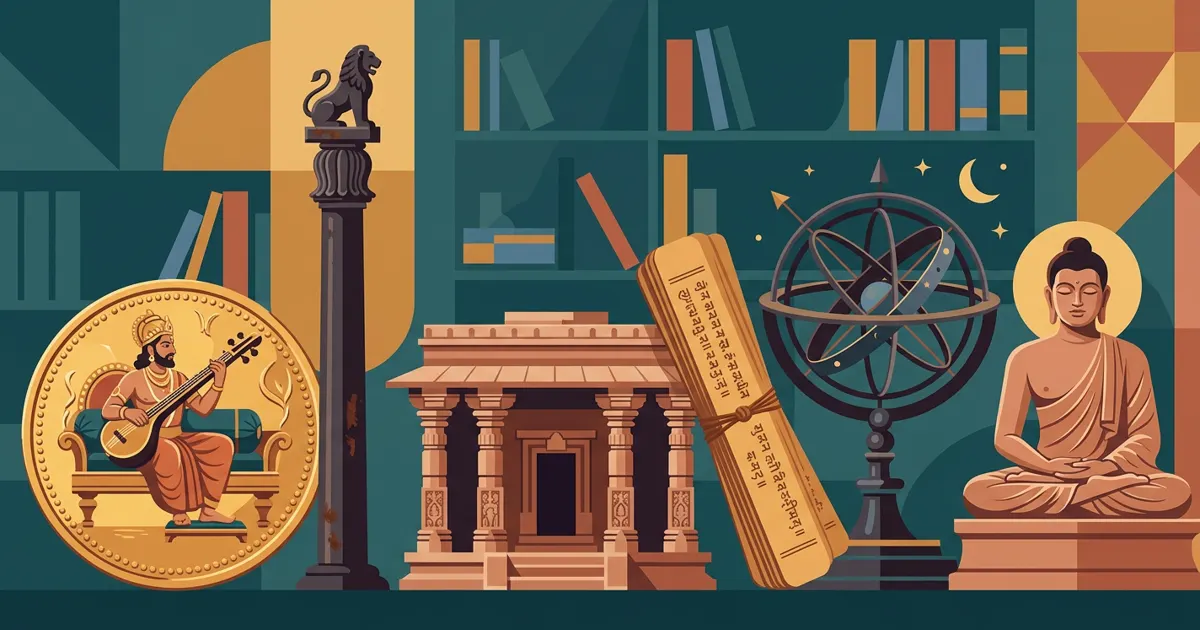
Gupta Empire Rulers: Quick Answer
The Gupta dynasty was founded by Sri Gupta (late 3rd century CE), but its real founder was Chandragupta I (c. 319-335 CE), who took the title Maharajadhiraja and began the Gupta era in 319-320 CE. The greatest rulers were Samudragupta (the conqueror, called the "Napoleon of India"), Chandragupta II Vikramaditya (defeated the Shakas; Kalidasa and Fa-Hien belong to his reign), Kumaragupta I (founded Nalanda) and Skandagupta (stopped the Hunas). The capital was Pataliputra.
Key takeaway: Learn one tag per ruler: Chandragupta I = Licchavi marriage + Gupta era, Samudragupta = Allahabad Pillar (Harisena) + veena coin, Chandragupta II = Shakari + Fa-Hien + navaratnas, Kumaragupta I = Nalanda, Skandagupta = Hunas + Junagadh inscription. That covers most SSC questions on the Guptas.
Gupta Empire Rulers List in Chronological Order
| Ruler | Approx. reign (CE) | Title / known as | Most asked facts |
|---|---|---|---|
| Sri Gupta | c. 240-280 | Maharaja | Founder of the dynasty |
| Ghatotkacha | c. 280-319 | Maharaja | Son of Sri Gupta |
| Chandragupta I | c. 319-335 | Maharajadhiraja | Real founder; married Licchavi princess Kumaradevi; started the Gupta era (319-320 CE) |
| Samudragupta | c. 335-375 | "Napoleon of India" (V.A. Smith), Kaviraja | Conquests recorded in the Allahabad Pillar inscription (Prayag Prashasti) by court poet Harisena; coins show him playing the veena; performed the Ashvamedha |
| Ramagupta | c. 375 (disputed) | — | Known from the play Devichandraguptam; said to be killed by his brother Chandragupta II |
| Chandragupta II | c. 375/380-415 | Vikramaditya, Shakari (destroyer of the Shakas) | Defeated the Western Kshatrapa (Shaka) ruler Rudrasimha III; Ujjain became a second capital; Fa-Hien visited; Mehrauli iron pillar; married his daughter Prabhavati Gupta to the Vakataka king Rudrasena II |
| Kumaragupta I | c. 415-455 | Mahendraditya | Founded Nalanda University; faced the Pushyamitras |
| Skandagupta | c. 455-467 | Vikramaditya | Repelled the Hunas; Junagadh (Girnar) inscription records repair of the Sudarshana lake |
| Later Guptas (Budhagupta, Narasimhagupta Baladitya and others) | c. 467-550 | — | Empire shrank under Huna attacks and revolts of feudatories |
| Vishnugupta | c. 540-550 | — | Usually named as the last Gupta ruler |
Order trick: "Sri Ghatotkacha CHANDRA SAMUDRA, Chandra Kumar Skand" → Sri Gupta, Ghatotkacha, Chandragupta I, Samudragupta, Chandragupta II, Kumaragupta I, Skandagupta.
Samudragupta and the Allahabad Pillar Inscription
- The Prayag Prashasti was composed in Sanskrit by Harisena, Samudragupta's court poet and minister, and engraved on an Ashokan pillar at Allahabad (Prayagraj).
- It lists his campaigns: in the north (Aryavarta) he uprooted kings and annexed their lands; in the south (Dakshinapatha) he defeated 12 kings and then gave their kingdoms back (capture and release policy); frontier kingdoms and forest states paid tribute.
- The Sri Lankan king Meghavarna sent gifts and asked permission to build a monastery at Bodh Gaya.
- He was a poet and musician: his lyrist-type gold coins show him playing the veena. He also issued Ashvamedha-type coins.
- Historian V.A. Smith called him the "Napoleon of India".
Chandragupta II Vikramaditya: Facts for SSC
- Defeat of the Shakas of western India (Gujarat, Malwa) gave the Guptas the western sea ports and earned him the title Shakari.
- Ujjain became an important second capital.
- He issued silver coins in the western areas he won, copying the Shaka coins.
- The Chinese Buddhist pilgrim Fa-Hien (Faxian) travelled in India in his reign (about 399-414 CE) and wrote of a peaceful, prosperous country with few harsh punishments.
- The Iron Pillar at Mehrauli (Delhi), which has not rusted for about 1,600 years, carries an inscription of a king "Chandra", usually identified with Chandragupta II.
- Tradition places the navaratnas (nine gems) in his court, including Kalidasa, Amarasimha, Varahamihira and Dhanvantari. Historians note that not all nine were contemporaries.
Gupta Period Literature and Science (Golden Age)
| Person | Field | Main work or contribution |
|---|---|---|
| Kalidasa | Sanskrit poetry and drama | Abhijnanashakuntalam, Meghaduta, Raghuvamsha, Kumarasambhava, Malavikagnimitram, Vikramorvashiyam, Ritusamhara |
| Aryabhata | Mathematics and astronomy | Aryabhatiya (499 CE); place-value system, value of pi close to 3.1416; said the Earth rotates on its axis; explained eclipses scientifically. India's first satellite (1975) is named after him |
| Varahamihira | Astronomy and astrology | Pancha Siddhantika, Brihat Samhita |
| Amarasimha | Lexicography | Amarakosha (a Sanskrit thesaurus) |
| Vishakhadatta | Drama | Mudrarakshasa (on Chandragupta Maurya and Chanakya), Devichandraguptam |
| Shudraka | Drama | Mrichchhakatika (The Little Clay Cart) |
| Harisena | Poetry | Allahabad Pillar inscription (Prayag Prashasti) |
| Dhanvantari | Medicine (Ayurveda) | Traditionally one of the navaratnas |
Note on a common trap: Brahmagupta (Brahmasphutasiddhanta, 628 CE) lived after the Gupta empire, and the classic Sushruta Samhita and Charaka Samhita are older works; do not tick them as "Gupta-age" unless the option says "compiled or revised".
Gupta Art, Architecture and Coins
| Item | Detail |
|---|---|
| Dashavatara Temple, Deogarh (Lalitpur, Uttar Pradesh) | One of the earliest Hindu stone temples with a shikhara (tower); Vishnu reliefs |
| Bhitargaon Temple (Kanpur, Uttar Pradesh) | Early brick temple with terracotta panels |
| Udayagiri Caves (near Vidisha, Madhya Pradesh) | Huge Varaha (boar incarnation of Vishnu) relief, time of Chandragupta II |
| Sarnath school of sculpture | Graceful Buddha images in Chunar sandstone, such as the seated Buddha preaching the first sermon |
| Mehrauli Iron Pillar | Rust-resistant wrought iron; inscription of king "Chandra" |
| Ajanta Caves | Many later caves and paintings date to the 5th century under the Vakatakas, Gupta allies, not the Guptas directly |
| Coins | The Guptas issued the largest number of gold coins (dinaras) in ancient India; silver coins called rupaka; types include archer, lyrist (veena), Ashvamedha and tiger-slayer |
Gupta Administration: Terms Asked in Exams
| Term | Meaning |
|---|---|
| Maharajadhiraja, Parama Bhattaraka | Imperial titles of the Gupta kings |
| Bhukti | Province, under an Uparika |
| Vishaya | District, under a Vishayapati |
| Kumaramatya | High-ranking officers |
| Agrahara | Tax-free land granted to Brahmins |
| Vishti | Forced (unpaid) labour |
| Sandhivigrahika | Minister for peace and war (Harisena held this post) |
The Gupta period saw more land grants to priests and officials, which historians link to the growth of feudal tendencies.
Decline of the Gupta Empire
- Huna invasions: Skandagupta held them back, but later rulers Toramana and his son Mihirakula seized parts of western and central India. Mihirakula was defeated by Yashodharman of Malwa and by Narasimhagupta Baladitya.
- Rise of feudatories: the Maukharis (Kannauj), the Maitrakas (Valabhi) and the later Guptas of Magadha broke away.
- Weak successors and loss of revenue: fewer gold coins of lower purity show economic strain.
- The empire ended around 550 CE.
Gupta Empire: PYQ-Style Practice Questions with Answers
1. Who is considered the real founder of the Gupta empire? (a) Sri Gupta (b) Ghatotkacha (c) Chandragupta I (d) Samudragupta Answer: (c) Chandragupta I, who took the title Maharajadhiraja and started the Gupta era in 319-320 CE.
2. The Allahabad Pillar inscription was composed by: (a) Kalidasa (b) Harisena (c) Banabhatta (d) Ravikirti Answer: (b) Harisena. Ravikirti wrote the Aihole inscription of Pulakeshin II.
3. Which Gupta ruler is called the "Napoleon of India"? (a) Chandragupta I (b) Samudragupta (c) Chandragupta II (d) Skandagupta Answer: (b) Samudragupta, a title given by V.A. Smith.
4. Fa-Hien visited India during the reign of: (a) Samudragupta (b) Chandragupta II (c) Kumaragupta I (d) Harshavardhana Answer: (b) Chandragupta II. Hiuen Tsang came later, during Harsha's reign.
5. Nalanda University was founded by: (a) Kumaragupta I (b) Harshavardhana (c) Dharmapala (d) Skandagupta Answer: (a) Kumaragupta I. Dharmapala of the Pala dynasty founded Vikramashila.
6. Which Gupta ruler took the title "Shakari"? (a) Chandragupta I (b) Samudragupta (c) Chandragupta II (d) Kumaragupta I Answer: (c) Chandragupta II, after defeating the Shaka ruler Rudrasimha III.
7. Aryabhatiya was written by: (a) Varahamihira (b) Brahmagupta (c) Aryabhata (d) Bhaskara I Answer: (c) Aryabhata, in 499 CE.
8. Which Gupta ruler repelled the Huna invasion? (a) Skandagupta (b) Kumaragupta I (c) Budhagupta (d) Vishnugupta Answer: (a) Skandagupta.
9. The Dashavatara Temple of the Gupta period is at: (a) Bhitargaon (b) Deogarh (c) Sanchi (d) Aihole Answer: (b) Deogarh, in Lalitpur district, Uttar Pradesh.
10. Gold coins of the Gupta period were called: (a) Karshapana (b) Dinara (c) Rupaka (d) Tanka Answer: (b) Dinara. Rupaka were silver coins; the tanka belongs to the Delhi Sultanate.
11. Chandragupta I married a princess of which clan? (a) Maukhari (b) Licchavi (c) Vakataka (d) Kushana Answer: (b) Licchavi (Kumaradevi). Coins of Chandragupta I show the king and queen together.
12. Abhijnanashakuntalam was written by: (a) Shudraka (b) Vishakhadatta (c) Kalidasa (d) Bhasa Answer: (c) Kalidasa.
Gupta Empire FAQs
Who was the founder of the Gupta dynasty?
Sri Gupta founded the dynasty in the late 3rd century CE, but Chandragupta I (c. 319-335 CE) is called its real founder because he made it an empire.
What was the capital of the Gupta empire?
Pataliputra (modern Patna). Ujjain became an important second capital under Chandragupta II.
Why is the Gupta period called the Golden Age of India?
Because of its political unity and its great achievements in Sanskrit literature (Kalidasa), science and mathematics (Aryabhata, Varahamihira), art (Sarnath sculpture, Deogarh temple) and the rich gold coinage.
Who was the last ruler of the Gupta empire?
Vishnugupta, around 540-550 CE, is usually named as the last ruler of the main Gupta line.
Which inscription tells us about Skandagupta?
The Junagadh (Girnar) rock inscription, which records the repair of the Sudarshana lake, and the Bhitari pillar inscription, which describes his fight against the Hunas.
Who were the navaratnas of Chandragupta II?
By tradition: Kalidasa, Amarasimha, Varahamihira, Dhanvantari, Kshapanaka, Shanku, Vetala Bhatta, Ghatakarpara and Vararuchi. Historians treat the list as a later tradition, since not all of them lived at the same time.
Practice Next
- History mock tests: SSC CGL History Mock Test 01, SSC CGL History Mock Test 02, SSC CHSL History Mock Test 01, RRB NTPC History Mock Test 01.
- Related notes: Buddhist councils list, Delhi Sultanate dynasties list, Important battles in Indian history, Revolt of 1857, Classical dances of India.
- Exam updates: SSC CGL 2026, RRB NTPC 2026.
- Browse all study notes.