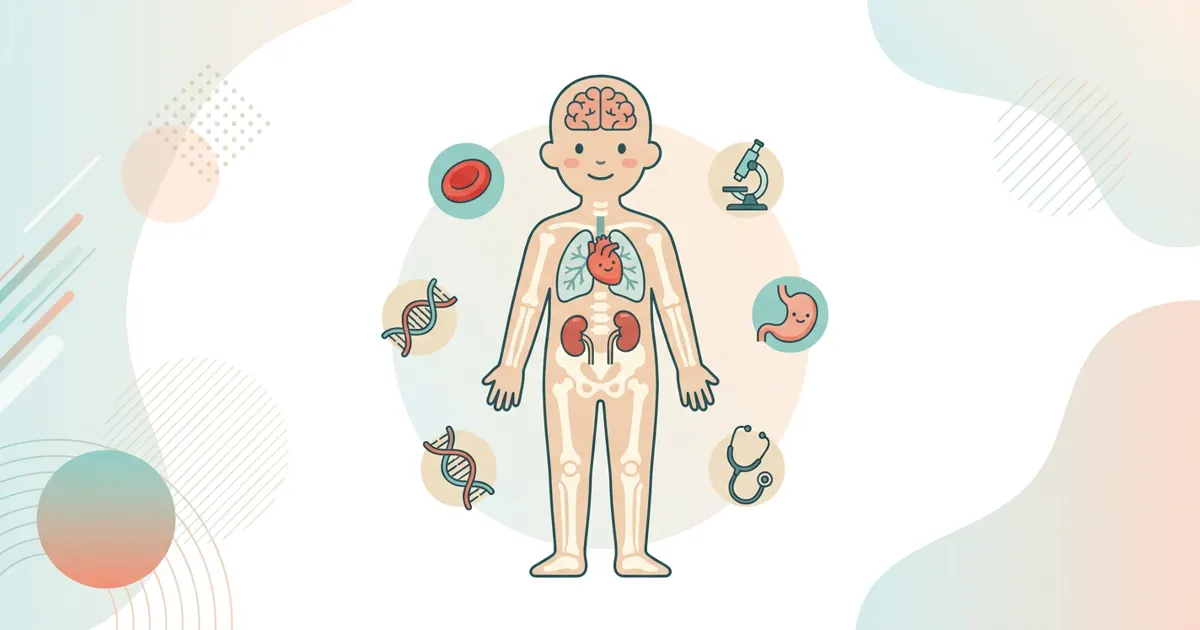
Human Body GK: Quick Answer
An adult human has 206 bones, 32 teeth, 46 chromosomes and about 5-6 litres of blood. The largest organ is the skin, the largest internal organ and largest gland is the liver, the largest bone is the femur and the smallest is the stapes in the ear. Normal body temperature is about 37°C (98.6°F), normal blood pressure is about 120/80 mmHg, and the heart beats about 72 times a minute.
Key takeaway: Human body questions in SSC and Railway exams are mostly "largest / smallest / normal value / which organ makes what". Learn the record-holders table, the normal values table and the one-line job of each organ on this page, and you will answer 4 out of 5 such questions.
Important Facts About the Human Body (Numbers to Remember)
| Fact | Value |
|---|---|
| Bones in an adult | 206 |
| Bones in a newborn | About 300 (many fuse as we grow) |
| Muscles | More than 600 (about 639 is the usual textbook figure) |
| Teeth: adult / milk teeth | 32 / 20 |
| Chromosomes | 46 (23 pairs); 22 pairs of autosomes + 1 pair of sex chromosomes (XX female, XY male) |
| Normal body temperature | About 37°C or 98.6°F |
| Blood volume | About 5-6 litres in an adult (roughly 7% of body weight) |
| Normal blood pressure | About 120/80 mmHg (systolic/diastolic) |
| Heart rate (adult at rest) | About 72 beats per minute |
| Breathing rate (adult at rest) | About 12-20 breaths per minute |
| pH of blood | About 7.4 (slightly alkaline) |
| Life span of red blood cells | About 120 days |
| Life span of platelets | About 7-10 days |
| Weight of adult brain | About 1.3-1.4 kg |
| Length of small intestine | About 6-7 metres |
| Lobes of the lungs | Right lung 3, left lung 2 |
Largest and Smallest in the Human Body (Record Table)
| Record | Answer |
|---|---|
| Largest organ | Skin |
| Largest internal organ | Liver |
| Largest gland | Liver |
| Largest endocrine gland | Thyroid |
| Master gland | Pituitary |
| Largest and longest bone | Femur (thigh bone) |
| Smallest bone | Stapes (in the middle ear) |
| Largest muscle | Gluteus maximus (buttock) |
| Smallest muscle | Stapedius (in the middle ear) |
| Longest nerve | Sciatic nerve |
| Largest artery | Aorta |
| Largest vein | Vena cava (inferior vena cava) |
| Largest part of the brain | Cerebrum |
| Hardest substance | Tooth enamel |
| Largest cell | Ovum (egg cell) |
| Longest cell | Neuron (nerve cell) |
| Largest white blood cell | Monocyte |
| Most common white blood cell | Neutrophil |
Human Body Systems and Their Functions (Table)
| Organ system | Main organs | Main function |
|---|---|---|
| Integumentary | Skin, hair, nails, sweat glands | Protection, temperature control, vitamin D formation |
| Skeletal | Bones, cartilage, ligaments | Support, shape, protection, blood cell formation in red bone marrow |
| Muscular | Skeletal, smooth and cardiac muscle | Movement, posture, pumping of the heart |
| Nervous | Brain, spinal cord, nerves | Control and coordination; neuron is the unit |
| Endocrine | Pituitary, thyroid, adrenal, pancreas (islets), gonads | Control through hormones |
| Circulatory | Heart, arteries, veins, capillaries, blood | Transport of oxygen, food, hormones and wastes |
| Lymphatic and immune | Lymph nodes, spleen, thymus, tonsils | Defence against infection, return of tissue fluid |
| Respiratory | Nose, trachea, bronchi, lungs (alveoli) | Exchange of oxygen and carbon dioxide |
| Digestive | Mouth, oesophagus, stomach, intestines, liver, pancreas | Breakdown and absorption of food |
| Excretory (urinary) | Kidneys, ureters, bladder, urethra | Removal of urea and wastes; nephron is the unit |
| Reproductive | Testes, ovaries, uterus | Production of offspring |
Blood and Circulatory System Facts for SSC
| Topic | Fact |
|---|---|
| Red blood cells (erythrocytes) | Carry oxygen using haemoglobin; no nucleus in mature human RBCs; made in red bone marrow; normal count about 4.5-5.5 million per mm³ |
| White blood cells (leucocytes) | Fight infection; normal count about 4,000-11,000 per mm³ |
| Platelets (thrombocytes) | Help blood to clot; about 1.5-4 lakh per mm³ |
| Graveyard of RBCs | Spleen (old RBCs are broken down in the spleen and liver) |
| Blood groups | Discovered by Karl Landsteiner (ABO, 1900-01); Rh factor by Landsteiner and Wiener (1940) |
| Universal donor / recipient | O negative / AB positive |
| Discovery of blood circulation | William Harvey (1628) |
| Heart | Four chambers (2 atria, 2 ventricles); the SA node is the natural pacemaker |
| Exceptions | Pulmonary artery carries deoxygenated blood; pulmonary vein carries oxygenated blood |
| Blood pressure | Measured with a sphygmomanometer |
Digestive System: Enzymes and Glands Asked in Exams
| Part or gland | Juice or enzyme | Acts on |
|---|---|---|
| Mouth (salivary glands) | Salivary amylase (ptyalin) | Starch → maltose |
| Stomach | Hydrochloric acid, pepsin | HCl kills germs and makes the medium acidic; pepsin digests proteins |
| Liver | Bile (stored in the gall bladder) | Emulsifies fats; bile has no digestive enzyme |
| Pancreas | Trypsin, pancreatic amylase, lipase | Proteins, starch, fats |
| Small intestine | Intestinal juice; villi absorb digested food | Completes digestion; main site of absorption |
| Large intestine | — | Absorbs water and salts |
Digestion of food begins in the mouth and is completed in the small intestine. Dental formula of an adult (one half of each jaw): 2-1-2-3 (incisors, canine, premolars, molars).
Endocrine Glands and Hormones Table
| Gland | Hormone | Job / disorder |
|---|---|---|
| Pituitary (master gland) | Growth hormone and others | Excess in childhood: gigantism; deficiency: dwarfism |
| Thyroid | Thyroxine (needs iodine) | Controls metabolism; iodine deficiency causes goitre |
| Pancreas (islets of Langerhans) | Insulin (beta cells), glucagon (alpha cells) | Controls blood sugar; low insulin causes diabetes mellitus |
| Adrenal | Adrenaline | "Fight or flight" hormone |
| Testes / ovaries | Testosterone / oestrogen and progesterone | Sex characters and reproduction |
| Pineal | Melatonin | Sleep and body clock |
Brain, Nervous System and Sense Organs Facts
- Cerebrum: thinking, memory, intelligence and voluntary actions.
- Cerebellum: balance and coordination of body movements.
- Medulla oblongata: involuntary actions such as heartbeat, breathing, vomiting and swallowing.
- Hypothalamus: controls body temperature, hunger and thirst, and links the brain to the pituitary.
- Eye: the retina has rods (dim light) and cones (colour). Myopia (short-sightedness) is corrected by a concave lens; hypermetropia (long-sightedness) by a convex lens. The cornea is the part transplanted in eye donation.
- Ear: the three ear ossicles are malleus, incus and stapes; the ear also controls balance.
Human Body GK Questions with Answers (PYQ-Style)
1. How many bones are there in the adult human body? (a) 204 (b) 206 (c) 208 (d) 212 Answer: (b) 206.
2. Which is the largest gland in the human body? (a) Pancreas (b) Thyroid (c) Liver (d) Pituitary Answer: (c) Liver. The thyroid is the largest endocrine gland.
3. The smallest bone in the human body is found in the: (a) Nose (b) Ear (c) Finger (d) Toe Answer: (b) Ear. The stapes is in the middle ear.
4. What is the life span of human red blood cells? (a) 30 days (b) 60 days (c) 120 days (d) 180 days Answer: (c) About 120 days.
5. Which blood group is known as the universal donor? (a) A (b) B (c) AB (d) O Answer: (d) O (strictly, O negative). AB positive is the universal recipient.
6. Insulin is secreted by: (a) Liver (b) Pancreas (c) Kidney (d) Thyroid Answer: (b) Pancreas, by the beta cells of the islets of Langerhans.
7. Which part of the brain controls balance of the body? (a) Cerebrum (b) Cerebellum (c) Medulla oblongata (d) Hypothalamus Answer: (b) Cerebellum.
8. Which is the longest nerve in the human body? (a) Optic nerve (b) Sciatic nerve (c) Vagus nerve (d) Radial nerve Answer: (b) Sciatic nerve.
9. The functional unit of the kidney is: (a) Neuron (b) Nephron (c) Alveolus (d) Villus Answer: (b) Nephron.
10. Who discovered blood groups? (a) William Harvey (b) Karl Landsteiner (c) Robert Koch (d) Edward Jenner Answer: (b) Karl Landsteiner. William Harvey discovered blood circulation.
11. Which blood vessel carries deoxygenated blood from the heart to the lungs? (a) Aorta (b) Pulmonary vein (c) Pulmonary artery (d) Vena cava Answer: (c) Pulmonary artery.
12. Bile is produced by the: (a) Gall bladder (b) Liver (c) Pancreas (d) Stomach Answer: (b) Liver. It is only stored in the gall bladder.
13. Normal human body temperature is: (a) 35°C (b) 36°C (c) 37°C (d) 39°C Answer: (c) About 37°C (98.6°F).
Human Body GK FAQs
Which is the largest organ of the human body?
The skin. The largest internal organ is the liver.
How many chromosomes are there in a human cell?
46, arranged in 23 pairs. Sex cells (sperm and ovum) have 23 chromosomes each.
Which is the strongest and longest bone in the human body?
The femur, the thigh bone.
Which organ is called the graveyard of red blood cells?
The spleen, where old and damaged RBCs are broken down.
What is the normal blood pressure of a human?
About 120/80 mmHg: 120 is the systolic pressure (when the heart contracts) and 80 is the diastolic pressure (when it relaxes).
How many organ systems are there in the human body?
Eleven are usually listed: integumentary, skeletal, muscular, nervous, endocrine, circulatory, lymphatic (immune), respiratory, digestive, excretory and reproductive.
Where is digestion completed in the human body?
In the small intestine, which is also where most digested food is absorbed through the villi.
Practice Next
- Science mock tests: SSC CGL Biology Mock Test 01, SSC CGL Science Mock Test 02, SSC CHSL Science Mock Test 02, RRB Group D Biology Mock Test 03.
- Related notes: Vitamins and deficiency diseases list, Biology for RRB Group D, Physics for RRB Group D, SSC GD syllabus 2026.
- Exam updates: SSC CHSL 2026, RRB NTPC 2026.
- Browse all study notes.