Physics in RRB Group D: What to Study
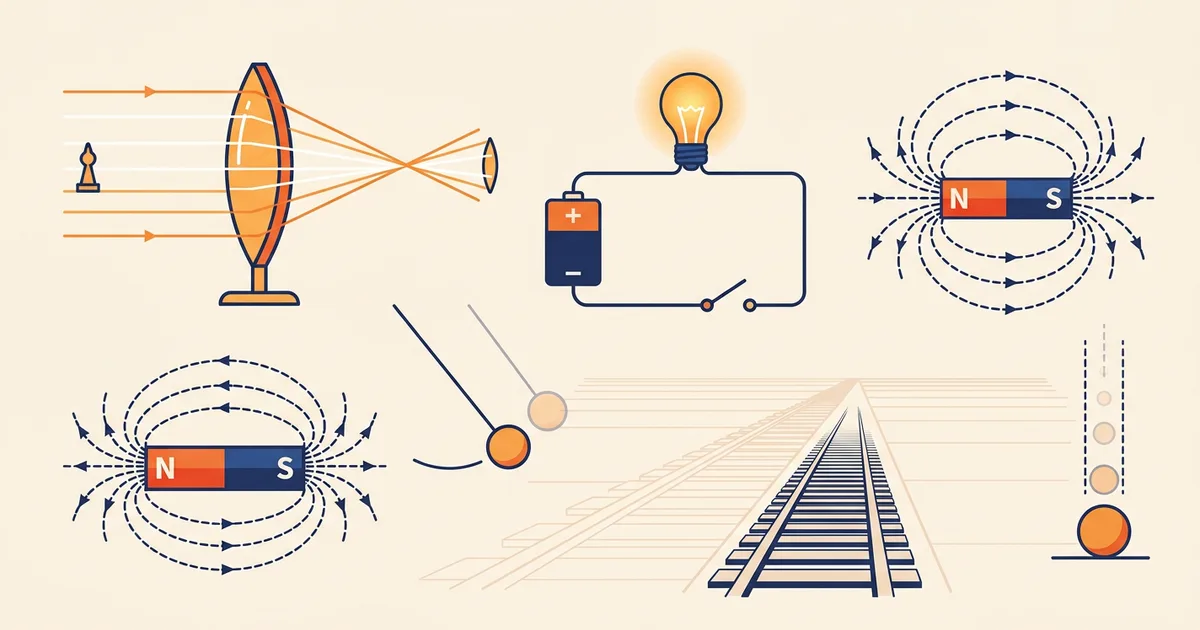
General Science in RRB Group D is set at Class 10 (NCERT) level and covers physics, chemistry and life science. Physics questions come from a short list of chapters: motion, force and laws of motion, gravitation, work-energy-power, sound, light (reflection, refraction, human eye), electricity and magnetic effects of current. Most questions are either one-line facts (SI unit, law, instrument) or a 1–2 step numerical.
Key takeaway: Learn the 25 formulas and the SI units table below, and practise 1–2 step numericals with g = 10 m/s². Most Group D physics questions can be answered in under 40 seconds once the formula is known.
Every solved answer below was computed in Python.
RRB Group D Physics Important Topics (Chapter-Wise)
| Chapter (NCERT Class 9–10) | What is asked most |
|---|---|
| Motion | Speed, velocity, acceleration, equations of motion, distance–time graphs |
| Force and laws of motion | Newton's three laws, inertia, momentum, F = ma |
| Gravitation | g, weight vs mass, free fall, value of g on the Moon |
| Work, energy and power | W = Fs, KE, PE, power, units (joule, watt, kWh, HP) |
| Sound | Speed in media, echo, audible range, ultrasound, SONAR |
| Light | Mirror and lens formula, image nature, refractive index, power of lens |
| Human eye | Myopia, hypermetropia, presbyopia and their lenses; scattering (blue sky) |
| Electricity | Ohm's law, series and parallel resistance, power, Joule heating, kWh bills |
| Magnetic effects | Field lines, Fleming's rules, motor vs generator, fuse, earthing |
Physics Formulas for RRB Group D (Formula Sheet)
| Quantity | Formula |
|---|---|
| Speed | distance ÷ time |
| Acceleration | a = (v − u) ÷ t |
| First equation of motion | v = u + at |
| Second equation of motion | s = ut + ½at² |
| Third equation of motion | v² = u² + 2as |
| Momentum | p = mv |
| Newton's second law | F = ma |
| Weight | W = mg |
| Work | W = F × s (force along displacement) |
| Kinetic energy | KE = ½mv² |
| Potential energy | PE = mgh |
| Power | P = W ÷ t |
| Pressure | P = F ÷ A |
| Density | ρ = m ÷ V |
| Wave speed | v = f × λ |
| Echo distance | d = (v × t) ÷ 2 |
| Mirror formula | 1/f = 1/v + 1/u |
| Lens formula | 1/f = 1/v − 1/u |
| Magnification (lens) | m = v ÷ u |
| Power of a lens | P = 1 ÷ f (f in metres), unit dioptre |
| Refractive index | n = c ÷ v |
| Ohm's law | V = IR |
| Resistors in series | R = R₁ + R₂ + … |
| Resistors in parallel | 1/R = 1/R₁ + 1/R₂ + … |
| Electric power | P = VI = I²R = V²/R |
| Heat (Joule's law) | H = I²Rt |
| Electrical energy | E = P × t (1 kWh = 1 unit = 3.6 × 10⁶ J) |
| Charge | Q = I × t |
Sign convention for mirrors and lenses (NCERT): distances are measured from the pole/optical centre; distances against the direction of incident light are negative. A concave mirror and a concave lens have negative focal length; a convex lens has positive focal length.
SI Units List for RRB Group D Physics
| Quantity | SI unit | Symbol |
|---|---|---|
| Length | metre | m |
| Mass | kilogram | kg |
| Time | second | s |
| Electric current | ampere | A |
| Temperature | kelvin | K |
| Amount of substance | mole | mol |
| Luminous intensity | candela | cd |
| Force | newton | N |
| Work / energy | joule | J |
| Power | watt | W |
| Pressure | pascal | Pa |
| Frequency | hertz | Hz |
| Charge | coulomb | C |
| Potential difference | volt | V |
| Resistance | ohm | Ω |
| Power of lens | dioptre | D |
| Momentum | kilogram metre per second | kg m/s |
| Acceleration | metre per second squared | m/s² |
The first seven are the seven SI base units; the rest are derived units.
Important Physics Facts and Values for Railway Exams
| Fact | Value |
|---|---|
| Acceleration due to gravity (Earth) | about 9.8 m/s² (use 10 in numericals if told) |
| g on the Moon | about 1/6 of Earth's (about 1.6 m/s²) |
| Speed of light in vacuum | 3 × 10⁸ m/s |
| Speed of sound in air | about 340–343 m/s (fastest in solids, slowest in gases, none in vacuum) |
| Audible range for humans | 20 Hz to 20,000 Hz |
| Least distance of distinct vision | 25 cm |
| Domestic AC supply in India | 220–230 V, 50 Hz |
| 1 horsepower | 746 W |
| Absolute zero | 0 K = −273.15 °C |
| Normal body temperature | 37 °C = 98.6 °F |
Laws, Rules and Instruments Asked in RRB Group D
| Item | One-line fact |
|---|---|
| Newton's first law | Law of inertia: a body stays at rest or uniform motion unless a net force acts |
| Newton's third law | Action and reaction are equal and opposite (gun recoil, rocket) |
| Fleming's left-hand rule | Direction of force on a current-carrying conductor (electric motor) |
| Fleming's right-hand rule | Direction of induced current (generator) |
| Ammeter | Measures current; connected in series |
| Voltmeter | Measures potential difference; connected in parallel |
| Galvanometer | Detects small currents |
| Fuse | Works on the heating effect of current; low melting point wire |
| Myopia | Near-sightedness, corrected by a concave lens |
| Hypermetropia | Far-sightedness, corrected by a convex lens |
| Blue sky | Scattering of light by air molecules (shorter wavelengths scatter more) |
Physics Solved Questions for RRB Group D (Class 10 Level)
- A stone is dropped from rest. Find its speed after 4 s and the distance fallen (g = 10 m/s²). v = 0 + 10 × 4 = 40 m/s; s = ½ × 10 × 4² = 80 m.
- A force of 30 N acts on a 6 kg body. Acceleration? a = 30 ÷ 6 = 5 m/s².
- A 2 kg ball moves at 10 m/s. Kinetic energy? ½ × 2 × 10² = 100 J.
- A 5 kg box is lifted 8 m (g = 10 m/s²). Potential energy gained? 5 × 10 × 8 = 400 J.
- A motor does 1,500 J of work in 30 s. Power? 1,500 ÷ 30 = 50 W.
- A 200 N force acts on an area of 0.5 m². Pressure? 200 ÷ 0.5 = 400 Pa.
- Resistors of 4 Ω and 6 Ω are joined in series and then in parallel. Equivalent resistances? Series 10 Ω; parallel (4 × 6) ÷ (4 + 6) = 2.4 Ω.
- A 12 V battery is connected to a 4 Ω resistor. Current and power? I = 12 ÷ 4 = 3 A; P = 12 × 3 = 36 W.
- A 1,500 W heater runs for 4 hours. Energy used and cost at ₹7 per unit? 1.5 kW × 4 h = 6 kWh (6 units); cost = ₹42.
- Power of a convex lens of focal length 50 cm, and of a concave lens of focal length 25 cm? 1 ÷ 0.5 = +2 D; 1 ÷ (−0.25) = −4 D.
- An object is placed 30 cm in front of a convex lens of focal length 20 cm. Where is the image? 1/v = 1/20 + 1/(−30) = 1/60, so v = +60 cm (real, inverted, magnification −2).
- A person hears an echo 3 s after shouting (speed of sound 340 m/s). Distance of the reflecting wall? (340 × 3) ÷ 2 = 510 m.
Physics Mistakes to Avoid in RRB Group D
- Using focal length in cm in P = 1/f (it must be in metres).
- Forgetting to halve the distance in echo questions.
- Mixing mass (kg) and weight (N): weight changes on the Moon, mass does not.
- Writing kW where the bill asks for kWh (units).
- Adding resistors in parallel directly instead of adding their reciprocals.
Physics for RRB Group D FAQs
What is the level of physics in RRB Group D?
Class 10 NCERT level. Questions are factual (units, laws, instruments) or short numericals on motion, work-energy, light and electricity.
Which physics chapters are most important for RRB Group D?
Electricity, light (mirrors, lenses, human eye), motion and laws of motion, work-energy-power, sound and magnetic effects of current.
How many science questions come in RRB Group D?
General Science carries 25 of the 100 questions in the CBT, shared between physics, chemistry and life science.
Is physics asked in RRB NTPC?
Yes, basic physics appears within General Awareness (General Science) in RRB NTPC CBT 1, at a similar Class 10 level.
What is the SI unit of power of a lens?
Dioptre (D). P = 1 ÷ f, with f in metres.
Practice Next
- New SSC CGL practice: SSC CGL Science Mock Test 01.
- Mock tests: RRB Group D General Science Physics Sectional Mock Test 01, Physics Sectional Mock Test 02, RRB Group D General Science Mini Quiz 01, RRB Group D General Science Chemistry Sectional Mock Test 01 and RRB Group D Full Mock Test 03.
- Related notes: Indian railway zones and headquarters 2026, chemistry for RRB Group D, mensuration formulas for SSC CGL, statistics formulas for SSC CGL, Indian climate notes, biology for RRB Group D and RRB NTPC maths formulas.
- Browse all study notes.