National Symbols of India: Quick Answer
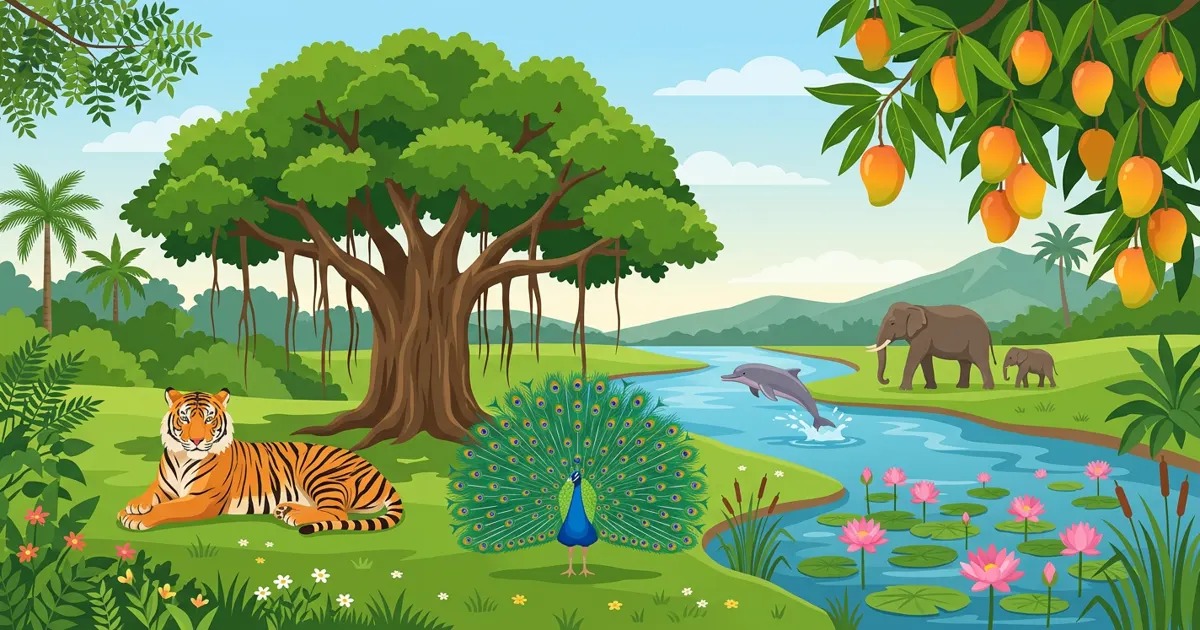
India's main national symbols are the National Flag (adopted 22 July 1947), the State Emblem (26 January 1950), the National Anthem "Jana Gana Mana" and National Song "Vande Mataram" (both adopted 24 January 1950) and the National Calendar based on the Saka era (22 March 1957). In nature, the national animal is the tiger, bird the peacock, flower the lotus, tree the banyan, fruit the mango, river the Ganga, aquatic animal the Ganges river dolphin and heritage animal the elephant.
Key takeaway: India has no officially declared national game. Hockey is popularly called the national game, but the Ministry of Youth Affairs and Sports has said no sport has been given that status; this is a favourite trick question. Also remember 24 January 1950 for both the anthem and the national song.
National Symbols of India List (Table)
| Symbol | National symbol | Adopted / declared | Key fact |
|---|---|---|---|
| National Flag | Tiranga (saffron, white, green with a navy-blue Ashoka Chakra) | 22 July 1947 (Constituent Assembly) | Ratio 2:3 (breadth : length); the Chakra has 24 spokes; design credited to Pingali Venkayya |
| State Emblem | Adapted from the Lion Capital of Ashoka at Sarnath | 26 January 1950 | Four lions (three visible), a wheel, a bull and a horse; motto Satyameva Jayate from the Mundaka Upanishad |
| National Anthem | Jana Gana Mana, by Rabindranath Tagore | 24 January 1950 | Full version takes about 52 seconds; first sung on 27 December 1911 at the Calcutta Congress session |
| National Song | Vande Mataram, by Bankim Chandra Chatterjee | 24 January 1950 | From the novel Anandamath (1882); equal status with the anthem; first sung at the 1896 Congress session |
| National Calendar | Saka calendar | 22 March 1957 | First month Chaitra; 1 Chaitra falls on 22 March (21 March in a leap year) |
| National Animal | Tiger (Panthera tigris) | 1973 | Replaced the lion; Project Tiger began the same year |
| National Bird | Indian peacock (Pavo cristatus) | 1963 | Protected under the Wildlife (Protection) Act, 1972 |
| National Flower | Lotus (Nelumbo nucifera) | Sacred in Indian art and mythology | |
| National Tree | Banyan (Ficus benghalensis) | Known for its aerial prop roots | |
| National Fruit | Mango (Mangifera indica) | India is the largest producer of mangoes | |
| National River | Ganga | 4 November 2008 | Declared by the Union government; India's longest river system |
| National Aquatic Animal | Ganges river dolphin (Platanista gangetica) | Decided 5 October 2009 | Decided at the first meeting of the National Ganga River Basin Authority; an indicator of river health |
| National Heritage Animal | Indian elephant | 22 October 2010 | Declared to boost elephant conservation |
| Currency Symbol | ₹ (Indian Rupee sign) | 15 July 2010 | Designed by D. Udaya Kumar |
| National Pledge | "India is my country..." | 1962 (written) | Written by Pydimarri Venkata Subba Rao in Telugu |
National Flag of India Facts (Most Asked)
| Question | Answer |
|---|---|
| Adopted by the Constituent Assembly | 22 July 1947 |
| Ratio | 2:3 |
| Colours (top to bottom) | Saffron (courage and sacrifice), white (truth and peace), green (faith and growth) |
| Wheel | Ashoka Chakra in navy blue, 24 spokes, taken from the Sarnath Lion Capital |
| Designed by | Pingali Venkayya (credited) |
| Rules | Flag Code of India, 2002 |
National Anthem and National Song Facts
| Fact | Jana Gana Mana (anthem) | Vande Mataram (song) |
|---|---|---|
| Written by | Rabindranath Tagore | Bankim Chandra Chatterjee |
| Original language | Bengali (highly Sanskritised) | Sanskrit-Bengali |
| Source | Poem "Bharoto Bhagyo Bidhata" | Novel Anandamath (1882) |
| Adopted | 24 January 1950 | 24 January 1950 |
| First sung at a Congress session | 1911 (Calcutta) | 1896 (Calcutta) |
| Playing time | About 52 seconds (short version about 20 seconds) |
State Emblem of India Facts
- Adapted from the Lion Capital of Ashoka at Sarnath, adopted on 26 January 1950.
- Shows four lions standing back to back (only three are visible), mounted on an abacus with a wheel (Dharma Chakra) in the centre, a bull on the right and a horse on the left.
- The words Satyameva Jayate ("Truth alone triumphs") from the Mundaka Upanishad are written below in Devanagari script.
- Its use is regulated by the State Emblem of India (Prohibition of Improper Use) Act, 2005.
National Symbols Trick to Remember
- "22-24-26": Flag on 22 July 1947, anthem and song on 24 January 1950, emblem on 26 January 1950.
- Calendar 22 too: the Saka calendar was adopted on 22 March 1957, and 1 Chaitra normally falls on 22 March.
- Ganga pair: Ganga (national river, 2008) and its Ganges river dolphin (national aquatic animal, 2009).
- 2010 pair: rupee symbol (July 2010) and heritage animal elephant (October 2010).
National Symbols of India MCQs (with Answers)
Q1. When was the National Flag of India adopted by the Constituent Assembly? (a) 15 August 1947 (b) 22 July 1947 (c) 26 January 1950 (d) 24 January 1950 Answer: (b).
Q2. "Satyameva Jayate" is taken from: (a) Rig Veda (b) Mundaka Upanishad (c) Bhagavad Gita (d) Kathopanishad Answer: (b).
Q3. What is the national aquatic animal of India? (a) Blue whale (b) Ganges river dolphin (c) Gharial (d) Olive ridley turtle Answer: (b).
Q4. The National Calendar of India is based on the: (a) Vikram Samvat (b) Saka era (c) Hijri era (d) Gregorian calendar only Answer: (b).
Q5. Who wrote the National Song "Vande Mataram"? (a) Rabindranath Tagore (b) Bankim Chandra Chatterjee (c) Sarojini Naidu (d) Muhammad Iqbal Answer: (b).
Q6. What is the playing time of the full National Anthem? (a) 30 seconds (b) 52 seconds (c) 60 seconds (d) 72 seconds Answer: (b).
Q7. Which animal was declared the National Heritage Animal of India in 2010? (a) Tiger (b) Elephant (c) Lion (d) One-horned rhino Answer: (b).
Q8. How many spokes does the Ashoka Chakra on the National Flag have? (a) 22 (b) 24 (c) 26 (d) 32 Answer: (b).
Q9. The Indian Rupee symbol ₹ was designed by: (a) Pingali Venkayya (b) D. Udaya Kumar (c) Nandalal Bose (d) Raja Ravi Varma Answer: (b).
Q10. Which of these is NOT an officially declared national symbol of India? (a) Banyan tree (b) Hockey as national game (c) Mango (d) Lotus Answer: (b). No sport has been officially declared the national game.
National Symbols of India FAQs
What is the national game of India?
India has no officially declared national game. Hockey is popularly believed to be one, but the Sports Ministry has clarified that no sport has been given that status.
Which animal is the national animal of India?
The tiger (Panthera tigris), adopted in 1973 in place of the lion.
When were the National Anthem and National Song adopted?
Both on 24 January 1950, by the Constituent Assembly.
What is the national river of India?
The Ganga, declared on 4 November 2008.
What is the ratio of the Indian National Flag?
2:3 (breadth to length).
From where is the State Emblem of India taken?
From the Lion Capital of Ashoka at Sarnath, near Varanasi; it was adopted on 26 January 1950.
Practice Next
- GK mock tests: SSC CGL Static GK Mock Test 01, SSC CHSL Static GK Mock Test 01, RRB NTPC GK Mini Mock Test 01, SSC GD GK Mini Mock Test 01, SSC MTS GK Mini Mock Test 01.
- Related notes: states and capitals of India 2026, Indian National Congress sessions list, list of Prime Ministers of India, important articles of the Indian Constitution, important days list 2026.
- Browse all study notes.