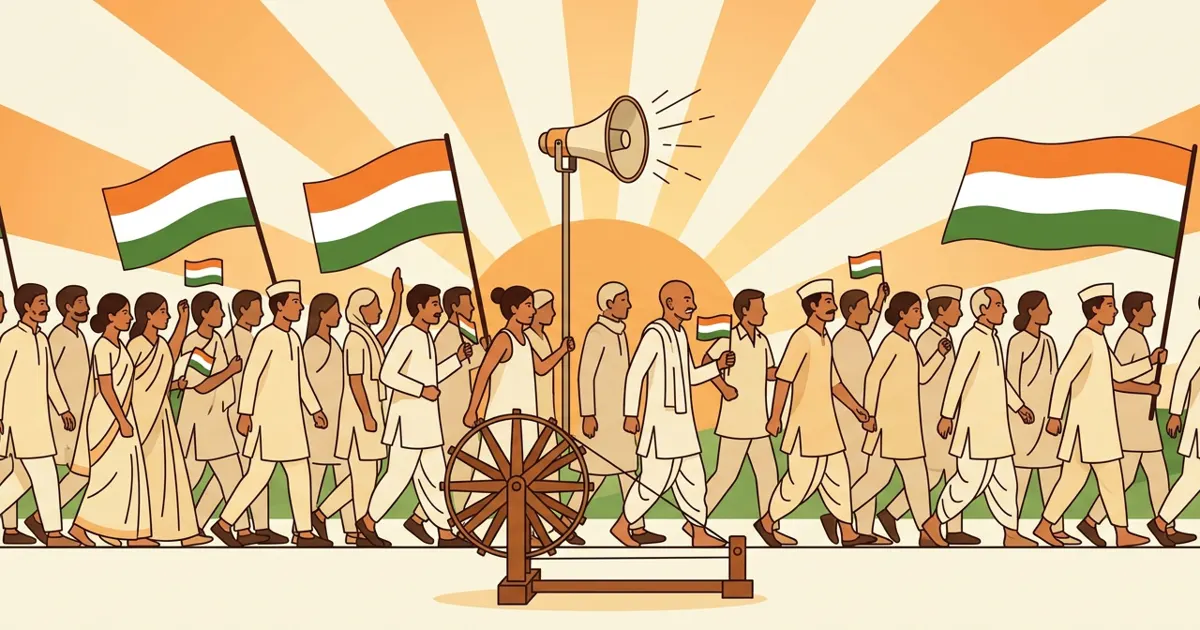
Famous Slogans of Freedom Fighters: Quick Answer
"Swaraj is my birthright and I shall have it" was given by Bal Gangadhar Tilak, "Do or Die" by Mahatma Gandhi (Quit India, 1942), "Give me blood and I will give you freedom" and "Dilli Chalo" by Subhas Chandra Bose, "Inquilab Zindabad" was coined by Hasrat Mohani and popularised by Bhagat Singh, "Jai Jawan Jai Kisan" by Lal Bahadur Shastri, and "Vande Mataram" comes from Bankim Chandra Chatterjee's novel Anandamath.
Key takeaway: SSC asks slogans in two ways: "Who gave the slogan X?" and "X was associated with which movement?" For each slogan learn the person + year + movement. Watch the coined-by vs popularised-by pairs: Inquilab Zindabad (coined by Hasrat Mohani, popularised by Bhagat Singh), Jai Hind (coined by Abid Hasan, popularised by Netaji), Quit India and Simon Go Back (coined by Yusuf Meherally).
Famous Slogans of Freedom Fighters List (Table)
| Slogan | Given / coined by | Year and context |
|---|---|---|
| Swaraj is my birthright and I shall have it | Bal Gangadhar Tilak | Home Rule movement, 1916 (Belgaum); original in Marathi |
| Do or Die (Karo ya Maro) | Mahatma Gandhi | Quit India speech, 8 August 1942, Gowalia Tank, Bombay |
| Quit India | Coined by Yusuf Meherally; adopted by Gandhi | Quit India Movement, 1942 |
| Simon Go Back | Coined by Yusuf Meherally | Protests against the Simon Commission, 1928; Lala Lajpat Rai led the Lahore protest |
| Give me blood and I will give you freedom (Tum mujhe khoon do, main tumhe azadi dunga) | Subhas Chandra Bose | Speech to the INA in Burma, July 1944 |
| Dilli Chalo (On to Delhi) | Subhas Chandra Bose | Call to the Indian National Army, 1943-44 |
| Jai Hind | Coined by Abid Hasan Safrani; popularised by Subhas Chandra Bose | INA greeting, 1940s |
| Inquilab Zindabad (Long live the revolution) | Coined by Maulana Hasrat Mohani (1921); popularised by Bhagat Singh | Raised by Bhagat Singh and B.K. Dutt in the Central Legislative Assembly, 1929 |
| Sarfaroshi ki tamanna ab hamare dil mein hai | Poem by Bismil Azimabadi; made famous by Ram Prasad Bismil | Revolutionary song of the 1920s |
| Vande Mataram | Bankim Chandra Chatterjee | Song in the novel Anandamath (1882); Swadeshi movement slogan, 1905 |
| Saare Jahan Se Achha | Muhammad Iqbal | Poem "Tarana-e-Hind", 1904 |
| Every blow on my body will be a nail in the coffin of British rule | Lala Lajpat Rai | After the police lathi charge at Lahore, 1928 |
| Dushman ki goliyon ka hum samna karenge, azad hi rahe hain, azad hi rahenge | Chandrashekhar Azad | Revolutionary pledge |
| Satyameva Jayate (Truth alone triumphs) | From the Mundaka Upanishad; popularised by Madan Mohan Malaviya | INC session, 1918; now the national motto |
| Go back to the Vedas | Swami Dayanand Saraswati | Arya Samaj (founded 1875) |
| Arise, awake and stop not till the goal is reached | Swami Vivekananda | Based on the Katha Upanishad |
| One caste, one religion, one God for mankind | Sree Narayana Guru | Social reform movement in Kerala |
| Who lives if India dies? | Jawaharlal Nehru | Freedom struggle speeches |
| Aaram haram hai (Rest is forbidden) | Jawaharlal Nehru | Call for hard work after independence |
| Hey Ram | Mahatma Gandhi | His last words, 30 January 1948 |
Slogans After Independence (Also Asked in SSC)
| Slogan | Given by | Year |
|---|---|---|
| Jai Jawan Jai Kisan | Lal Bahadur Shastri | 1965 (Indo-Pak war and food shortage) |
| Jai Jawan Jai Kisan Jai Vigyan | Atal Bihari Vajpayee | 1998, after the Pokhran-II tests |
| Jai Jawan Jai Kisan Jai Vigyan Jai Anusandhan | Narendra Modi | 2019, Indian Science Congress |
| Garibi Hatao (Remove poverty) | Indira Gandhi | 1971 general election |
| Sampoorna Kranti (Total Revolution) | Jayaprakash Narayan | 1974, Bihar movement |
Slogans Movement-Wise (Best Way to Revise)
| Movement or phase | Slogans |
|---|---|
| Swadeshi movement (1905) | Vande Mataram |
| Home Rule movement (1916) | Swaraj is my birthright (Tilak) |
| Simon Commission protest (1928) | Simon Go Back |
| Revolutionaries (1920s-30s) | Inquilab Zindabad, Sarfaroshi ki tamanna |
| Purna Swaraj (Lahore session, 1929) | Complete independence resolution under Jawaharlal Nehru |
| Quit India (1942) | Quit India, Do or Die |
| Indian National Army (1943-45) | Dilli Chalo, Jai Hind, Tum mujhe khoon do |
Famous Slogans: Memory Tricks
- Swaraj vs Purna Swaraj: "Swaraj is my birthright" is Tilak's slogan (1916). The Purna Swaraj (complete independence) resolution was passed at the Lahore session of 1929, presided over by Jawaharlal Nehru.
- Bose's three: Blood, Delhi, Hind → "Tum mujhe khoon do", "Dilli Chalo", "Jai Hind".
- Yusuf Meherally's two: he coined both "Quit India" and "Simon Go Back". Trick: Yusuf said "You go back" twice.
- Shastri to Modi ladder: Jai Jawan Jai Kisan (Shastri, 1965) → + Jai Vigyan (Vajpayee, 1998) → + Jai Anusandhan (Modi, 2019).
- Bismil vs Bismil: the poem "Sarfaroshi ki tamanna" was written by Bismil Azimabadi and made famous by Ram Prasad Bismil.
Famous Slogans of Freedom Fighters: PYQ-Style Questions with Answers
1. Who gave the slogan "Swaraj is my birthright and I shall have it"? (a) Mahatma Gandhi (b) Bal Gangadhar Tilak (c) Lala Lajpat Rai (d) Gopal Krishna Gokhale Answer: (b) Bal Gangadhar Tilak.
2. The slogan "Do or Die" was given during which movement? (a) Non-Cooperation (b) Civil Disobedience (c) Quit India (d) Khilafat Answer: (c) Quit India, in Gandhi's speech of 8 August 1942.
3. Who coined the slogan "Inquilab Zindabad"? (a) Bhagat Singh (b) Hasrat Mohani (c) Chandrashekhar Azad (d) Ram Prasad Bismil Answer: (b) Hasrat Mohani, in 1921. Bhagat Singh made it popular.
4. "Give me blood and I will give you freedom" was said by: (a) Bhagat Singh (b) Subhas Chandra Bose (c) Chandrashekhar Azad (d) Rash Behari Bose Answer: (b) Subhas Chandra Bose.
5. "Jai Jawan Jai Kisan" was given by: (a) Jawaharlal Nehru (b) Indira Gandhi (c) Lal Bahadur Shastri (d) Atal Bihari Vajpayee Answer: (c) Lal Bahadur Shastri, in 1965.
6. Who added "Jai Vigyan" to "Jai Jawan Jai Kisan"? (a) Rajiv Gandhi (b) Atal Bihari Vajpayee (c) A.P.J. Abdul Kalam (d) Manmohan Singh Answer: (b) Atal Bihari Vajpayee, in 1998.
7. "Vande Mataram" was taken from the novel: (a) Gitanjali (b) Anandamath (c) Godaan (d) Durgeshnandini Answer: (b) Anandamath, by Bankim Chandra Chatterjee.
8. Who said "Every blow on my body will be a nail in the coffin of British rule"? (a) Lala Lajpat Rai (b) Bipin Chandra Pal (c) Bhagat Singh (d) Madan Mohan Malaviya Answer: (a) Lala Lajpat Rai, after the lathi charge during the anti-Simon protest at Lahore in 1928.
9. The slogan "Go back to the Vedas" was given by: (a) Swami Vivekananda (b) Raja Ram Mohan Roy (c) Dayanand Saraswati (d) Ramakrishna Paramahamsa Answer: (c) Dayanand Saraswati, founder of the Arya Samaj.
10. "Garibi Hatao" was the slogan of: (a) Jawaharlal Nehru (b) Indira Gandhi (c) Morarji Desai (d) Rajiv Gandhi Answer: (b) Indira Gandhi, in the 1971 election.
11. "Satyameva Jayate", India's national motto, is taken from the: (a) Rig Veda (b) Bhagavad Gita (c) Mundaka Upanishad (d) Katha Upanishad Answer: (c) Mundaka Upanishad.
12. Who gave the call "Sampoorna Kranti" (Total Revolution)? (a) Ram Manohar Lohia (b) Jayaprakash Narayan (c) Vinoba Bhave (d) Charan Singh Answer: (b) Jayaprakash Narayan, in 1974.
Famous Slogans FAQs
Who gave the slogan "Jai Hind"?
It was coined by Abid Hasan Safrani, an INA officer, and popularised by Subhas Chandra Bose as the greeting of the Indian National Army.
Who gave the slogan "Quit India"?
The phrase was coined by Yusuf Meherally, a socialist leader, and Mahatma Gandhi adopted it for the movement launched on 8 August 1942.
Who gave the slogan "Dilli Chalo"?
Subhas Chandra Bose, to the soldiers of the Indian National Army.
Who wrote "Sarfaroshi ki tamanna ab hamare dil mein hai"?
Bismil Azimabadi wrote it in 1921; the revolutionary Ram Prasad Bismil made it famous.
Which slogan is associated with the Swadeshi movement?
"Vande Mataram", the song from Bankim Chandra Chatterjee's Anandamath, became the rallying cry of the Swadeshi and anti-partition movement of 1905.
Who said "Arise, awake and stop not till the goal is reached"?
Swami Vivekananda, drawing on a verse of the Katha Upanishad.
Practice Next
- History mock tests: SSC CGL History Mock Test 01, SSC CGL History Mock Test 02, SSC CHSL History Mock Test 01, RRB NTPC History Mock Test 01.
- Related notes: Indian National Congress sessions list, Revolt of 1857, List of Prime Ministers of India, First in India list, Mauryan empire rulers list.
- Exam updates: SSC CGL 2026, SSC CHSL 2026.
- Browse all study notes.