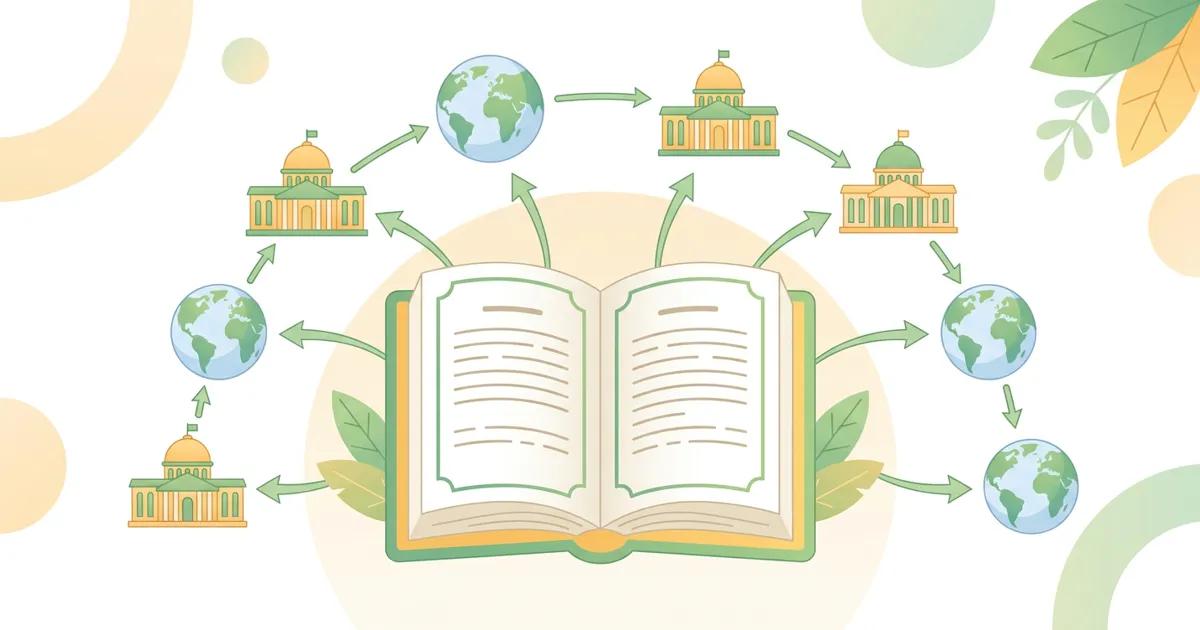
Sources of Indian Constitution: The Short Answer
The Indian Constitution borrowed features from several sources. The largest single source is the Government of India Act, 1935 (federal scheme, office of governor, judiciary, public service commissions, emergency provisions). From Britain came the parliamentary system, rule of law and single citizenship; from the USA, fundamental rights and judicial review; from Ireland, the Directive Principles of State Policy; from Canada, a federation with a strong centre; from Australia, the Concurrent List; from the USSR, fundamental duties; and from Japan, "procedure established by law".
Key takeaway for SSC and bank exams: The most asked pairs are DPSP – Ireland, fundamental rights – USA, fundamental duties – USSR, Concurrent List – Australia, residuary powers – Canada, amendment procedure – South Africa, and emergency suspension of rights – Germany (Weimar). Learn the country-wise table below and the memory tricks.
Revise the matching parts of the Constitution in fundamental rights articles 12 to 35, directive principles of state policy and fundamental duties and the 12 schedules of the Indian Constitution trick.
Sources of Indian Constitution Country-Wise List (Table)
| Source | Features borrowed |
|---|---|
| Government of India Act, 1935 | Federal scheme, office of governor, judiciary, public service commissions, emergency provisions, administrative details |
| Britain (UK) | Parliamentary government, rule of law, legislative procedure, single citizenship, cabinet system, prerogative writs, parliamentary privileges, bicameralism |
| USA | Fundamental rights, independence of the judiciary, judicial review, impeachment of the President, removal of Supreme Court and High Court judges, post of Vice-President |
| Ireland | Directive Principles of State Policy, nomination of members to the Rajya Sabha, method of election of the President |
| Canada | Federation with a strong centre, residuary powers with the centre, appointment of state governors by the centre, advisory jurisdiction of the Supreme Court |
| Australia | Concurrent List, freedom of trade, commerce and intercourse, joint sitting of the two Houses of Parliament |
| Weimar Constitution of Germany | Suspension of fundamental rights during an emergency |
| USSR (former Soviet Union) | Fundamental duties, ideals of justice (social, economic and political) in the Preamble |
| France | Republic, ideals of liberty, equality and fraternity in the Preamble |
| South Africa | Procedure for amendment of the Constitution, election of members of the Rajya Sabha |
| Japan | Procedure established by law |
Note: Fundamental duties were added later, by the 42nd Amendment Act, 1976, on the recommendation of the Swaran Singh Committee; the idea is traced to the USSR constitution.
Government of India Act 1935: Biggest Source of the Constitution
About the largest part of the structural and administrative provisions came from the Government of India Act, 1935. Exams ask:
- Federal scheme: the idea of an all-India federation and the division of powers into three lists.
- Office of governor in the provinces (now states).
- Federal court, which became the model for the Supreme Court.
- Public service commissions (now UPSC and state PSCs).
- Emergency provisions.
- Administrative details of the Union–state relationship.
The 1935 Act was a long and detailed law (321 sections and 10 schedules). It also introduced provincial autonomy and dyarchy at the centre (the federation and dyarchy at the centre never actually came into force).
Features Borrowed From Britain, USA and Ireland (Most Asked)
Britain gave the "working" of Parliament: the Prime Minister and cabinet are responsible to the lower house, the President is a nominal head like the British monarch, laws are passed through a similar legislative procedure, and courts can issue writs (habeas corpus, mandamus, prohibition, certiorari, quo warranto).
USA gave the "rights and courts" side: a written list of fundamental rights, an independent judiciary with the power of judicial review, impeachment of the head of state and the post of Vice-President (who chairs the upper house, like the US Vice-President chairs the Senate).
Ireland gave the Directive Principles of State Policy (Part IV). Ireland itself borrowed the idea from the Spanish constitution. Ireland is also the source of nomination of 12 members to the Rajya Sabha for art, literature, science and social service, and of the method of electing the President (proportional representation by single transferable vote).
Features Borrowed From Canada, Australia and Other Countries
| Country | What to remember | Where it is in our Constitution |
|---|---|---|
| Canada | Strong centre; residuary powers with the Union | Article 248 (residuary powers), Seventh Schedule |
| Canada | Governors appointed by the centre | Article 155 |
| Canada | Supreme Court can give advisory opinions | Article 143 |
| Australia | Concurrent List | Seventh Schedule, List III |
| Australia | Joint sitting of Parliament | Article 108 |
| Australia | Freedom of trade, commerce and intercourse | Article 301 |
| Germany (Weimar) | Suspension of fundamental rights in an emergency | Articles 358 and 359 |
| South Africa | Amendment procedure | Article 368 |
| Japan | Procedure established by law | Article 21 |
| France | Republic; liberty, equality, fraternity | Preamble |
Sources of Indian Constitution Trick (Easy Memory Tricks)
- "I-DP" → Ireland gave Directive Principles.
- "US Rights" → USA gave fundamental Rights and judicial review.
- "Duty to Russia" → fundamental Duties from the USSR.
- "Aus-Con" → Australia gave the Concurrent List.
- "Strong Canada" → Canada gave a federation with a strong centre and residuary powers.
- "Germany stops rights" → Weimar Germany: suspension of rights in an emergency.
- "South Africa amends" → amendment procedure.
- "Japan follows the procedure" → procedure established by law.
- "French Revolution slogan" → liberty, equality, fraternity.
- "British Parliament" → parliamentary form, cabinet, single citizenship, rule of law.
Constituent Assembly Facts Linked to the Sources
| Fact | Detail |
|---|---|
| First meeting of the Constituent Assembly | 9 December 1946 |
| Permanent President | Dr Rajendra Prasad |
| Chairman of the Drafting Committee | Dr B. R. Ambedkar |
| Constitution adopted | 26 November 1949 (Constitution Day) |
| Came into force | 26 January 1950 (Republic Day) |
| Time taken | 2 years, 11 months and 18 days |
| Original Constitution | A Preamble, 395 articles in 22 parts and 8 schedules |
| Schedules now | 12 |
| Constitutional adviser | B. N. Rau |
For the major changes made since 1950, read the important constitutional amendments list.
Sources of Indian Constitution Topic-Wise (Reverse Table)
Exams often ask the question the other way round: the feature first, then the country.
| Feature | Source |
|---|---|
| Parliamentary system and cabinet | Britain |
| Single citizenship | Britain |
| Writs | Britain |
| Fundamental rights | USA |
| Judicial review | USA |
| Vice-President | USA |
| Impeachment of the President | USA |
| Directive Principles | Ireland |
| Election of the President | Ireland |
| Nominated Rajya Sabha members | Ireland |
| Residuary powers with the centre | Canada |
| Advisory jurisdiction of the Supreme Court | Canada |
| Concurrent List | Australia |
| Joint sitting | Australia |
| Emergency suspension of fundamental rights | Weimar Germany |
| Fundamental duties | USSR |
| Republic and liberty, equality, fraternity | France |
| Amendment procedure | South Africa |
| Procedure established by law | Japan |
| Office of governor, federal scheme, PSCs | Government of India Act, 1935 |
Exam tip: When two options both look right (for example "Britain" and "Government of India Act, 1935" for the office of governor), pick the 1935 Act for structure and administration and Britain for how Parliament and the cabinet work.
Common Mistakes on Sources of the Constitution
| Wrong | Right |
|---|---|
| DPSP from the USA | DPSP from Ireland |
| Fundamental duties from Japan | Fundamental duties from the USSR |
| Concurrent List from Canada | Concurrent List from Australia |
| Residuary powers from Australia | Residuary powers from Canada (with the centre) |
| Amendment procedure from the USA | Amendment procedure from South Africa |
| Procedure established by law from Britain | Procedure established by law from Japan |
| Rule of law from the USA | Rule of law from Britain |
| Impeachment from Britain | Impeachment of the President from the USA |
Sources of Indian Constitution MCQs (with Answers)
1. The Directive Principles of State Policy were borrowed from the constitution of: Ireland.
2. The idea of the Concurrent List was taken from: Australia.
3. Fundamental duties in the Indian Constitution were inspired by the constitution of: The USSR (former Soviet Union).
4. Which country is the source of "procedure established by law"? Japan.
5. Judicial review in India is borrowed from: The USA.
6. The procedure for amending the Constitution was borrowed from: South Africa.
7. Suspension of fundamental rights during an emergency comes from: The Weimar Constitution of Germany.
8. A federation with a strong centre and residuary powers with the Union was borrowed from: Canada.
9. Which document is the largest single source of the Indian Constitution? The Government of India Act, 1935.
10. The ideals of liberty, equality and fraternity in the Preamble were borrowed from: France.
Sources of Indian Constitution FAQs
What are the sources of the Indian Constitution?
The main sources are the Government of India Act, 1935 and the constitutions of Britain, the USA, Ireland, Canada, Australia, Weimar Germany, the USSR, France, South Africa and Japan.
Which is the largest source of the Indian Constitution?
The Government of India Act, 1935. It provided the federal scheme, the office of governor, the judiciary, public service commissions and emergency provisions.
From which country are fundamental rights taken?
From the USA, whose Bill of Rights inspired Part III of the Indian Constitution.
From which country were DPSPs borrowed?
From Ireland. Ireland had itself taken the idea from the Spanish constitution.
What was borrowed from the British constitution?
Parliamentary government, rule of law, legislative procedure, single citizenship, the cabinet system, prerogative writs, parliamentary privileges and bicameralism.
Why is the Indian Constitution called a "bag of borrowings"?
Because it took many features from other constitutions. The framers adapted them to Indian conditions, so the result is a blend rather than a copy.
Practice Next
- Mock tests: SSC CGL General Awareness Sectional Mock Test 01, SSC CHSL Static GK Mock Test 01, RRB NTPC General Awareness Sectional Mock Test 01 and SSC MTS General Awareness Sectional Mock Test 01.
- Related notes: fundamental rights articles 12 to 35, DPSP and fundamental duties, important constitutional amendments list and 12 schedules of the Indian Constitution trick, plus important articles of Indian Constitution.
- Exam details: SSC CGL 2026 and RRB NTPC 2026.
- Browse all study notes.