How Many Biosphere Reserves Are There in India in 2026?
India has 18 notified biosphere reserves covering about 91,425 sq km, and 13 of them are in UNESCO's World Network of Biosphere Reserves (WNBR). The 13th UNESCO site is the Cold Desert Biosphere Reserve in Lahaul-Spiti, Himachal Pradesh, added on 27 September 2025. The first biosphere reserve is Nilgiri (1986), the newest is Panna (2011), and the largest is the Great Rann of Kutch (12,454 sq km) in Gujarat.
Key takeaway: 18 national biosphere reserves, 13 UNESCO-listed (since September 2025), 5 not yet in UNESCO's network: Manas, Dibru-Saikhowa, Dehang-Dibang, Great Rann of Kutch and Seshachalam. No new national biosphere reserve has been notified since Panna in 2011.
Figures here come from the Ministry of Environment, Forest and Climate Change (MoEFCC) Biosphere Reserve Division list and the PIB release of 3 November 2025, and the 2025 UNESCO addition from UNESCO's own announcement; all were rechecked on 17 October 2026. For the other protected-area lists, see our tiger reserves in India 2026 and Ramsar sites in India 2026 list.
Biosphere Reserves in India 2026: Quick Facts
| Fact | Answer |
|---|---|
| Total biosphere reserves | 18 |
| In UNESCO's WNBR | 13 |
| Total area | 91,425.11 sq km (MoEFCC) |
| First (oldest) | Nilgiri, 1986 (Tamil Nadu, Kerala, Karnataka) |
| Newest notified | Panna, 2011 (Madhya Pradesh) |
| Latest added to UNESCO list | Cold Desert, Himachal Pradesh, 27 September 2025 |
| First Indian site in UNESCO's network | Nilgiri, 2000 |
| Largest | Great Rann of Kutch, Gujarat (12,454 sq km) |
| Second largest | Gulf of Mannar, Tamil Nadu (10,500 sq km) |
| Smallest | Dibru-Saikhowa, Assam (765 sq km) |
| States with most | Madhya Pradesh 3 (Pachmarhi, Achanakmar-Amarkantak, Panna) and Tamil Nadu 3 (Nilgiri, Gulf of Mannar, Agasthyamalai) |
| Scheme | Centrally Sponsored Scheme, 60:40 (90:10 for North-Eastern and Himalayan states) |
| International day | 3 November, International Day for Biosphere Reserves |
List of 18 Biosphere Reserves in India (State, Year, Area)
"Designated" is the year India notified the reserve; "UNESCO" is the year it joined the World Network of Biosphere Reserves. Areas are MoEFCC figures in sq km.
| No. | Biosphere reserve | State / UT | Designated | UNESCO (WNBR) | Area (sq km) |
|---|---|---|---|---|---|
| 1 | Nilgiri | Tamil Nadu, Kerala, Karnataka | 1986 | 2000 | 5,520 |
| 2 | Nanda Devi | Uttarakhand | 1988 | 2004 | 6,407.03 |
| 3 | Nokrek | Meghalaya | 1988 | 2009 | 820 |
| 4 | Gulf of Mannar | Tamil Nadu | 1989 | 2001 | 10,500 |
| 5 | Sundarbans | West Bengal | 1989 | 2001 | 9,630 |
| 6 | Manas | Assam | 1989 | Not listed | 2,837 |
| 7 | Great Nicobar | Andaman and Nicobar Islands | 1989 | 2013 | 1,038.70 |
| 8 | Similipal | Odisha | 1994 | 2009 | 5,569 |
| 9 | Dibru-Saikhowa | Assam | 1997 | Not listed | 765 |
| 10 | Dehang-Dibang | Arunachal Pradesh | 1998 | Not listed | 5,111.50 |
| 11 | Pachmarhi | Madhya Pradesh | 1999 | 2009 | 4,981.72 |
| 12 | Khangchendzonga | Sikkim | 2000 | 2018 | 2,931.12 |
| 13 | Agasthyamalai | Kerala, Tamil Nadu | 2001 | 2016 | 3,500 |
| 14 | Achanakmar-Amarkantak | Madhya Pradesh, Chhattisgarh | 2005 | 2012 | 3,835.46 |
| 15 | Great Rann of Kutch | Gujarat | 2008 | Not listed | 12,454 |
| 16 | Cold Desert | Himachal Pradesh | 2009 | 2025 | 7,770 |
| 17 | Seshachalam | Andhra Pradesh | 2010 | Not listed | 4,755.58 |
| 18 | Panna | Madhya Pradesh | 2011 | 2020 | 2,998.98 |
Some older books spell the names differently (Simlipal / Similipal, Kachchh / Great Rann of Kutch, Agasthyamala / Agasthyamalai). They are the same reserves.
13 UNESCO Biosphere Reserves in India (Year-Wise Order)
This is the order exams ask most: "which was the first / latest Indian biosphere reserve in UNESCO's list".
| Order | UNESCO biosphere reserve | Year included |
|---|---|---|
| 1 | Nilgiri | 2000 |
| 2 | Gulf of Mannar | 2001 |
| 3 | Sundarbans | 2001 |
| 4 | Nanda Devi | 2004 |
| 5 | Nokrek | 2009 |
| 6 | Pachmarhi | 2009 |
| 7 | Similipal | 2009 |
| 8 | Achanakmar-Amarkantak | 2012 |
| 9 | Great Nicobar | 2013 |
| 10 | Agasthyamalai | 2016 |
| 11 | Khangchendzonga | 2018 |
| 12 | Panna | 2020 |
| 13 | Cold Desert | 2025 |
Memory hook: "2000-01 South, 2004 Himalaya, 2009 three together (Nokrek, Pachmarhi, Similipal), then one every few years, Cold Desert last."
Cold Desert Biosphere Reserve: why it is in the news
- Included in UNESCO's WNBR on 27 September 2025, during the 37th session of the MAB International Coordinating Council at the 5th World Congress of Biosphere Reserves in Hangzhou, China.
- Area 7,770 sq km in Lahaul-Spiti, Himachal Pradesh, covering Pin Valley National Park, Chandratal, Sarchu and Kibber Wildlife Sanctuary.
- India's first high-altitude cold desert biosphere reserve in the UNESCO network (altitudes of about 3,300 to 6,600 m).
- It was notified nationally in 2009, so it is not a "new" biosphere reserve, only newly UNESCO-listed. This is a favourite trap.
5 Biosphere Reserves Not in UNESCO's List
| Biosphere reserve | State | Designated |
|---|---|---|
| Manas | Assam | 1989 |
| Dibru-Saikhowa | Assam | 1997 |
| Dehang-Dibang | Arunachal Pradesh | 1998 |
| Great Rann of Kutch | Gujarat | 2008 |
| Seshachalam | Andhra Pradesh | 2010 |
Trick: "Two from Assam, one each from Arunachal, Gujarat and Andhra." Note that Manas is a UNESCO World Heritage Site (natural) but not a UNESCO biosphere reserve; examiners use this exact confusion.
What Is a Biosphere Reserve? (Zones and Purpose)
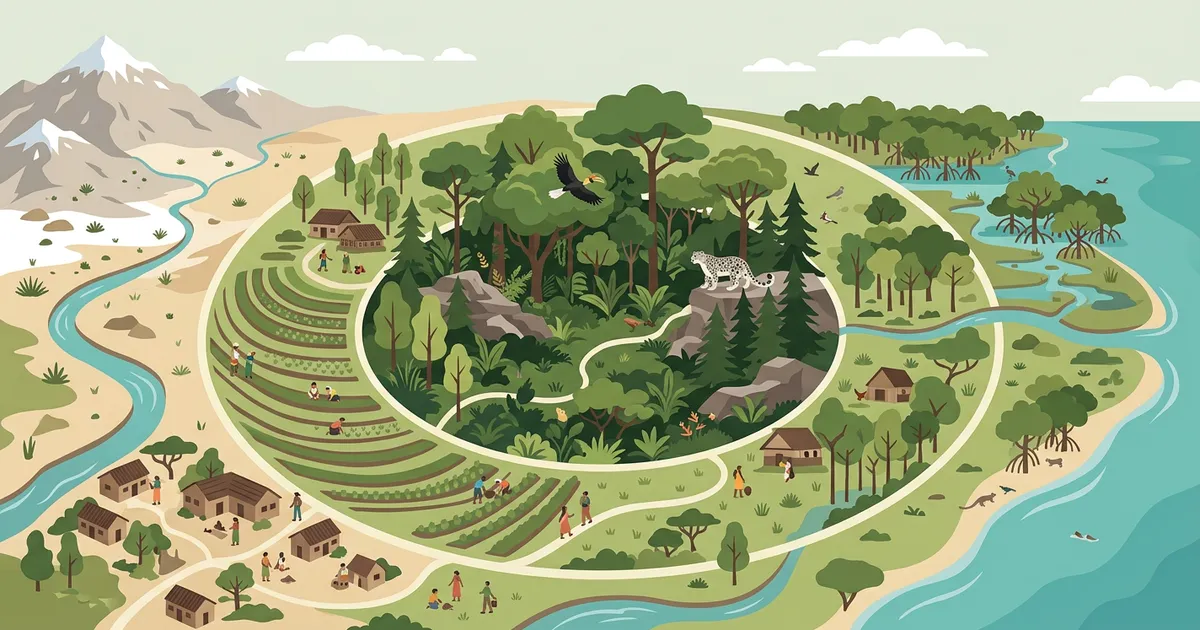
A biosphere reserve is an area that a national government nominates to combine biodiversity conservation with sustainable use by local people. It is not created under the Wild Life (Protection) Act, which is why its rules are lighter than those of a national park or tiger reserve.
| Zone | What happens there |
|---|---|
| Core zone | Strictly protected; only monitoring and non-destructive research |
| Buffer zone | Surrounds the core; research, education and limited, regulated use |
| Transition zone | Outermost; villages, farming and sustainable economic activity |
UNESCO's Man and the Biosphere (MAB) Programme was launched in 1971, and the World Network of Biosphere Reserves is managed under it. Being in the network is recognition, not ownership: the reserve stays under India's sovereign control.
Biosphere Reserve vs National Park vs Tiger Reserve
| Point | Biosphere reserve | National park | Tiger reserve |
|---|---|---|---|
| Legal basis | Notified by the Centre; not under the Wild Life (Protection) Act | Wild Life (Protection) Act, 1972 | Section 38V, Wild Life (Protection) Act, 1972 |
| Human activity | Allowed in buffer and transition zones | Not allowed inside | Not in core; regulated in buffer |
| Count in India (2026) | 18 | Over 100 | 58 |
| International label | UNESCO MAB (13 sites) | None by itself | None by itself |
Biosphere Reserves State-Wise (for Quick Revision)
- Madhya Pradesh (3): Pachmarhi, Achanakmar-Amarkantak (shared with Chhattisgarh), Panna.
- Tamil Nadu (3): Nilgiri (shared), Gulf of Mannar, Agasthyamalai (shared with Kerala).
- Assam (2): Manas, Dibru-Saikhowa.
- One each: Uttarakhand (Nanda Devi), Meghalaya (Nokrek), West Bengal (Sundarbans), A&N Islands (Great Nicobar), Odisha (Similipal), Arunachal (Dehang-Dibang), Sikkim (Khangchendzonga), Gujarat (Great Rann of Kutch), Himachal (Cold Desert), Andhra Pradesh (Seshachalam).
Common Mistakes in Biosphere Reserve Questions
- Writing 12 UNESCO sites. That was true only until September 2025; the 2026 answer is 13.
- Calling Cold Desert the newest biosphere reserve. It is the newest UNESCO listing; the newest national designation is Panna (2011).
- Calling Gulf of Mannar the largest. It is second; the Great Rann of Kutch is largest.
- Mixing up Nokrek (Meghalaya) with Namdapha (Arunachal, a tiger reserve).
Biosphere Reserves Questions with Answers (Practice Set)
- How many biosphere reserves are there in India? Answer: 18.
- How many Indian biosphere reserves are in UNESCO's World Network? Answer: 13 (since 27 September 2025).
- Which is the latest Indian biosphere reserve added to UNESCO's network? Answer: Cold Desert, Himachal Pradesh (2025).
- Which is the first biosphere reserve of India? Answer: Nilgiri (1986).
- Which is the largest biosphere reserve in India? Answer: Great Rann of Kutch, Gujarat (12,454 sq km).
- Nokrek Biosphere Reserve is in which state? Answer: Meghalaya.
- Seshachalam Biosphere Reserve is in which state? Answer: Andhra Pradesh. It is not UNESCO-listed.
- Which Indian biosphere reserve joined UNESCO's network in 2020? Answer: Panna, Madhya Pradesh.
- Where was the 5th World Congress of Biosphere Reserves held in 2025? Answer: Hangzhou, China.
- Which UNESCO programme governs biosphere reserves? Answer: Man and the Biosphere (MAB) Programme, started in 1971.
Test yourself further in the SSC CGL General Awareness Sectional Mock Test 03 and SSC CHSL General Awareness Sectional Mock Test 03.
Biosphere Reserves in India FAQs
How many biosphere reserves are there in India in 2026?
18 notified biosphere reserves, of which 13 are part of UNESCO's World Network of Biosphere Reserves.
Which is the 13th UNESCO biosphere reserve of India?
The Cold Desert Biosphere Reserve in Lahaul-Spiti, Himachal Pradesh, included on 27 September 2025.
Which is the largest biosphere reserve in India?
The Great Rann of Kutch (Kachchh) Biosphere Reserve in Gujarat, about 12,454 sq km.
Which is the smallest biosphere reserve in India?
Dibru-Saikhowa in Assam, about 765 sq km.
Which state has the most biosphere reserves?
Madhya Pradesh and Tamil Nadu, with three each (counting shared reserves).
Is a biosphere reserve the same as a national park?
No. A national park is created under the Wild Life (Protection) Act and allows no human use inside, while a biosphere reserve allows people to live and work in its buffer and transition zones.
Practice Next
- Mock tests: SSC CGL General Awareness Sectional Mock Test 04 and IBPS & SBI Clerk Banking Awareness Mock Test 01 for the GA section of bank exams.
- Related notes: tiger reserves in India 2026, UNESCO World Heritage Sites in India 2026, Ramsar sites in India 2026 list, Indian climate notes for SSC and national parks in India list 2026.
- Exam details: SSC CGL 2026.
- Browse all study notes.