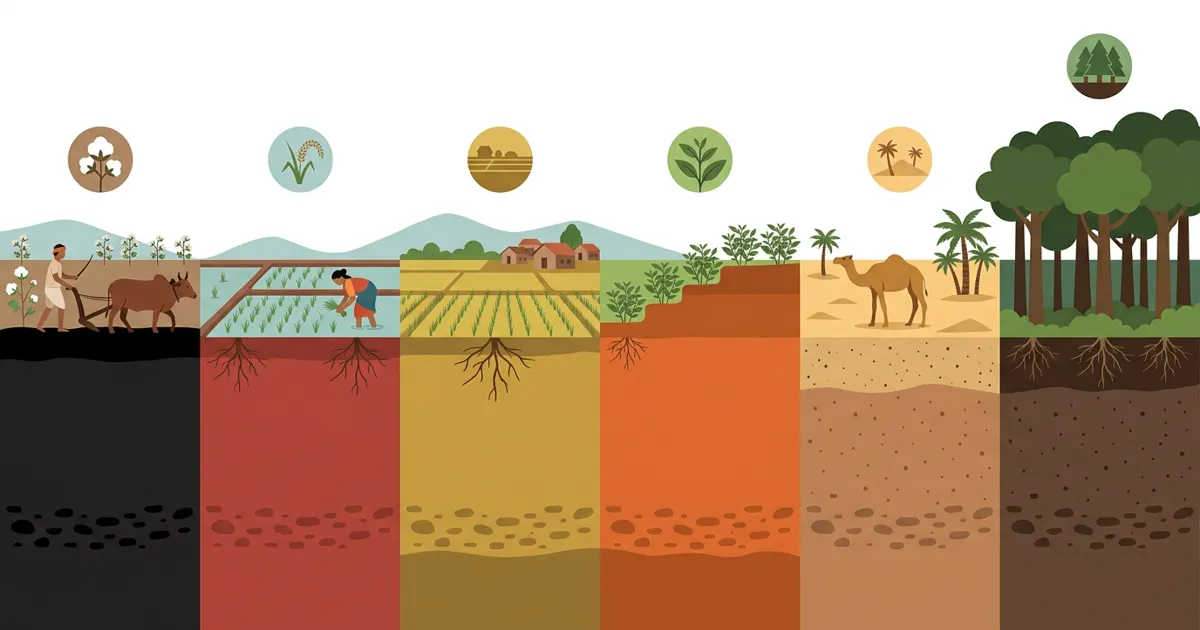
Types of Soil in India: Quick Answer
The Indian Council of Agricultural Research (ICAR) groups Indian soils into eight major types: alluvial, black (regur), red and yellow, laterite, arid (desert), saline and alkaline, peaty and marshy, and forest and mountain soils. Alluvial soil is the most widespread (about 40% of India's area, in the Indo-Gangetic plains); black soil, formed from Deccan basalt lava, is best for cotton; laterite soil forms by heavy leaching in hot, wet areas and is used for tea, coffee and cashew.
Key takeaway: For each soil, learn where it is found, how it formed, what it is rich and poor in, and its main crop. The most asked pairs: black soil → cotton (Deccan trap), red soil colour → iron oxide, laterite → leaching, cashew and bricks, alluvial → khadar and bangar, saline soil → treated with gypsum.
Major Types of Soil in India (ICAR Classification Table)
| Soil type | Approx. share of area | Where found | Rich in | Poor in | Main crops |
|---|---|---|---|---|---|
| Alluvial | About 40% (largest) | Indo-Gangetic-Brahmaputra plains; river deltas of the Mahanadi, Godavari, Krishna, Kaveri; Gujarat coast | Potash, lime | Phosphorus, nitrogen, humus (varies) | Rice, wheat, sugarcane, pulses, oilseeds, jute |
| Black (Regur) | About 15% | Deccan trap: Maharashtra (largest), Madhya Pradesh, Gujarat, western Andhra Pradesh and Telangana, north Karnataka, Tamil Nadu (parts) | Iron, lime, calcium, magnesium, potash, aluminium | Nitrogen, phosphorus, organic matter | Cotton (called black cotton soil), sugarcane, soybean, jowar, groundnut |
| Red and Yellow | About 18% | Eastern and southern Deccan: Tamil Nadu, Karnataka, Odisha, Chhattisgarh, Jharkhand, parts of the North-East and the Western Ghats' eastern slopes | Iron (oxide), potash | Nitrogen, phosphorus, humus, lime | Millets, groundnut, pulses, tobacco, potato (with fertilisers) |
| Laterite | About 3.7% | High-rainfall hills: Western Ghats (Kerala, Karnataka, Goa), Eastern Ghats, Odisha, Meghalaya, Assam hills | Iron and aluminium oxides | Nitrogen, potash, lime, organic matter | Cashew, tea, coffee, rubber, coconut; used to make bricks |
| Arid (Desert) | About 4.4% | Western Rajasthan, Kutch, parts of Haryana and Punjab | Soluble salts, phosphate (varies) | Humus, nitrogen, moisture | Bajra, pulses, guar, fodder (with irrigation: wheat, cotton) |
| Saline and Alkaline | About 1-1.3% | Dry areas with poor drainage: Punjab, Haryana, Uttar Pradesh, Rajasthan, Gujarat (Kutch) coast, Sundarbans | Sodium, potassium, magnesium salts | Nitrogen, calcium | Unfit for most crops until treated; salt-tolerant crops such as barley, berseem |
| Peaty and Marshy | Small | Kerala (Kuttanad backwaters), Sundarbans (West Bengal), coastal Odisha, Uttarakhand (Almora) | Organic matter (up to 40-50%) | Potash, phosphate | Rice (in Kerala's kari soil areas), jute |
| Forest and Mountain | About 8% | Himalayas, Western and Eastern Ghats, North-East hills | Humus (in the upper layer) | Potash, phosphorus, lime; usually acidic | Tea, coffee, spices, fruits (apples), temperate crops |
Shares follow the commonly quoted ICAR/NCERT figures and are approximate; exams ask only "largest" (alluvial) and the order of the top three (alluvial > red and yellow > black, by most sources).
Alluvial Soil: Khadar and Bangar
| Point | Khadar | Bangar |
|---|---|---|
| Age | New alluvium | Old alluvium |
| Location | Low-lying flood plains, renewed every year by floods | Higher land above flood level |
| Texture | Fine, sandy, light | Clayey, contains lime nodules called kankar |
| Fertility | More fertile | Less fertile |
Other alluvial terms: Bhabar (pebbly belt at the foot of the Shiwaliks, where streams disappear), Terai (marshy belt south of the Bhabar), and Reh/Kallar (salt crust on poorly drained alluvium).
Black Soil (Regur): Facts for SSC
- Formed from the weathering of basalt lava of the Deccan trap; also called regur (from the Telugu word "reguda") and black cotton soil.
- Dark colour comes from titaniferous magnetite and humus.
- Clayey and moisture-retentive: it swells when wet and develops deep cracks when dry, so it gets aerated naturally ("self-ploughing").
- Maharashtra has the largest area of black soil.
Red and Laterite Soil: Why the Colour?
| Soil | Reason for colour / formation |
|---|---|
| Red soil | Iron oxide spread through old crystalline (granite and gneiss) rocks; it looks yellow when the iron is in hydrated form |
| Laterite soil | Formed by leaching under high temperature and heavy rainfall, which washes away lime and silica and leaves iron and aluminium; it hardens on exposure to air, so it is cut into building bricks. Name from the Latin "later" (brick) |
Soil Erosion and Conservation in India
| Type of erosion | Meaning | Example |
|---|---|---|
| Sheet erosion | Thin top layer removed over a wide area by water | Plains after heavy rain |
| Rill erosion | Small finger-like channels | Sloping fields |
| Gully erosion | Deep channels; land becomes bad land | Chambal ravines (Madhya Pradesh, Rajasthan, Uttar Pradesh) |
| Wind erosion | Topsoil blown away | Thar desert region |
Conservation methods: contour ploughing, terrace (step) farming in hills, strip cropping, shelter belts (rows of trees against wind in deserts), afforestation, controlled grazing, and check dams. Saline and alkaline soils are reclaimed by adding gypsum and improving drainage.
Soil Institutes, Schemes and Days
| Item | Fact |
|---|---|
| ICAR (Indian Council of Agricultural Research) | Headquarters New Delhi; set up in 1929 |
| National Bureau of Soil Survey and Land Use Planning (NBSS&LUP) | Nagpur |
| Central Soil Salinity Research Institute | Karnal, Haryana |
| Indian Institute of Soil Science | Bhopal |
| Soil Health Card Scheme | Launched on 19 February 2015 at Suratgarh, Rajasthan |
| World Soil Day | 5 December |
Types of Soil in India: Memory Tricks
- Order by area: "A-R-B" (Alluvial > Red and yellow > Black), as in most textbooks.
- Black soil is "LIP-rich, NP-poor": rich in Lime, Iron, Potash; poor in Nitrogen and Phosphorus.
- Laterite = Leaching: both start with L; think "Laterite = Leached = Ladder of bricks".
- Red = Rust: the colour comes from iron oxide, like rust.
- Peaty = Kerala's Kari: waterlogged, humus-rich soil of Kuttanad.
- Salt soil treatment = Gypsum: "Salt Goes with Gypsum".
Types of Soil in India: PYQ-Style Questions with Answers
1. Which is the most widespread soil in India? (a) Black soil (b) Red soil (c) Alluvial soil (d) Laterite soil Answer: (c) Alluvial soil.
2. Black soil is best suited for the cultivation of: (a) Rice (b) Tea (c) Cotton (d) Wheat Answer: (c) Cotton, hence the name black cotton soil.
3. The red colour of red soil is due to: (a) Humus (b) Iron oxide (c) Aluminium (d) Manganese Answer: (b) Iron oxide.
4. Laterite soil is formed mainly by the process of: (a) Leaching (b) Deposition (c) Wind erosion (d) Volcanic activity Answer: (a) Leaching, in areas of high temperature and heavy rainfall.
5. Which state has the largest area under black soil? (a) Gujarat (b) Madhya Pradesh (c) Maharashtra (d) Karnataka Answer: (c) Maharashtra.
6. Old alluvium containing kankar nodules is called: (a) Khadar (b) Bangar (c) Bhabar (d) Terai Answer: (b) Bangar.
7. Saline and alkaline soils can be reclaimed by adding: (a) Lime (b) Gypsum (c) Urea (d) Potash Answer: (b) Gypsum.
8. Black soil is poor in: (a) Lime (b) Iron (c) Potash (d) Nitrogen Answer: (d) Nitrogen (and phosphorus).
9. Peaty (marshy) soil is mainly found in: (a) Rajasthan (b) Kerala (c) Punjab (d) Madhya Pradesh Answer: (b) Kerala, in the Kuttanad region, and also in the Sundarbans.
10. Which crop grows best in laterite soil? (a) Cashew (b) Wheat (c) Cotton (d) Bajra Answer: (a) Cashew.
11. The Soil Health Card scheme was launched in 2015 at: (a) Anand (b) Suratgarh (c) Karnal (d) Nagpur Answer: (b) Suratgarh, Rajasthan.
12. The Chambal ravines are an example of: (a) Sheet erosion (b) Rill erosion (c) Gully erosion (d) Wind erosion Answer: (c) Gully erosion.
Types of Soil in India FAQs
How many types of soil are there in India?
ICAR classifies Indian soils into eight major groups: alluvial, black, red and yellow, laterite, arid, saline and alkaline, peaty and marshy, and forest and mountain soils.
Why is black soil called self-ploughing?
Because it swells when wet and shrinks with deep cracks when dry; this cracking lets air into the soil, as if it had been ploughed.
Which soil is called regur?
Black soil. The name comes from the Telugu word "reguda".
What is the difference between khadar and bangar?
Khadar is new alluvium on flood plains, renewed each year and very fertile. Bangar is old alluvium on higher ground, with kankar nodules, and is less fertile.
Which soil is used to make bricks?
Laterite soil, which hardens when exposed to air.
Which soil has the highest organic matter in India?
Peaty and marshy soil, found in Kerala, the Sundarbans and coastal Odisha.
Practice Next
- Geography mock tests: SSC CGL Geography Mock Test 01, SSC CGL Geography Mock Test 02, SSC CHSL Geography Mock Test 01, RRB NTPC Geography Mock Test 01.
- Related notes: Indian climate notes, Indian rivers origin and end list, Major dams of India, National parks in India list.
- Exam updates: SSC CGL 2026, RRB NTPC 2026.
- Browse all study notes.