Pipe and Cistern Formula for SSC CGL
The core pipe and cistern formula for SSC CGL is simple: if a pipe fills a tank in x hours, it fills 1/x of the tank per hour. Add the rates of filling pipes, subtract the rates of emptying pipes (outlets or leaks), and divide 1 tank by the net rate. Two pipes that fill a tank in a and b hours fill it together in ab/(a + b) hours; a filling pipe (a hours) with an emptying pipe (b hours) fills it in ab/(b − a) hours.
🔥 Key Exam Takeaway: Skip fractions. Take the LCM of all the times as the tank capacity, find each pipe's units per hour (its efficiency), give outlets a minus sign, and divide. Example: fill in 10 h, empty in 15 h → capacity 30 units → +3 and −2 → net 1 unit/h → 30 hours.
Pipes and cisterns is a part of Time and Work, which the official SSC CGL 2026 notice lists in both the Tier 1 Quantitative Aptitude and Tier 2 Mathematical Abilities syllabus. It is also asked in SSC CHSL, MTS, CPO and IBPS/SBI Clerk prelims. Every answer in this note has been checked by direct calculation.
What Is Pipe and Cistern in Maths? (Inlet, Outlet and Leak)
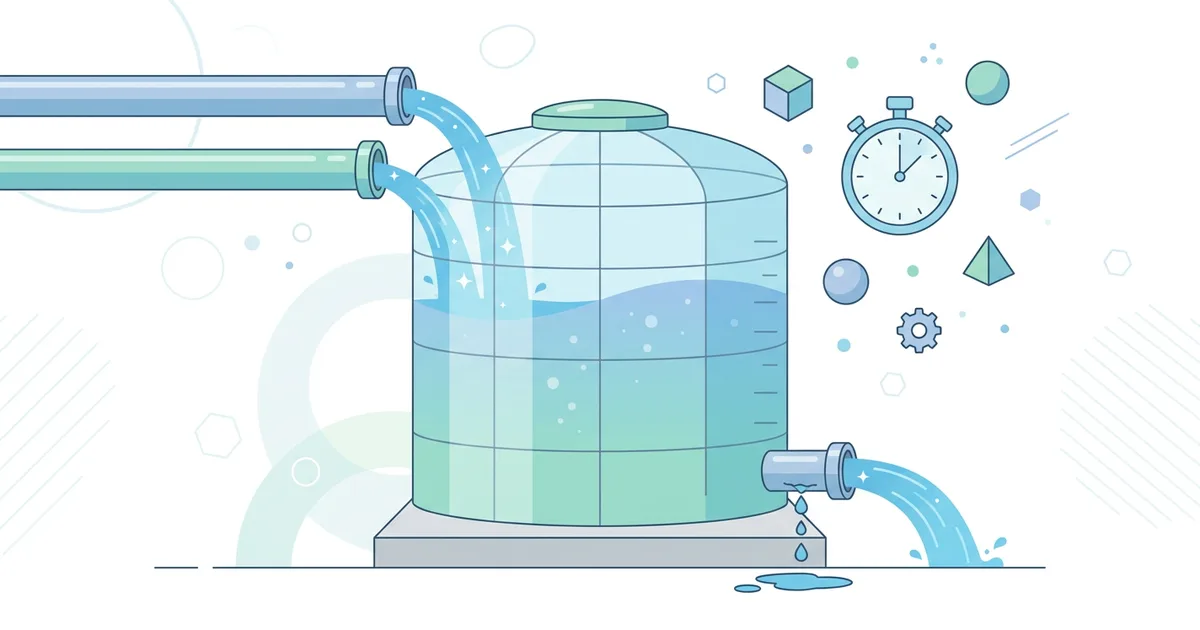
A cistern is just a tank. Questions describe pipes that fill it and pipes that empty it, and ask how long it takes to fill or empty the tank.
| Term | Meaning | Sign in calculation |
|---|---|---|
| Inlet pipe | A pipe that fills the tank | + (positive work) |
| Outlet pipe | A pipe that empties the tank | − (negative work) |
| Leak | A hole that empties the tank; it behaves exactly like an outlet | − (negative work) |
| Efficiency | Part of the tank (or units) a pipe fills per minute or hour | units per unit time |
| Capacity | Whole tank; take it as 1, or as the LCM of the times | total units |
The logic is the same as Time and Work: a pipe = a worker, the tank = the job, and an outlet or leak = a worker who undoes the job.
All Pipe and Cistern Formulas for SSC CGL (Formula Table)
| Situation | Formula | Quick check |
|---|---|---|
| One pipe fills in x hours | Part filled in 1 hour = 1/x | Fills in 5 h → 1/5 per hour |
| Two inlets: a h and b h | Time together = ab/(a + b) | 12 and 15 → 180/27 = 6 h 40 min |
| Three inlets: a, b, c h | Time together = abc/(ab + bc + ca) | 10, 12, 15 → 1800/450 = 4 h |
| Inlet a h, outlet b h (b > a) | Time to fill = ab/(b − a) | 10 and 15 → 150/5 = 30 h |
| Outlet faster than inlet (a > b), tank full | Time to empty = ab/(a − b) | Inlet 15, outlet 10 → 30 h to empty |
| Pipe fills in a h; with a leak it takes b h | Leak empties a full tank in ab/(b − a) h | 8 and 10 → 80/2 = 40 h |
| Pipe A alone takes x more than (A + B), B alone takes y more | Time together = √(xy) | x = 16, y = 9 → √144 = 12 |
| Tank already part full (p of the tank) | Time = (1 − p) ÷ net rate | Half full → only 1/2 tank left |
| Pipes of different diameter, same flow speed | Volume per minute ∝ (diameter)² | Double diameter → 4 times the flow |
Why the leak formula works: the pipe alone does 1/a per hour, the pipe with leak does 1/b per hour, so the leak removes 1/a − 1/b = (b − a)/ab per hour. A full tank therefore empties in ab/(b − a) hours.
Pipe and Cistern LCM Trick (Efficiency Method) Step by Step
This is the fastest pipe and cistern trick for SSC CGL, and it avoids messy fractions.
- Write the time of each pipe. Mark outlets and leaks clearly.
- Take the LCM of all the times. Treat it as the tank capacity in units (litres, if you like).
- Find each pipe's efficiency = capacity ÷ its time. Put a minus sign on outlets and leaks.
- Add the efficiencies to get the net units per hour (or minute).
- Divide the units still to be filled by the net efficiency. If the net is negative, the tank is emptying.
Worked example (three pipes): A, B and C fill a tank in 10, 12 and 15 hours. LCM(10, 12, 15) = 60 units. A = 6, B = 5, C = 4 units per hour. Together = 15 units per hour. Time = 60 ÷ 15 = 4 hours.
| Pipe | Time | Efficiency (capacity 60) |
|---|---|---|
| A | 10 h | 6 units/h |
| B | 12 h | 5 units/h |
| C | 15 h | 4 units/h |
| A + B + C | 4 h | 15 units/h |
Pipe and Cistern Solved Examples for SSC CGL and CHSL
Example 1: Two inlet pipes together (SSC CHSL level)
Pipe A fills a tank in 12 hours and pipe B fills it in 15 hours. How long do they take together?
Solution: LCM(12, 15) = 60. A = 5 units/h, B = 4 units/h, together 9 units/h. Time = 60/9 = 20/3 hours = 6 hours 40 minutes. (Formula check: 12 × 15 ÷ 27 = 180/27 = 20/3.)
Example 2: Inlet and outlet open together (SSC CGL Tier 1)
A pipe fills a tank in 10 hours and another pipe empties the full tank in 15 hours. If both are opened together on an empty tank, when is it full?
Solution: Capacity = 30 units. Inlet = +3, outlet = −2. Net = 1 unit/h. Time = 30 hours.
Example 3: Leak at the bottom of the tank
A pipe can fill a cistern in 8 hours. Because of a leak, it takes 10 hours. In how much time can the leak alone empty the full cistern?
Solution: Capacity = LCM(8, 10) = 40 units. Pipe = 5 units/h; pipe with leak = 4 units/h, so the leak removes 1 unit/h. Leak empties 40 units in 40 hours. (Formula: 8 × 10 ÷ (10 − 8) = 40.)
Example 4: Leak makes the tank take 1 hour longer
A tap normally fills a tank in 6 hours, but a leak makes it take 7 hours. Find the time the leak takes to empty the full tank.
Solution: 6 × 7 ÷ (7 − 6) = 42 hours.
Example 5: Pipe closed midway (SSC CGL Tier 2 style)
Pipes A and B fill a tank in 20 minutes and 30 minutes. Both are opened together. After how many minutes should B be closed so that the tank is full in exactly 15 minutes?
Solution: Capacity = 60 units. A = 3/min, B = 2/min. A runs all 15 minutes: 3 × 15 = 45 units. B must fill the remaining 15 units at 2 per minute → 7.5 minutes. So B is closed after 7 minutes 30 seconds.
Example 6: Second pipe opened later
Pipe A fills a tank in 30 minutes and pipe B in 45 minutes. A is opened first, and B is opened 10 minutes later. How long does it take to fill the tank from the start?
Solution: Capacity = 90 units. A = 3/min, B = 2/min. In the first 10 minutes A fills 30 units. Remaining 60 units at 5/min = 12 minutes. Total = 10 + 12 = 22 minutes.
Example 7: Pipes opened alternately (frequently asked)
Pipes A and B fill a tank in 6 hours and 8 hours. They are opened alternately for 1 hour each, starting with A. When will the tank be full?
Solution: Capacity = 24 units. A = 4/h, B = 3/h. One 2-hour cycle = 7 units. After 3 cycles (6 hours): 21 units. Remaining 3 units are filled by A (its turn) at 4 per hour → 3/4 hour = 45 minutes. Total = 6 hours 45 minutes.
Trap: If B starts first, the answer changes to 7 hours (after 6 hours, 21 units; B's turn fills the last 3 units in exactly 1 hour). Always check whose turn it is.
Example 8: Two inlets and one outlet
Taps A and B fill a tank in 12 and 16 minutes; tap C empties it in 8 minutes. All three are opened together on an empty tank. When is it full?
Solution: Capacity = LCM(12, 16, 8) = 48. A = +4, B = +3, C = −6. Net = 1 unit/min. Time = 48 minutes.
Example 9: Efficiency ratio given
Pipe A is twice as fast as pipe B. Together they fill a tank in 12 minutes. How long does B alone take?
Solution: Let B = 1 unit/min, A = 2 units/min. Together 3 units/min for 12 minutes → capacity 36 units. B alone = 36 ÷ 1 = 36 minutes (A alone = 18 minutes).
Example 10: Find the capacity in litres
A leak can empty a full cistern in 6 hours. An inlet pipe that fills 4 litres per minute is opened, and now the full cistern empties in 8 hours. Find the capacity.
Solution: Inlet = 4 × 60 = 240 litres per hour. Leak rate − inlet rate = net emptying rate: C/6 − 240 = C/8. So C × (1/6 − 1/8) = 240 → C/24 = 240 → C = 5,760 litres. (Check: leak = 960 L/h, net = 960 − 240 = 720 L/h = 5,760 ÷ 8.)
Example 11: Tank already half full
A tank is half full. Pipe A fills the whole tank in 10 minutes and pipe B empties the whole tank in 15 minutes. If both are opened, when will the tank be full?
Solution: Capacity = 30 units, so 15 units are already in. Net = 3 − 2 = 1 unit/min. Remaining 15 units take 15 minutes.
Example 12: The √(xy) shortcut
Pipe A alone takes 16 minutes more than A and B together, and B alone takes 9 minutes more than A and B together. Find the time taken together.
Solution: Time together = √(16 × 9) = √144 = 12 minutes. (Check: A = 28 min, B = 21 min, together 28 × 21 ÷ 49 = 12.)
Common Mistakes in Pipe and Cistern Questions
| Trap | What students do wrong | Correct approach |
|---|---|---|
| Leak sign | Add the leak like an inlet | A leak or outlet always gets a minus sign |
| Outlet faster than inlet | Report a "fill" time | If the net rate is negative, the tank empties; a tank that starts empty never fills |
| Alternate pipes | Multiply full cycles blindly | Stop before the last cycle and check whose turn it is |
| Part-full tank | Use the full capacity | Use only the part still to be filled (or emptied) |
| Mixed units | Hours for one pipe, minutes for another | Convert everything to one unit first |
| "Leak takes 1 hour more" | Treat 1 hour as the leak time | Use ab/(b − a) with the normal and the slower time |
| Litres given | Ignore the litres | Write every rate in litres per hour and form one equation for the capacity |
Pipe and Cistern Quick Revision Table for SSC Exams
| You are given | Do this | Answer form |
|---|---|---|
| Two inlets a, b | ab/(a + b) | Time together |
| Inlet a, outlet b (b > a) | ab/(b − a) | Time to fill |
| Normal a, with leak b | ab/(b − a) | Leak's time to empty |
| Three pipes | LCM, add efficiencies with signs | Capacity ÷ net |
| Pipe closed after t | Units done in t, rest by remaining pipes | Total time |
| Alternate opening | Units per cycle, then last part | Full cycles + fraction |
| Extra times x and y | √(xy) | Time together |
Pipe and Cistern Practice Questions with Answers (SSC CGL Level)
Q1. Pipe A fills a tank in 20 minutes and pipe B in 30 minutes. How long do both take together? Answer: 12 minutes. Capacity 60; A = 3, B = 2; 60 ÷ 5 = 12.
Q2. A pipe fills a tank in 6 hours and another empties it in 9 hours. If both are opened on an empty tank, when is it full? Answer: 18 hours. Capacity 18; +3 and −2; net 1 per hour.
Q3. Pipes A, B and C fill a tank in 20, 30 and 60 minutes. Working together, how long do they take? Answer: 10 minutes. Capacity 60; 3 + 2 + 1 = 6 per minute; 60 ÷ 6 = 10.
Q4. A pipe fills a tank in 5 hours, but because of a leak it takes 6 hours. How long will the leak take to empty the full tank? Answer: 30 hours. 5 × 6 ÷ (6 − 5) = 30.
Q5. Pipes A and B fill a tank in 12 and 18 minutes. Both are opened, and B is closed after 6 minutes. How long does it take to fill the tank in total? Answer: 8 minutes. Capacity 36; A = 3, B = 2. In 6 minutes: 30 units. Remaining 6 units by A at 3 per minute = 2 minutes. Total 6 + 2 = 8.
Q6. Pipes A and B fill a tank in 4 hours and 6 hours. They are opened alternately for 1 hour each, starting with A. How long does the tank take to fill? Answer: 4 hours 40 minutes. Capacity 12; A = 3, B = 2; each 2-hour cycle = 5 units. After 4 hours: 10 units. A fills the last 2 units in 2/3 hour = 40 minutes.
Q7. Pipe A is twice as fast as B, and B is three times as fast as C. All three together fill a tank in 6 hours. How long does C alone take? Answer: 60 hours. C = 1, B = 3, A = 6 units/h; together 10 units/h × 6 h = 60 units; C alone = 60 hours (A alone = 10 hours).
Q8. A leak can empty a full tank in 7 hours. An inlet filling 6 litres per minute is opened, and the full tank now empties in 12 hours. Find the capacity. Answer: 6,048 litres. Inlet = 360 L/h. C/7 − 360 = C/12 → C × 5/84 = 360 → C = 6,048. Check: 864 − 360 = 504 L/h, and 6,048 ÷ 12 = 504.
Q9. Pipe A alone takes 25 minutes more than A and B together, and B alone takes 16 minutes more. How long do A and B take together? Answer: 20 minutes. √(25 × 16) = √400 = 20. (A = 45 min, B = 36 min; 45 × 36 ÷ 81 = 20.)
Q10. A tank is 2/5 full. Pipe A fills the whole tank in 15 minutes and pipe B empties the whole tank in 10 minutes. If both are opened, in how much time will the tank be empty? Answer: 12 minutes. Capacity 30; 12 units are in. A = +2, B = −3; net −1 per minute, so 12 units drain in 12 minutes.
Pipe and Cistern FAQs
What is the formula of pipe and cistern?
If a pipe fills a tank in x hours, it fills 1/x of the tank in one hour. For two filling pipes the time together is ab/(a + b). For a filling pipe (a) and an emptying pipe (b), the time to fill is ab/(b − a).
What is the LCM method in pipe and cistern?
Take the LCM of all the given times as the capacity of the tank, find how many units each pipe fills per hour, give emptying pipes a minus sign, and divide the capacity by the net units per hour.
How do you solve a leak question in pipe and cistern?
Treat the leak as an outlet. If a pipe fills the tank in a hours and takes b hours with the leak, the leak alone empties a full tank in ab/(b − a) hours.
Is pipe and cistern part of time and work for SSC CGL?
Yes. It is the same idea with negative work allowed for outlets. The SSC CGL 2026 notice lists Time and Work in the quantitative syllabus, and pipe and cistern questions are asked under it.
How many pipe and cistern questions come in SSC CGL?
Usually zero to two questions per shift in Tier 1, often merged with Time and Work. The number changes from shift to shift, so practise both topics together.
What happens if the outlet is faster than the inlet?
The net rate is negative, so an empty tank never fills. If the tank starts full, it empties in ab/(a − b) hours, where a is the inlet time and b is the outlet time.
Related topics: revise time and work tricks for SSC CGL, mensuration formulas for SSC CGL and percentage tricks for SSC CGL next.
Practice Next
- Take the full-length SSC CGL Quantitative Aptitude Sectional Mock Test 01, then Mock Test 02 and Mock Test 03.
- New topic-wise test: SSC CGL Time and Work Mock Test 01: Pipes and Cisterns, Efficiency and Wages (15 Questions).
- New SSC topic test: SSC CHSL Time and Work Mock Test 01: Work Together, Leaving Midway and Pipes (15 Questions).
- Revise the next formula sheet: Statistics Formulas for SSC CGL, CI and SI Difference Formula for 2, 3 and 4 Years and Unit Digit Tricks for SSC CGL.
- Speed up your calculations with Vedic Maths and Quant Shortcuts for SSC CGL, and switch to reasoning with the Calendar Odd Days Trick.
- Check dates and eligibility in the SSC CGL 2026 notification and the SSC CHSL 2026 notification.
- Browse all study notes.