Priority Sector Lending Targets: Quick Answer
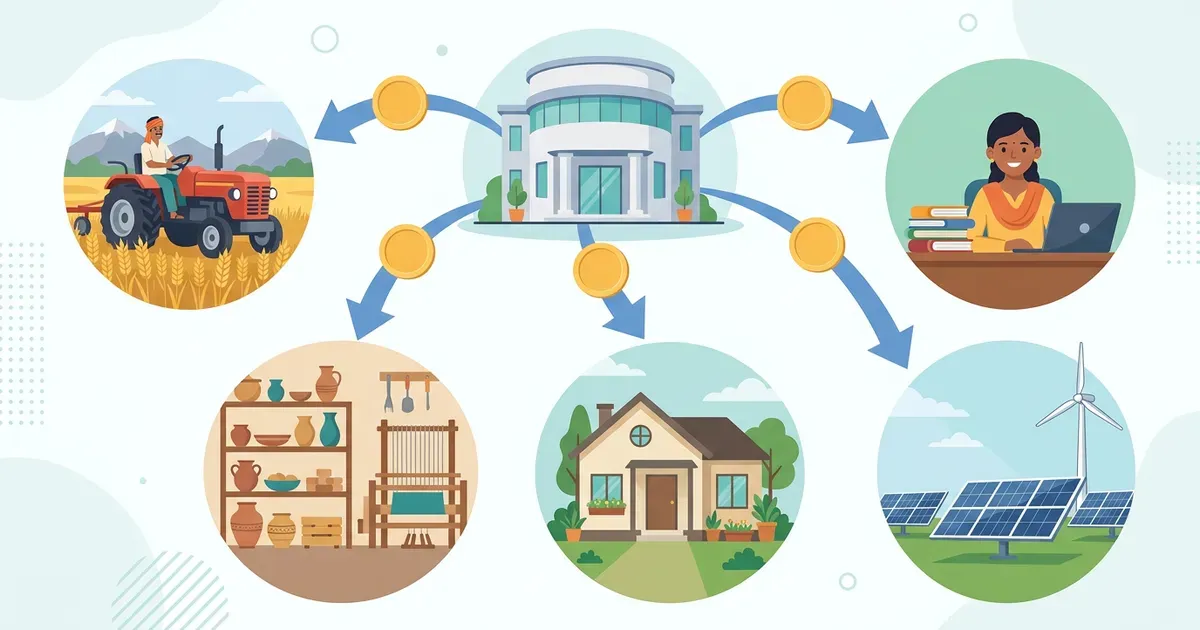
Under the RBI's priority sector lending (PSL) rules, a domestic commercial bank must lend 40% of its Adjusted Net Bank Credit (ANBC) or Credit Equivalent of Off-Balance Sheet Exposures (CEOBSE), whichever is higher, to the priority sector. Inside that 40%, 18% must go to agriculture (with 10% for small and marginal farmers), 7.5% to micro enterprises and 12% to weaker sections. Regional Rural Banks have a 75% target, while Small Finance Banks and Urban Co-operative Banks now have 60%.
Every number in this note is checked against the RBI's Master Directions – Reserve Bank of India (Priority Sector Lending – Targets and Classification) Directions, 2025, as updated on rbi.org.in up to 11 September 2026.
🔥 Key Exam Takeaway: Domestic banks and foreign banks with 20+ branches = 40%. Foreign banks with fewer than 20 branches = 40%, of which up to 32% can be export credit. RRBs = 75%. SFBs = 60% (cut from 75% by the RBI amendment of 19 January 2026). UCBs = 60%. Agriculture 18% (NCF 14%, SMF 10%), Micro 7.5%, Weaker Sections 12% (15% for RRBs). Many websites still show 75% for SFBs. That figure is out of date.
What Is Priority Sector Lending (PSL)?
Priority sector lending is the share of bank credit that the RBI requires banks to give to sectors that are important for growth and jobs but may not get enough credit on purely commercial terms, such as small farmers, micro units, poor households and students. The rules apply to every commercial bank (including RRBs, SFBs and Local Area Banks) and to Primary (Urban) Co-operative Banks, except Salary Earners' Banks.
The current rulebook is the Master Direction on PSL dated 24 March 2025, which came into effect on 1 April 2025 and replaced the 2020 Master Direction. Loans already classified as PSL under the 2020 rules stay PSL till maturity.
Priority Sector Lending Categories (8 categories)
The RBI lists eight categories under priority sector:
| No. | Category | Key point for exams |
|---|---|---|
| 1 | Agriculture | Farm credit, agriculture infrastructure, ancillary activities |
| 2 | Micro, Small and Medium Enterprises (MSMEs) | All bank loans to MSMEs qualify |
| 3 | Export Credit | Only the incremental part, with limits (see below) |
| 4 | Education | Loans up to ₹25 lakh per student |
| 5 | Housing | Loan and dwelling-cost caps by city size |
| 6 | Social Infrastructure | Schools, drinking water, sanitation, health care |
| 7 | Renewable Energy | Up to ₹35 crore per borrower |
| 8 | Others | SHG/JLG loans, distressed persons, start-ups, etc. |
Weaker Sections is not a separate category. It is an overlapping target: a loan to an SC/ST borrower for a dairy unit counts under Agriculture and also under Weaker Sections.
Priority Sector Lending Targets for Different Banks (RBI Table)
The targets are calculated on ANBC or CEOBSE as on the corresponding date of the preceding year, whichever is higher.
| Target / Sub-target | Domestic SCBs & foreign banks with 20+ branches | Foreign banks with < 20 branches | Regional Rural Banks | Small Finance Banks |
|---|---|---|---|---|
| Total priority sector | 40% | 40% (up to 32% can be export credit; at least 8% to other PSL) | 75% (Medium Enterprises, Social Infrastructure and Renewable Energy count only up to 15% of ANBC) | 60% |
| Agriculture | 18% | Not applicable | 18% | 18% |
| – Non-Corporate Farmers (NCF) | 14% (within 18%) | Not applicable | 14% | 14% |
| – Small & Marginal Farmers (SMF) | 10% (within 14%) | Not applicable | 10% | 10% |
| Micro Enterprises | 7.5% | Not applicable | 7.5% | 7.5% |
| Weaker Sections | 12% | Not applicable | 15% | 12% |
All percentages are "of ANBC or CEOBSE, whichever is higher".
Priority Sector Lending Targets for UCBs
| Category | Target for Urban Co-operative Banks |
|---|---|
| Total priority sector | 60% |
| Micro Enterprises | 7.5% |
| Weaker Sections | 12% |
UCBs do not have a separate agriculture sub-target in the table. Their overall target was fixed at 60% in the 2025 Master Direction.
How to remember the PSL targets (memory trick)
- 40 – 18 – 14 – 10 – 7.5 – 12: read it as "Forty banks, eighteen farms, fourteen farmers, ten small farmers, seven-and-a-half micro units, twelve weak sections".
- 75 only for RRBs, because they are rural by design.
- 60 for SFBs and UCBs: both are "small" lenders, both 60.
- 15% weaker sections only for RRBs; everyone else is 12%.
Priority Sector Lending Targets 2025 Revisions and 2026 Amendments
The RBI press release of 24 March 2025 listed the main changes in the new Master Direction:
- Higher loan limits in several categories, especially housing.
- Wider list of purposes counted under Renewable Energy.
- Overall PSL target for UCBs revised to 60% of ANBC or CEOBSE.
- Longer list of borrowers counted as Weaker Sections, and the per-borrower cap on loans by UCBs to individual women beneficiaries removed.
After that, the Master Direction was amended three times in 2026 (19 January, 7 August and 11 September 2026). The changes that matter for exams came on 19 January 2026:
- SFB overall target cut from 75% to 60% of ANBC or CEOBSE.
- Bank loans to NCDC (National Co-operative Development Corporation) for on-lending to co-operative societies became PSL-eligible, for loans sanctioned after 19 January 2026 (not for RRBs, UCBs, SFBs and LABs).
- NCDC on-lending is now counted inside the overall 5% on-lending cap along with NBFCs and HFCs.
Priority Sector Loan Limits: Category-wise Table
| Category | Loan limit as per the Master Direction |
|---|---|
| Education | Up to ₹25 lakh per individual, including vocational courses |
| Housing (purchase/construction) | ₹50 lakh in centres with 50 lakh+ population (house cost ≤ ₹63 lakh); ₹45 lakh in 10–50 lakh centres (≤ ₹57 lakh); ₹35 lakh in centres below 10 lakh (≤ ₹44 lakh) |
| Housing repairs | ₹15 lakh / ₹12 lakh / ₹10 lakh for the same three city sizes |
| Social infrastructure | ₹8 crore per borrower for schools, drinking water, sanitation; ₹12 crore for health care facilities in Tier II to Tier VI centres |
| Renewable energy | ₹35 crore per borrower; ₹10 lakh for individual households |
| Agriculture infrastructure | Aggregate ₹100 crore per borrower from the banking system |
| Food and agro-processing | Aggregate ₹100 crore per borrower |
| Start-ups | Up to ₹50 crore (agriculture, MSME or other activities) |
| Corporate farmers, FPOs, co-operatives of farmers | ₹4 crore per entity; ₹10 crore for FPOs/FPCs with assured marketing |
| Export credit (domestic banks, SFBs, UCBs) | Incremental export credit up to 2% of ANBC/CEOBSE, sanctioned limit up to ₹50 crore per borrower |
| SHG/JLG loans for non-farm, non-MSME needs | Up to ₹2 lakh |
| Distressed persons (non-farmers) | Up to ₹1 lakh to repay non-institutional lenders |
Housing loans to a bank's own employees are not PSL. Housing loans backed by long-term bonds are also excluded.
Who Are Small and Marginal Farmers Under PSL?
- Marginal farmer: landholding up to 1 hectare.
- Small farmer: more than 1 hectare and up to 2 hectares.
- Landless labourers, tenant farmers, oral lessees and share-croppers within these landholding limits.
- Individuals in allied activities (dairy, fisheries, poultry etc.) with loans up to ₹2.5 lakh, with no land condition.
- FPOs/FPCs and farmer co-operatives where SMFs hold at least 75% of the land.
Weaker Sections List Under Priority Sector Lending
Loans to these borrowers count towards the 12% (RRBs: 15%) weaker sections target: small and marginal farmers; artisans and village/cottage industries with credit limits up to ₹2 lakh; beneficiaries of government schemes such as NRLM and SRMS; SCs and STs; DRI scheme beneficiaries; SHGs/JLGs; microfinance borrowers; individual women beneficiaries up to ₹2 lakh (no limit for UCBs); distressed farmers and other distressed persons (up to ₹1 lakh); persons with disabilities; transgenders; and notified minority communities. PMJDY overdrafts also qualify.
Priority Sector Lending Certificates (PSLC): 4 Types
A bank that has lent more than its target can sell the excess as PSLCs; a bank with a shortfall can buy them. Only the PSL achievement moves; the loan and its risk stay with the original lender. The fee is market-determined, treated as an expense for the buyer and miscellaneous income for the seller.
| PSLC type | Counts towards |
|---|---|
| PSLC – Agriculture | Agriculture target and overall PSL target |
| PSLC – SF/MF | SMF sub-target, Weaker Sections, NCF, agriculture and overall targets |
| PSLC – Micro Enterprises | Micro enterprise sub-target and overall target |
| PSLC – General | Overall PSL target only |
SFBs can buy PSLCs only to meet their sub-targets within the overall target.
How Is PSL Achievement Calculated? (Quarterly Average Rule)
- Compliance is checked on a calendar-quarter basis.
- Shortfall or excess is worked out for each quarter separately.
- The simple average of the four quarters gives the year's achievement. The same method is used for each sub-target.
- District weights apply to incremental PSL credit: 125% in districts with per capita PSL below ₹9,000 and 90% in districts above ₹42,000, valid up to FY 2026-27. RRBs, UCBs, LABs and foreign banks are exempt from these weights.
What Happens If a Bank Misses Priority Sector Lending Targets?
The shortfall is deposited in the Rural Infrastructure Development Fund (RIDF) and other funds with NABARD, NHB, SIDBI and MUDRA, at below-market interest:
| Shortfall in overall PSL target | Interest paid to the bank |
|---|---|
| Less than 5 percentage points | Bank Rate minus 2 percentage points |
| 5 to less than 10 percentage points | Bank Rate minus 3 percentage points |
| 10 percentage points and above | Bank Rate minus 4 percentage points |
If the overall target is met but a sub-target is missed, the rate is Bank Rate minus 2 percentage points. Shortfalls are also considered when RBI grants regulatory approvals. UCBs under all-inclusive directions are excluded from the RIDF allocation.
Priority Sector Lending Solved Examples (Bank Exam Style)
Example 1 (IBPS PO level). A domestic bank's ANBC is ₹2,00,000 crore and CEOBSE is ₹1,50,000 crore. Find its agriculture target and SMF target.
Base = higher of the two = ₹2,00,000 crore. Agriculture = 18% × 2,00,000 = ₹36,000 crore. SMF = 10% × 2,00,000 = ₹20,000 crore.
Example 2 (SBI PO level). A foreign bank with 15 branches has ANBC of ₹10,000 crore. What is the most it can count from export credit, and how much must go to other PSL?
Total target = 40% × 10,000 = ₹4,000 crore. Export credit can be up to 32% = ₹3,200 crore; at least 8% = ₹800 crore must go to other priority sectors.
Example 3 (RBI Assistant level). An RRB has ANBC of ₹5,000 crore. Find its total PSL and weaker sections targets.
Total = 75% × 5,000 = ₹3,750 crore. Weaker sections = 15% × 5,000 = ₹750 crore.
Example 4. A bank falls 6 percentage points short of its overall PSL target. If the Bank Rate is 5.75%, what interest does it earn on its RIDF deposit?
Shortfall is between 5 and 10 points, so rate = Bank Rate − 3 = 5.75 − 3 = 2.75%.
Common Traps in Priority Sector Lending Questions
- SFB target is 60%, not 75%. The 75% figure was replaced on 19 January 2026.
- Weaker sections for RRBs is 15%, not 12%.
- Foreign banks with fewer than 20 branches have no agriculture, micro or weaker-section sub-targets.
- The base is ANBC or CEOBSE, whichever is higher, as on the corresponding date of the previous year.
- Medium enterprises are part of the MSME category, but there is no separate "medium" sub-target. The 7.5% sub-target is for micro enterprises only.
- Housing loans to bank staff are not PSL.
Priority Sector Lending Quick Revision Table
| Fact | Value |
|---|---|
| Current Master Direction | 24 March 2025, effective 1 April 2025 (updated to 11 Sep 2026) |
| Number of PSL categories | 8 |
| Domestic SCB overall target | 40% of ANBC/CEOBSE |
| Agriculture / NCF / SMF | 18% / 14% / 10% |
| Micro enterprises | 7.5% |
| Weaker sections | 12% (RRBs 15%) |
| RRB / SFB / UCB overall target | 75% / 60% / 60% |
| Foreign bank < 20 branches | 40%, export credit up to 32% |
| Types of PSLCs | 4 |
| Education loan limit | ₹25 lakh |
| Renewable energy limit | ₹35 crore (households ₹10 lakh) |
| On-lending cap (NBFC, HFC, NCDC) | 5% of previous year's PSL |
| No service charges on PSL loans up to | ₹50,000 |
Priority Sector Lending Targets MCQs with Answers
Q1. What is the overall priority sector lending target for a domestic scheduled commercial bank? (a) 32% (b) 40% (c) 60% (d) 75% Answer: (b) 40%. It is 40% of ANBC or CEOBSE, whichever is higher.
Q2. The PSL target for Small Finance Banks as per the amended Master Direction (2026) is: (a) 40% (b) 50% (c) 60% (d) 75% Answer: (c) 60%. The RBI cut it from 75% on 19 January 2026.
Q3. The sub-target for lending to small and marginal farmers is: (a) 8% (b) 10% (c) 14% (d) 18% Answer: (b) 10%. It sits inside the 14% NCF sub-target, which sits inside the 18% agriculture target.
Q4. For which type of bank is the weaker sections target 15% of ANBC? (a) SFBs (b) UCBs (c) RRBs (d) Foreign banks with 20+ branches Answer: (c) RRBs. Others have 12%.
Q5. How many types of Priority Sector Lending Certificates are there? (a) 2 (b) 3 (c) 4 (d) 5 Answer: (c) 4. Agriculture, SF/MF, Micro Enterprises and General.
Q6. A foreign bank with fewer than 20 branches can meet up to what share of ANBC through export credit? (a) 8% (b) 18% (c) 32% (d) 40% Answer: (c) 32%. At least 8% must still go to other priority sectors.
Q7. What is the maximum education loan that qualifies as priority sector? (a) ₹10 lakh (b) ₹20 lakh (c) ₹25 lakh (d) ₹50 lakh Answer: (c) ₹25 lakh, including vocational courses.
Q8. A marginal farmer, for PSL purposes, has a landholding of: (a) up to 1 hectare (b) up to 2 hectares (c) 1 to 2 hectares (d) up to 5 acres Answer: (a) up to 1 hectare. Small farmers hold more than 1 and up to 2 hectares.
Q9. Banks that miss PSL targets have to deposit the shortfall mainly in: (a) NHAI bonds (b) RIDF with NABARD (c) Government securities (d) the Deposit Insurance Fund Answer: (b) RIDF with NABARD, plus other funds with NHB, SIDBI and MUDRA as RBI decides.
Q10. A bank's shortfall in the overall PSL target is 11 percentage points. The interest on its RIDF deposit will be: (a) Bank Rate − 2 (b) Bank Rate − 3 (c) Bank Rate − 4 (d) Repo Rate − 4 Answer: (c) Bank Rate − 4 percentage points, because the shortfall is 10 points or more.
Priority Sector Lending Targets FAQs
What is the priority sector lending target for banks in 2026?
40% of ANBC or CEOBSE, whichever is higher, for domestic commercial banks and foreign banks with 20 or more branches. RRBs have 75%, and SFBs and UCBs have 60%.
What are the priority sector lending targets for RRBs?
75% overall, 18% agriculture (14% NCF, 10% SMF), 7.5% micro enterprises and 15% weaker sections. Lending to medium enterprises, social infrastructure and renewable energy counts only up to 15% of ANBC.
What is the PSL target for small finance banks now?
60% of ANBC or CEOBSE. It was 75% earlier and was reduced through the RBI amendment dated 19 January 2026.
What is ANBC in priority sector lending?
Adjusted Net Bank Credit. It starts from Net Bank Credit (bank credit in India minus bills rediscounted with RBI and approved institutions) and then adds or subtracts items such as RIDF deposits, outstanding PSLCs and certain eligible investments, as set out in paragraph 6 of the Master Direction.
Is education loan a priority sector loan?
Yes. Loans to individuals for education, including vocational courses, up to ₹25 lakh qualify.
Which banks are exempt from district weights in PSL?
RRBs, UCBs, Local Area Banks and foreign banks (including wholly owned subsidiaries) are exempt.
Related topics: revise current CRR and SLR rate 2026, banking terms A to Z, small finance banks list 2026 and NPA classification and provisioning norms next.
Practice Next
- Test yourself: IBPS & SBI Clerk Banking Awareness Mock Test 01
- PO level: IBPS & SBI PO Banking Awareness Mock Test 01
- RBI topics: IBPS & SBI Clerk RBI and Monetary Policy Mock Test 01
- Bank jobs open now: SBI Clerk Recruitment 2026 (Junior Associate) and UCO Bank Apprentice Recruitment 2026
- Related notes: Basel Norms 1, 2, 3 Difference, RBI Governor List 1935 to 2026, Banks Headquarters and Taglines 2026 and Ramsar Sites in India 2026 List; also see financial inclusion schemes in India.
- More free notes: All Study Notes
Source: Master Directions – Reserve Bank of India (Priority Sector Lending – Targets and Classification) Directions, 2025 (updated as on 11 September 2026), the RBI Amendment Directions of 19 January 2026 and the RBI press release of 24 March 2025, all on rbi.org.in. Checked on 16 October 2026.