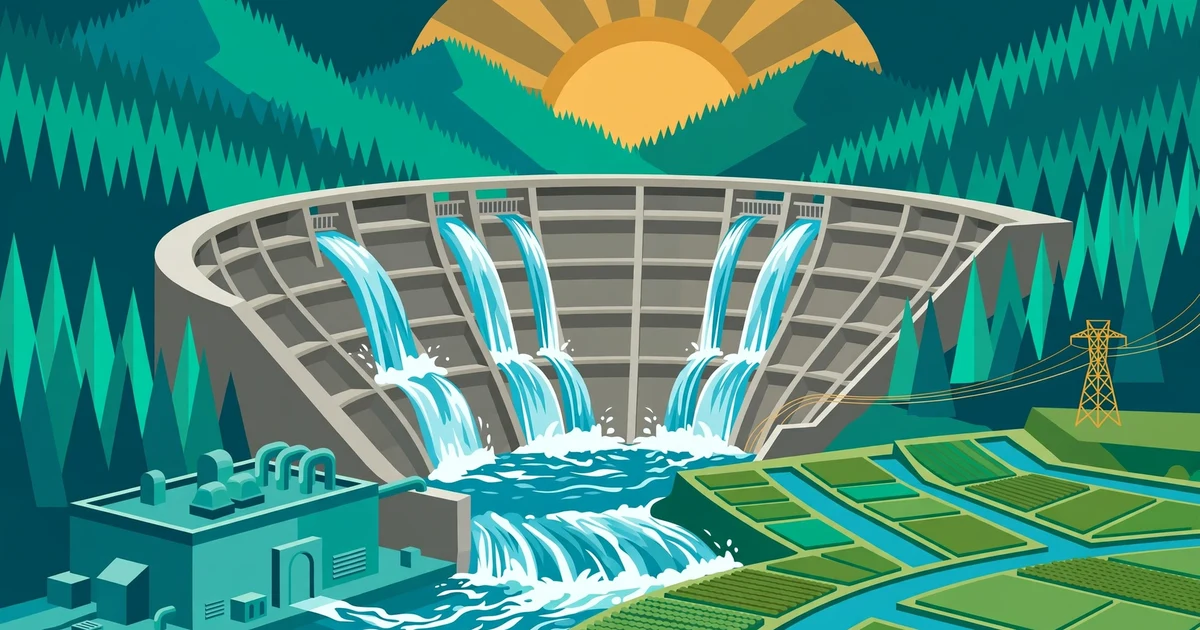
Major River Valley Projects of India: Quick Answer
The Damodar Valley Project is India's first multipurpose river valley project, set up through the Damodar Valley Corporation (DVC) in 1948. A multipurpose project is one dam or dam system that serves several purposes at once — irrigation, hydroelectric power, flood control and drinking-water supply — instead of just one. Jawaharlal Nehru called these projects the "Temples of Modern India" when he dedicated the Bhakra Dam.
🔥 Key Exam Takeaway: First multipurpose project = Damodar Valley Project, 1948. Highest dam = Tehri, 260.5 m, Bhagirathi, Uttarakhand. Highest concrete gravity dam = Bhakra, 226 m, Sutlej, Himachal Pradesh. Longest dam = Hirakud, 25.8 km total (4.8 km main dam), Mahanadi, Odisha. Largest masonry dam = Nagarjuna Sagar, 124 m, Krishna. Largest reservoir by capacity = Indira Sagar, 12.22 billion cubic metres, Narmada, Madhya Pradesh. Oldest dam still in use = Kallanai (Grand Anicut), Kaveri, Tamil Nadu, about 2nd century AD.
How is this note different from the house dams note? The companion note, Major Dams of India, lists dams state-wise with their rivers and years. This note is organised by project — the river-valley scheme as a whole — with the states each project serves, its purpose, and the command area or power figure that makes it exam-relevant. This page is as of 17 November 2026.
What Is a River Valley Project?
A river valley project builds one or more dams across a river and its tributaries, stores the water in a reservoir, and then uses that stored water for several purposes through canals, turbines and flood gates. The classic Indian model has four purposes: irrigation, hydroelectric power, flood control and drinking-water supply. A project that serves only one purpose — a barrage built only to divert water, for example — is not a multipurpose river valley project.
India has more than 5,700 large dams, the third-largest number in the world after China and the United States. The table below lists the eighteen projects that appear in SSC, banking and railway papers, with the dam, the river, the states served, the purpose and the one figure you must remember for each.
Major River Valley Projects of India: Complete List
| # | Project | Dam | River | States Served | Purpose | Key Figure |
|---|---|---|---|---|---|---|
| 1 | Damodar Valley Project | Maithon, Panchet, Tilaiya, Konar | Damodar (Barakar tributary) | Jharkhand, West Bengal | Flood control, power, irrigation | First multipurpose project, DVC 1948 |
| 2 | Bhakra-Nangal Project | Bhakra, Nangal | Sutlej | Himachal Pradesh, Punjab, Haryana, Rajasthan | Irrigation, power, flood control | Bhakra 226 m, highest concrete gravity dam |
| 3 | Hirakud Project | Hirakud | Mahanadi | Odisha | Flood control, irrigation, power | 25.8 km total length, longest dam |
| 4 | Tehri Hydro Project | Tehri | Bhagirathi | Uttarakhand, Uttar Pradesh | Power, drinking water, irrigation | 260.5 m, highest dam in India |
| 5 | Nagarjuna Sagar Project | Nagarjuna Sagar | Krishna | Telangana, Andhra Pradesh | Irrigation, drinking water, power | 124 m, largest masonry dam in the world |
| 6 | Sardar Sarovar Project | Sardar Sarovar | Narmada | Gujarat, Madhya Pradesh, Maharashtra, Rajasthan | Irrigation, drinking water, power | 163 m high; 1,450 MW |
| 7 | Chambal Valley Project | Gandhi Sagar, Rana Pratap Sagar, Jawahar Sagar, Kota Barrage | Chambal | Madhya Pradesh, Rajasthan | Irrigation, power | Gandhi Sagar 1960, first dam on the Chambal |
| 8 | Tungabhadra Project | Tungabhadra (Pampa Sagar) | Tungabhadra | Karnataka, Andhra Pradesh | Irrigation, power | Completed 1953 |
| 9 | Indira Sagar Project | Indira Sagar | Narmada | Madhya Pradesh | Power, irrigation | 12.22 billion cubic metres, largest reservoir |
| 10 | Koyna Project | Koyna | Koyna | Maharashtra | Power | 1,960 MW, largest completed hydro project in Maharashtra |
| 11 | Rihand Project | Rihand | Rihand (Son tributary) | Uttar Pradesh, Madhya Pradesh | Power, irrigation | Govind Ballabh Pant Sagar, largest artificial lake by area |
| 12 | Mettur Project | Mettur | Kaveri | Tamil Nadu | Irrigation, power | Stanley Reservoir; completed 1934 |
| 13 | Kallanai / Grand Anicut | Kallanai | Kaveri | Tamil Nadu | Irrigation | About 2nd century AD, oldest functional dam |
| 14 | Krishna Raja Sagara Project | Krishna Raja Sagara | Kaveri | Karnataka | Irrigation, drinking water | Built under M. Visvesvaraya; completed 1931 |
| 15 | Idukki Project | Idukki (arch dam) | Periyar | Kerala | Power | Double-curvature arch dam; completed 1973 |
| 16 | Indira Gandhi Canal Project | Harike Barrage (feeder) | Sutlej–Beas waters | Rajasthan | Irrigation of the Thar desert | One of the longest canals in India |
| 17 | Farakka Barrage Project | Farakka Barrage | Ganga | West Bengal | Diverting water to the Hooghly; navigation | Completed 1975 |
| 18 | Ukai Project | Ukai | Tapi | Gujarat | Irrigation, power, flood control | Second-largest reservoir in Gujarat; completed 1972 |
The First Three: Damodar, Bhakra and Hirakud
The Damodar Valley Project is the starting point of the whole topic. The Damodar river, called the "Sorrow of Bengal" for its destructive floods, was tamed by a corporation modelled on the Tennessee Valley Authority of the United States. The Damodar Valley Corporation was set up in 1948, making it the first multipurpose river valley project of independent India. Its four main dams are Tilaiya (1953, on the Barakar), Konar (1955), Maithon (1957, on the Barakar) and Panchet (1959, on the Damodar itself). Tilaiya was the first dam built under the DVC.
The Bhakra-Nangal Project is the most famous. The Bhakra Dam (1963) on the Sutlej in Himachal Pradesh is a concrete gravity dam 226 metres high — the highest concrete gravity dam in India — and its reservoir is Gobind Sagar. The Nangal Dam (1954) downstream balances Bhakra's releases. Together the two serve Himachal Pradesh, Punjab, Haryana and Rajasthan with irrigation water and power.
The Hirakud Project on the Mahanadi in Odisha, completed in 1957, holds the length record: the main dam is 4.8 km long, and the total length including the earthen dykes is 25.8 km, making it the longest dam in India and one of the longest in the world. Its purpose was flood control on the Mahanadi first and irrigation second — the Mahanadi's floods had devastated coastal Odisha for centuries, and the dam's flood cushion is still its defining feature.
The Tallest and the Biggest: Tehri, Nagarjuna Sagar, Sardar Sarovar and Indira Sagar
The Tehri Dam (2006) on the Bhagirathi in Uttarakhand is the highest dam in India at 260.5 metres. It is an earth-and-rock-fill embankment dam, not a concrete gravity dam — that distinction is the trap. Bhakra (226 m) is the highest concrete gravity dam; Tehri (260.5 m) is the highest dam overall. Tehri's installed capacity is 1,000 MW.
The Nagarjuna Sagar Dam (1967) on the Krishna, on the Telangana–Andhra Pradesh border, is the world's largest masonry dam at 124 metres high and 1,450 metres long, with an installed capacity of 816 MW. The Sardar Sarovar Dam (2017, dedicated to the nation) on the Narmada in Gujarat is 163 metres high with 1,450 MW of installed capacity, and it serves four states — Gujarat, Madhya Pradesh, Maharashtra and Rajasthan — with irrigation and drinking water. The Indira Sagar Dam (2005) on the Narmada in Madhya Pradesh is 92 metres high but holds India's largest reservoir, with a gross storage of 12.22 billion cubic metres and 1,000 MW of capacity.
The Regional Projects: Chambal, Tungabhadra, Koyna, Idukki and the Rest
The Chambal Valley Project is a joint project of Madhya Pradesh and Rajasthan, built as a cascade of four structures on the Chambal: Gandhi Sagar (1960, Madhya Pradesh), Rana Pratap Sagar (1970, Rajasthan), Jawahar Sagar (1972, Rajasthan) and the Kota Barrage (Rajasthan). Learn the downstream order — Gandhi, Rana Pratap, Jawahar, Kota — because matching questions test the sequence. The Tungabhadra Project (1953), also called Pampa Sagar, is a joint Karnataka–Andhra Pradesh project on the Tungabhadra, a tributary of the Krishna.
The Koyna Project in Maharashtra is the state's largest hydroelectric project at 1,960 MW; the Koyna Dam was completed in 1964 and its reservoir is Shivaji Sagar. The Idukki Project in Kerala, completed in 1973, is built around a double-curvature arch dam on the Periyar. The Mettur Dam (1934) on the Kaveri in Tamil Nadu creates the Stanley Reservoir and is the oldest of the large modern dams on the Kaveri; the Kallanai Dam on the same river, built by the Chola king Karikalan in about the 2nd century AD, is the oldest functional dam in India and possibly in the world. The Krishna Raja Sagara Dam on the Kaveri in Karnataka, built under Sir M. Visvesvaraya and completed in 1931, supplies drinking water to Bengaluru and Mysuru.
Two projects in the table are not dams in the usual sense. The Indira Gandhi Canal Project carries Sutlej–Beas water from the Harike Barrage in Punjab across Rajasthan to irrigate the Thar desert — it is a canal project, and its purpose is desert irrigation. The Farakka Barrage (1975) on the Ganga in West Bengal diverts water into the Hooghly to keep the port of Kolkata navigable; a barrage diverts water rather than storing it, which is why it is listed separately from the storage dams.
Records and Superlatives
| Record | Answer |
|---|---|
| First multipurpose river valley project in India | Damodar Valley Project, DVC 1948 |
| Highest dam in India | Tehri Dam, 260.5 m, Bhagirathi, Uttarakhand |
| Highest concrete gravity dam in India | Bhakra Dam, 226 m, Sutlej, Himachal Pradesh |
| Longest dam in India | Hirakud Dam, 25.8 km total (4.8 km main dam), Mahanadi, Odisha |
| Largest masonry dam in the world | Nagarjuna Sagar Dam, 124 m, Krishna |
| Largest reservoir by storage capacity | Indira Sagar, 12.22 billion cubic metres, Narmada |
| Largest artificial lake by area | Govind Ballabh Pant Sagar (Rihand Dam), Uttar Pradesh–Madhya Pradesh |
| Oldest dam in India still in use | Kallanai (Grand Anicut), about 2nd century AD, Kaveri, Tamil Nadu |
| Largest earth dam in India | Banasura Sagar Dam, Kabini, Kerala |
| First dam built under the DVC | Tilaiya Dam, 1953, Barakar |
| Dam called the "Temple of Modern India" | Bhakra Dam (Nehru's phrase for the multipurpose projects) |
| Arch dam of India most asked in exams | Idukki Dam, Periyar, Kerala |
| Project serving the most states | Sardar Sarovar, 4 states (Gujarat, Madhya Pradesh, Maharashtra, Rajasthan) |
Common Mistakes Students Make
- Calling Bhakra the highest dam in India. Bhakra (226 m) is the highest concrete gravity dam. Tehri (260.5 m) is the highest dam overall. The two words "concrete gravity" change the answer.
- Writing 4.8 km as the full length of Hirakud. 4.8 km is the main dam only. The total length including dykes is 25.8 km, and that is the figure exams quote as "longest dam".
- Saying Nagarjuna Sagar is the highest dam. It is the largest masonry dam (124 m). Height belongs to Tehri; masonry belongs to Nagarjuna Sagar.
- Placing the Sardar Sarovar Dam in Madhya Pradesh. The dam stands in Gujarat; Madhya Pradesh is one of the states it serves, not where it stands.
- Calling the Indira Sagar reservoir the largest by area. Indira Sagar is the largest by storage capacity (12.22 billion cubic metres). The largest artificial lake by area is Govind Ballabh Pant Sagar (Rihand).
- Dating the Damodar Valley Project to 1953. 1953 is the year of the first DVC dam (Tilaiya). The corporation was set up in 1948, and 1948 is the answer to "first multipurpose project".
- Mixing up the Chambal cascade order. The downstream order is Gandhi Sagar (1960) → Rana Pratap Sagar (1970) → Jawahar Sagar (1972) → Kota Barrage. Gandhi Sagar is in Madhya Pradesh; the other two dams are in Rajasthan.
- Calling Farakka a storage dam. Farakka is a barrage — it diverts Ganga water into the Hooghly. Barrages and dams are different structures, and exams test the difference.
- Saying the Indira Gandhi Canal is a dam project. It is a canal project carrying Sutlej–Beas water into Rajasthan. Its purpose is irrigation of the Thar desert, not power.
- Confusing the two Narmada giants. Indira Sagar (Madhya Pradesh, 2005, largest reservoir) and Sardar Sarovar (Gujarat, 2017, 163 m, 1,450 MW) are both on the Narmada but are different projects in different states.
How to Remember the Projects (Memory Tricks)
- The height ladder: 260–226–163–124–92. Tehri 260.5, Bhakra 226, Sardar Sarovar 163, Nagarjuna Sagar 124, Indira Sagar 92. Five heights, descending, five questions answered.
- "DVC 1948, Tilaiya 1953." The corporation first, the first dam five years later. If a question asks for the first multipurpose project, the answer is the year 1948, not 1953.
- The Chambal ladder: 1960–1970–1972. Gandhi, Rana Pratap, Jawahar — ten years, then two. Downstream and chronological order match.
- "Hirakud is long, Tehri is tall, Nagarjuna is masonry." One adjective per record-holder. If the question asks for "longest", your brain should say Hirakud before it finishes reading the options.
- The Narmada pair: "Indira stores, Sardar serves." Indira Sagar = largest reservoir (storage). Sardar Sarovar = four states served. Both on the Narmada, opposite facts.
- Rivers carry the projects. Learn river first, then project: Sutlej–Bhakra, Mahanadi–Hirakud, Bhagirathi–Tehri, Krishna–Nagarjuna Sagar, Narmada–Sardar Sarovar and Indira Sagar, Chambal–Gandhi Sagar, Damodar–DVC. Matching questions are river questions in disguise.
Major River Valley Projects MCQs with Answers
Q1. Which is the first multipurpose river valley project in independent India? (a) Bhakra-Nangal Project (b) Hirakud Project (c) Damodar Valley Project (d) Chambal Valley Project Answer: (c) Damodar Valley Project — the Damodar Valley Corporation was set up in 1948.
Q2. The highest dam in India is: (a) Bhakra Dam (b) Tehri Dam (c) Sardar Sarovar Dam (d) Nagarjuna Sagar Dam Answer: (b) Tehri Dam — 260.5 m on the Bhagirathi in Uttarakhand. Bhakra (226 m) is the highest concrete gravity dam.
Q3. The Hirakud Dam, the longest dam in India, is built across which river? (a) Godavari (b) Mahanadi (c) Brahmani (d) Subarnarekha Answer: (b) Mahanadi — in Odisha. Its total length including dykes is 25.8 km; the main dam is 4.8 km.
Q4. The Nagarjuna Sagar Dam is famous as: (a) the highest dam in India (b) the longest dam in India (c) the largest masonry dam in the world (d) the oldest dam in India Answer: (c) the largest masonry dam in the world — 124 m high on the Krishna river.
Q5. Which dam creates the largest reservoir in India by storage capacity? (a) Sardar Sarovar (b) Bhakra (c) Indira Sagar (d) Hirakud Answer: (c) Indira Sagar — 12.22 billion cubic metres, on the Narmada in Madhya Pradesh.
Q6. The first dam built under the Damodar Valley Corporation was: (a) Maithon (b) Panchet (c) Tilaiya (d) Konar Answer: (c) Tilaiya — completed in 1953 on the Barakar river.
Q7. The Sardar Sarovar Project serves how many states? (a) Two (b) Three (c) Four (d) Five Answer: (c) Four — Gujarat, Madhya Pradesh, Maharashtra and Rajasthan. The dam itself stands in Gujarat.
Q8. The Idukki Dam in Kerala is famous because it is: (a) the highest dam in India (b) a double-curvature arch dam (c) the longest dam in India (d) the oldest dam in India Answer: (b) a double-curvature arch dam — on the Periyar river, completed in 1973.
Q9. The Indira Gandhi Canal Project primarily serves which purpose? (a) Hydroelectric power (b) Irrigation of the Thar desert (c) Flood control in Bihar (d) Navigation on the Ganga Answer: (b) Irrigation of the Thar desert — it carries Sutlej–Beas water from the Harike Barrage into Rajasthan.
Q10. Which of the following is the correct downstream order of dams on the Chambal river? (a) Jawahar Sagar – Gandhi Sagar – Rana Pratap Sagar (b) Gandhi Sagar – Rana Pratap Sagar – Jawahar Sagar (c) Rana Pratap Sagar – Jawahar Sagar – Gandhi Sagar (d) Gandhi Sagar – Jawahar Sagar – Rana Pratap Sagar Answer: (b) Gandhi Sagar – Rana Pratap Sagar – Jawahar Sagar — built in 1960, 1970 and 1972, followed by the Kota Barrage.
Major River Valley Projects FAQs
Which is the first multipurpose river valley project in India?
The Damodar Valley Project. The Damodar Valley Corporation was established in 1948, and its first dam, Tilaiya on the Barakar river, was completed in 1953. It serves Jharkhand and West Bengal with flood control, power and irrigation.
Which is the highest dam in India?
The Tehri Dam in Uttarakhand, at 260.5 metres on the Bhagirathi river. The Bhakra Dam (226 m) is the highest concrete gravity dam, which is a different record.
Which is the longest dam in India?
The Hirakud Dam in Odisha, on the Mahanadi river. The main dam is 4.8 km long and the total length including earthen dykes is 25.8 km.
On which river is the Sardar Sarovar Dam built?
The Narmada river, in Gujarat. It is 163 metres high with 1,450 MW of installed capacity, and it serves Gujarat, Madhya Pradesh, Maharashtra and Rajasthan.
What is the difference between a dam and a barrage?
A dam stores water in a reservoir behind a high wall; a barrage is a low, gated structure that diverts a river's flow, usually for irrigation or navigation. Farakka on the Ganga is a barrage; Bhakra on the Sutlej is a dam.
Which project is called the "Temple of Modern India"?
The Bhakra-Nangal Project. Jawaharlal Nehru used the phrase "Temples of Modern India" for the multipurpose river valley projects when he dedicated the Bhakra Dam.
Which dam has the largest reservoir in India?
The Indira Sagar Dam on the Narmada in Madhya Pradesh, with a gross storage capacity of 12.22 billion cubic metres.
Practice Next
- Test yourself: SSC CGL General Awareness Sectional Mock Test 01
- CHSL practice: SSC CHSL General Awareness Sectional Mock Test 01
- Railway practice: RRB NTPC General Awareness Sectional Mock Test 01
- Dam-by-dam facts: Major Dams of India and Indian Rivers Origin and End List
- River systems: Tributaries of Indian Rivers and Highest Waterfalls in India List
- Energy: Thermal Power Plants in India List and Nuclear Power Plants in India List
- More free notes: All Study Notes
Sources: National Register of Large Dams and Central Water Commission data as carried in standard compilations; Damodar Valley Corporation history (DVC established 1948); THDC and NHPC project pages for Tehri (260.5 m) and Indira Sagar (12.22 billion cubic metres); Narmada Control Authority figures for Sardar Sarovar (163 m, 1,450 MW); standard geography references for Bhakra (226 m), Hirakud (25.8 km), Nagarjuna Sagar (124 m) and Koyna (1,960 MW). Heights and capacities cross-checked across at least two compilations. As of 17 November 2026.