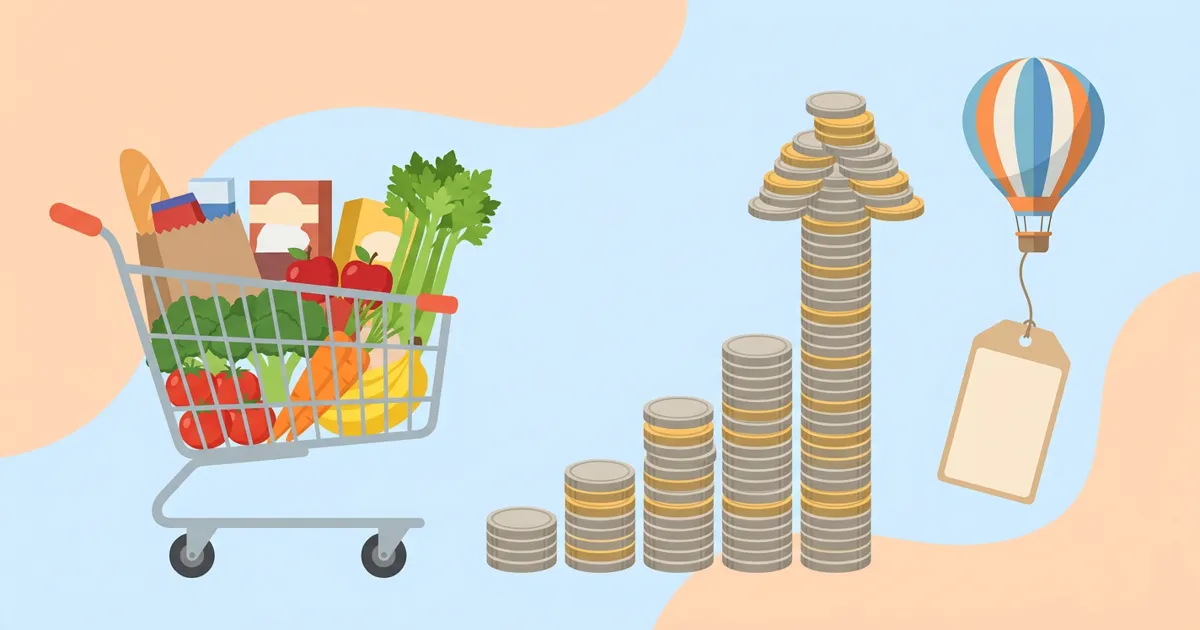
Inflation and Its Types: The Short Answer
Inflation is a sustained rise in the general price level, which reduces the purchasing power of money. By cause, it is demand-pull (too much demand chasing too few goods) or cost-push (rising input costs such as fuel or wages). By speed, it is creeping, walking, running, galloping or hyperinflation. Related terms are deflation (falling prices), disinflation (inflation slowing down), stagflation (high inflation with low growth) and reflation. In India, retail inflation is measured by the CPI with base 2024=100 (released by MoSPI on 12 February 2026), wholesale inflation by the WPI with base 2022-23 (released by DPIIT on 15 June 2026), and the RBI targets 4% CPI inflation with a band of 2%–6%.
Key takeaway for exams: The most asked points are demand-pull vs cost-push, stagflation, the difference between CPI and WPI (and who releases each), the new base years, and RBI's inflation target. Base-year facts are from PIB and MoSPI releases of 2026.
Inflation links directly to RBI policy, so read monetary policy tools of RBI, repo rate history year-wise and national income concepts too.
Types of Inflation Based on Causes
| Type | Cause | Example |
|---|---|---|
| Demand-pull inflation | Aggregate demand rises faster than supply (higher incomes, cheap credit, government spending) | Festive-season demand pushing up prices |
| Cost-push inflation | Costs of production rise (wages, raw materials, fuel, taxes) | Crude oil price rise raising transport costs |
| Built-in (wage-price spiral) | Workers demand higher wages to match prices, which raises costs again | Repeated wage hikes in a high-inflation period |
| Structural inflation | Supply bottlenecks in developing economies (poor storage, transport, farm output) | Vegetable prices jumping after a bad monsoon |
| Imported inflation | Rising prices of imported goods or a weaker rupee | Costlier imported edible oil and fertiliser |
| Profit-push inflation | Firms with market power raise margins | Price rises in concentrated industries |
Types of Inflation Based on Speed (Rate)
| Type | Approximate rate | What it means |
|---|---|---|
| Creeping (mild) inflation | Below about 3% a year | Slow, generally seen as healthy |
| Walking (trotting) inflation | About 3%–10% | Noticeable; needs watching |
| Running inflation | About 10%–20% | Hurts savings and fixed incomes |
| Galloping inflation | 20% to triple digits | Very fast price rise; loss of confidence |
| Hyperinflation | Extremely high (often 50% a month or more) | Money loses value rapidly (Germany 1923, Zimbabwe 2008) |
These ranges are textbook guides, not official definitions, so exams ask the order (creeping < walking < running < galloping < hyperinflation) more than exact numbers.
Deflation, Disinflation, Stagflation and Reflation (Difference)
| Term | Meaning |
|---|---|
| Deflation | The general price level falls (inflation is negative) |
| Disinflation | Inflation is still positive but slowing (for example, 6% → 4%) |
| Stagflation | High inflation + low growth + high unemployment together |
| Reflation | Policy action to lift prices and output after a slowdown or deflation |
| Skewflation | Inflation concentrated in a few items (for example, food) while others are stable |
| Core inflation | Headline inflation excluding food and fuel |
| Headline inflation | Inflation of the full basket, including food and fuel |
| Inflation tax | Loss of purchasing power of money held by the public |
Exam trap: Disinflation is not falling prices. Prices are still rising, only more slowly. Falling prices are deflation.
CPI vs WPI: Measures of Inflation in India (2026)
| Feature | CPI (Consumer Price Index) | WPI (Wholesale Price Index) |
|---|---|---|
| Measures | Retail prices paid by consumers | Prices at the wholesale (first bulk sale) level |
| Released by | National Statistics Office, MoSPI | Office of the Economic Adviser, DPIIT (Ministry of Commerce and Industry) |
| Current base year | 2024=100 (new series released 12 February 2026) | 2022-23 (new series released 15 June 2026) |
| Old base year | 2012=100 | 2011-12 |
| Covers services | Yes (housing, health, education, transport and more) | Goods only; separate Service PPIs now compiled |
| Used for | RBI's inflation target and monetary policy | Deflator for GDP, business contracts |
| Release | Monthly (usually the 12th) | Monthly (the 14th of the following month) |
New CPI series (2024=100) facts: item basket and weights from the Household Consumption Expenditure Survey 2023-24; 12 divisions in place of 6 groups, following COICOP 2018; markets increased from 2,295 to 2,860 (1,465 rural and 1,395 urban); new items include streaming services and rural housing (PIB, 12 February and 29 July 2026).
New WPI series (2022-23) facts: items increased from 697 to 957, and the Office of the Economic Adviser now also releases Output and Input Producer Price Indices (PPI) and Service PPIs (PIB, 2 and 15 June 2026).
RBI Inflation Target and Inflation Targeting in India
- India adopted flexible inflation targeting after the Urjit Patel Committee (2014). The RBI Act was amended in 2016 and the six-member Monetary Policy Committee (MPC) sets the repo rate.
- The target is 4% CPI inflation, with a tolerance band of 2% to 6%. The government has kept this target for the period up to 31 March 2031.
- If inflation stays outside the band for three consecutive quarters, the RBI must send a report to the government explaining why and what it will do.
- Tools to control inflation: repo rate hikes, CRR and SLR increases, open market sales of securities, and the Standing Deposit Facility to absorb liquidity. Fiscal tools include cutting government spending and adjusting taxes.
See important committees related to banking for the Urjit Patel Committee and CRR and SLR rate 2026 for the current reserve ratios.
Effects of Inflation (Who Gains and Who Loses)
| Group | Effect of unexpected inflation |
|---|---|
| Borrowers (debtors) | Gain: they repay with money worth less |
| Lenders (creditors) | Lose: the real value of repayments falls |
| Fixed-income earners (pensioners) | Lose purchasing power |
| Businesses with rising prices | Often gain in the short run |
| Savers in low-interest deposits | Lose if the deposit rate is below inflation |
| Government (as a borrower) | Gains: the real value of public debt falls |
| Exporters | Lose competitiveness if domestic prices rise faster than abroad |
Phillips curve: in the short run, lower unemployment is associated with higher inflation, and the reverse. Stagflation in the 1970s showed this trade-off can break down.
Inflation Measures Quick Revision Table
| Question | Answer |
|---|---|
| Retail inflation index | CPI (Combined), base 2024=100 |
| Wholesale inflation index | WPI, base 2022-23 |
| CPI released by | NSO, MoSPI |
| WPI released by | Office of the Economic Adviser, DPIIT |
| Inflation measure targeted by RBI | CPI (Combined) headline inflation |
| RBI target | 4% with a 2%–6% band |
| Body that sets the repo rate | Monetary Policy Committee (6 members) |
| Broadest price measure | GDP deflator |
| Inflation excluding food and fuel | Core inflation |
| Falling prices | Deflation |
Exam tip: If a question asks which index the RBI uses for inflation targeting, the answer is CPI, not WPI. India shifted from WPI to CPI as the key measure after the Urjit Patel Committee report (2014).
Common Mistakes in Inflation Questions
| Wrong | Right |
|---|---|
| Disinflation = falling prices | Disinflation = slowing inflation; falling prices = deflation |
| WPI is released by MoSPI | WPI is released by the Office of the Economic Adviser, DPIIT |
| CPI base year is 2012 | CPI base year is 2024 since February 2026 |
| WPI base year is 2011-12 | WPI base year is 2022-23 since June 2026 |
| RBI targets WPI inflation | RBI targets CPI (combined) inflation |
| Stagflation = high growth + high inflation | Stagflation = low growth + high inflation |
Inflation MCQs (with Answers)
1. Inflation caused by rising costs of raw materials and wages is called: Cost-push inflation.
2. A situation of high inflation with low growth and high unemployment is: Stagflation.
3. When the rate of inflation falls from 7% to 4%, it is called: Disinflation.
4. What is the base year of India's new CPI series? 2024=100 (released 12 February 2026).
5. Which office releases the WPI in India? Office of the Economic Adviser, DPIIT, Ministry of Commerce and Industry.
6. What is the base year of the new WPI series? 2022-23 (released 15 June 2026).
7. RBI's inflation target is: 4% CPI inflation with a band of 2%–6%.
8. Which group gains from unexpected inflation? Borrowers (debtors).
9. Core inflation excludes which items? Food and fuel.
10. Hyperinflation in Germany is associated with which year? 1923.
Inflation and Its Types FAQs
What are the main types of inflation?
By cause: demand-pull, cost-push, built-in, structural and imported inflation. By speed: creeping, walking, running, galloping and hyperinflation.
What is the difference between CPI and WPI?
CPI measures retail prices paid by consumers and includes services; it is released by MoSPI with base 2024=100. WPI measures wholesale prices of goods; it is released by DPIIT's Office of the Economic Adviser with base 2022-23.
What is the difference between deflation and disinflation?
Deflation means prices are falling. Disinflation means prices are still rising, but more slowly than before.
What is stagflation?
A mix of high inflation, slow economic growth and high unemployment, such as many economies saw in the 1970s oil shocks.
What is RBI's inflation target in 2026?
4% CPI inflation with a tolerance band of 2% to 6%, retained for the period up to 31 March 2031.
How does the RBI control inflation?
Mainly by raising the repo rate and absorbing liquidity (through the Standing Deposit Facility, open market sales and, if needed, a higher CRR), which makes credit costlier and cools demand.
Practice Next
- Mock tests: SSC CHSL General Awareness Sectional Mock Test 01, IBPS and SBI PO Banking Awareness Mock Test 02, RBI Functions and Organisation Quiz 01 and SSC CGL General Awareness Sectional Mock Test 03.
- Related notes: national income concepts, monetary policy tools of RBI, repo rate history year-wise and CRR and SLR rate 2026.
- Exam details: SSC CGL 2026 and SBI Clerk 2026 notification.
- Browse all study notes.