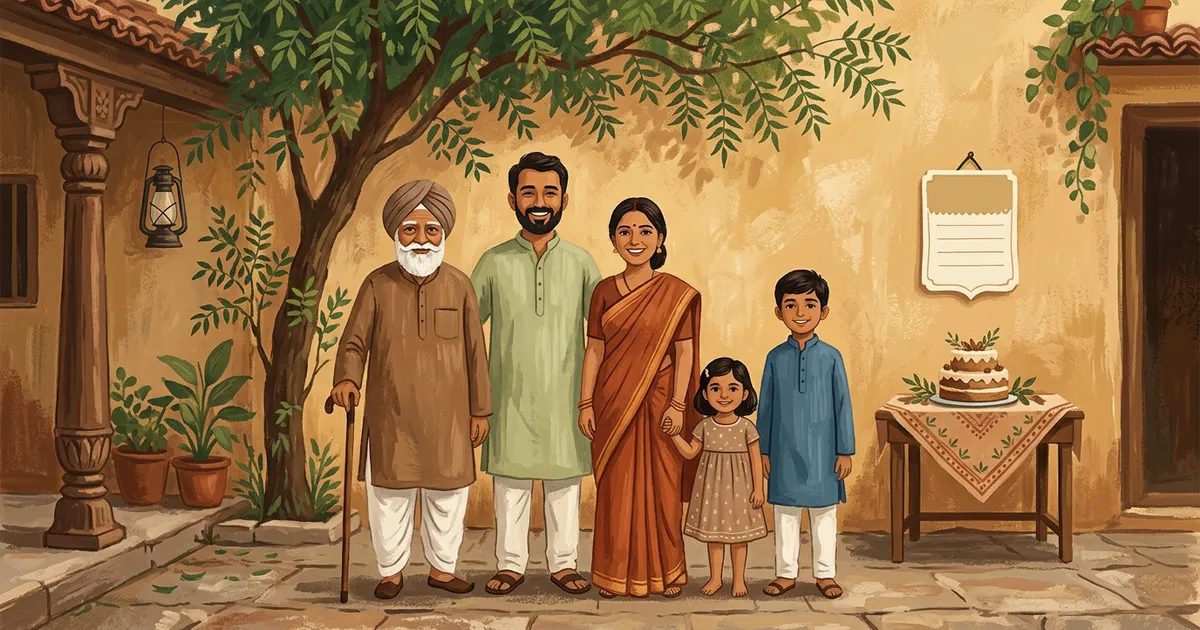
Age Problems in Bank Exams: Why They Are Easy Marks
Problems on ages appear in IBPS and SBI Clerk and PO prelims as 1 direct question or inside a quantity-comparison or data-sufficiency set. Each one is really a ratio or linear equation, and the difference between two people's ages never changes. That single fact solves most questions quickly.
Key takeaway: Write ages as 4k and 5k when a ratio is given. After t years both ages increase by t, so the ratio changes but the difference stays the same. Use a present / past / future table. When options are given, plug the options in: it is often faster than solving.
Every answer below was solved with Python (sympy). Pair this note with our quadratic equation tricks for bank exams for age questions that lead to a quadratic.
Age Problem Formulas and Rules
| Situation | How to write it |
|---|---|
| Present age x | t years ago: x − t ; after t years: x + t |
| Ratio of ages a : b | Ages = ak and bk |
| A is n times as old as B | A = nB |
| Sum of ages of a group grows | Group of n people: total increases by n·t after t years |
| Average age of n people = A | Total age = nA |
| Difference of ages | Same at every point in time |
Solved Age Questions (IBPS and SBI Pattern)
- Ratio method. Ages of A and B are in the ratio 4 : 5. After 6 years the ratio will be 5 : 6. Find their present ages. (4k + 6)/(5k + 6) = 5/6 ⇒ 24k + 36 = 25k + 30 ⇒ k = 6. Ages: A = 24, B = 30.
- Times-older. A father is 3 times as old as his son. After 15 years he will be twice as old. Son's present age? 3s + 15 = 2(s + 15) ⇒ s = 15 (father 45).
- Intervals. The sum of the ages of 5 children born at 3-year intervals is 50. Age of the youngest? x + (x + 3) + (x + 6) + (x + 9) + (x + 12) = 50 ⇒ 5x + 30 = 50 ⇒ x = 4.
- Past and present. Ten years ago A was half of B's age. Present ratio is 3 : 4. Sum of present ages? 3k − 10 = (4k − 10)/2 ⇒ k = 5. Ages 15 and 20; sum = 35.
- Fixed difference. A mother is 30 years older than her daughter. In 5 years she will be 3 times as old. Daughter's age? d + 35 = 3(d + 5) ⇒ d = 10.
- Average age replacement. The average age of 4 members is 25. A member aged 37 is replaced and the average falls to 22. Age of the new member? Total falls by 4 × 3 = 12, so new member = 37 − 12 = 25.
- When will the ratio change? Present ages are 35 and 15 (ratio 7 : 3). After how many years will the ratio be 3 : 2? 2(35 + t) = 3(15 + t) ⇒ t = 25 years.
- Average of a family over time. The average age of a family of 5 is 24 today. What was it 4 years ago (same members)? 20 (every member was 4 years younger).
Shortcuts for Age Questions
- Difference trick: if the ratio changes from a : b to c : d with the same people, make the differences equal first (scale both ratios), then the change in one term gives the years passed.
- Option check: in prelims, test the options in the first condition; usually only one fits.
- Group ageing: a group of n people ages n years in total each year, unless someone joins or leaves.
Common Mistakes in Age Problems
- Adding t to only one person when "after t years" applies to both.
- Forgetting that a ratio of ages after t years must include t in both numerator and denominator.
- Mixing "n times as old" with "n years older".
- In average-age questions, forgetting to multiply the change in average by the number of people.
Age Problems FAQs
How do you solve age problems quickly?
Write ages using a ratio constant (like 4k and 5k), add or subtract the same years for everyone, and use the fact that the difference between two ages never changes.
Are age problems asked in IBPS Clerk?
Yes, usually as one direct question or within quantity comparison and data sufficiency in prelims.
What is the trick for average age questions?
Total age = number of people × average. When someone is replaced, the change in total equals the change in average × number of people.
Practice Next
- Mock tests: IBPS Clerk Numerical Ability Sectional Mock Test 01, IBPS Clerk Numerical Ability Sectional Mock Test 02 and IBPS PO Quantitative Aptitude Sectional Mock Test 03.
- New topic tests with an ages question: IBPS Clerk Arithmetic Word Problems Test 01 and SBI Clerk Arithmetic Word Problems Test 01.
- Related notes: quadratic equation tricks for bank exams, mixture and alligation questions for bank exams, partnership questions for bank exams, simplification tricks for bank exams and data sufficiency questions for bank exams.
- Browse all study notes.