SSC MTS 2024 Question Paper 8 October Shift 1 with Answers
- Exam date
- 8 October 2024
- Shift
- Shift 19:00 AM
SSC uploaded the final answer keys with candidates' response sheets for MTS (Non-Technical) and Havaldar (CBIC & CBN) Examination 2024 (CBE held 30.09.2024 to 14.11.2024) on 26.03.2025. Each paper here is one shift's response sheet, keyed to SSC's marked answers.
Tip: attempt the paper first, then come back here to check every answer and solution.
Numerical and Mathematical Ability (Q1–20)
- Official paper: SSC Multi-Tasking (Non-Technical) Staff and Havaldar (CBIC & CBN) Examination 2024, held on 8 October 2024, Shift 1 (9:00 AM to 10:30 AM). Questions and the answer key are as on the SSC candidate response sheet (final answer keys uploaded 26.03.2025). Explanations are written by BookOfExams. Pattern (MTS 2024 notice, para 14.6): Session I = Numerical and Mathematical Ability 20 + Reasoning 20 (45 minutes, no negative marking); Session II = General Awareness 25 + English 25 (45 minutes, −1 per wrong answer); 3 marks per question.
Q1.A wooden toy is in the form of a sphere with diameter 28 cm. Find the cost of polishing its surface at the rate of 50 paise per cm². (Take π = 22/7)
- A₹1,234
- B₹1,232
- C₹1,230
- D₹1,236
Answer: (B) ₹1,232
Surface area = 4πr² = 4 × (22/7) × 14 × 14 = 2,464 cm². Cost = 2,464 × ₹0.50 = ₹1,232.
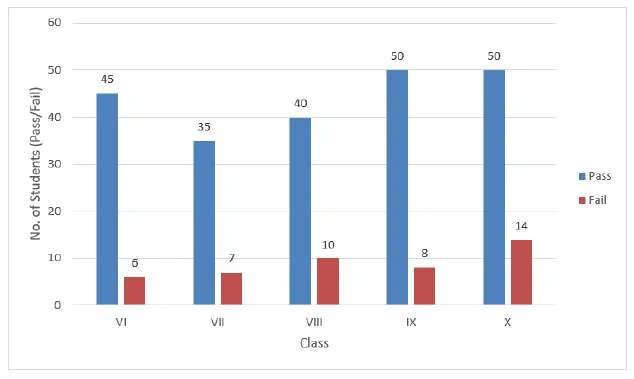
Q2.The following bar graph represents the annual result of five classes (VI to X) of a school. Study the bar graph carefully and answer the question given below: What is the average number of students in the given five classes?
- A44
- B57
- C53
- D47
Answer: (C) 53
Total students per class = pass + fail: VI 45 + 6 = 51, VII 35 + 7 = 42, VIII 40 + 10 = 50, IX 50 + 8 = 58, X 50 + 14 = 64. Sum = 265; average = 265 ÷ 5 = 53.
Q3.A thief saw a policeman and he started running at a speed of 12 m/s. After a certain time, the policeman starts running behind the thief at a speed of 18 m/s. If the policeman covered a 540 m distance to catch the thief, the time (in seconds) after which the policeman started running is:
- A12
- B10
- C15
- D18
Answer: (C) 15
The policeman runs 540 m at 18 m/s, so he runs for 30 s. In those 30 s the thief runs 12 × 30 = 360 m, so the thief was 540 − 360 = 180 m ahead. At 12 m/s that head start took 180 ÷ 12 = 15 s.
Q4.The average age of 11 players of a cricket team is increased by 2 months, when two of them aged 20 years and 21 years, respectively, are replaced by two new players. Find the average age of the two new players (in years).
- A21 5/12
- B20 1/2
- C18 5/12
- D18 1/4
Answer: (A) 21 5/12
The total age rises by 11 × 2 = 22 months = 1 year 10 months. New pair = 20 + 21 + 1 10/12 = 42 10/12 years, so their average = 21 5/12 years.
Q5.Study the table and answer the question. Height (in cm) – Number of girls Less than and equal to 110 – 15 Less than and equal to 115 – 24 Less than and equal to 120 – 31 Less than and equal to 125 – 43 Less than and equal to 130 – 54 Less than and equal to 135 – 68 The number of girls whose height is above 125 cm is
- A14
- B23
- C25
- D19
Answer: (C) 25
Girls up to 125 cm = 43 and up to 135 cm = 68 (cumulative table). Above 125 cm = 68 − 43 = 25.
Q6.The speeds of three cars are in the ratio 5 : 3 : 4. The ratio between the time taken by these cars to cover the same distance is:
- A12 : 20 : 15
- B12 : 13 : 15
- C10 : 13 : 15
- D16 : 13 : 15
Answer: (A) 12 : 20 : 15
For the same distance, time ∝ 1/speed: 1/5 : 1/3 : 1/4. Multiply by 60: 12 : 20 : 15.
Q7.A flat worth ₹9,50,000 is sold by Lakshman to Bharath at 8% profit. If Bharath sells it back to Lakshman at 3% loss, then find the gain/loss (in ₹) of Lakshman in the entire transaction?
- ALakshman gains ₹30,780
- BLakshman gains ₹50,200
- CLakshman loses ₹45,220
- DLakshman gains ₹45,220
Answer: (A) Lakshman gains ₹30,780
Lakshman sells at 9,50,000 × 1.08 = ₹10,26,000. Bharath sells back at 3% loss: 10,26,000 × 0.97 = ₹9,95,220. Lakshman received 10,26,000 and paid 9,95,220, so he gains ₹30,780.
Q8.Alfred buys an old scooter for ₹4,700 and spends ₹800 on its repairs. If he sells the scooter for ₹5,800, his gain percentage is:
- A4.5%
- B5 4/11%
- C5 5/11%
- D6 5/11%
Answer: (C) 5 5/11%
Cost = 4,700 + 800 = ₹5,500. Gain = 5,800 − 5,500 = ₹300. Gain % = 300 ÷ 5,500 × 100 = 60/11 = 5 5/11%.
Q9.Find the HCF of 70 and 90.
- A5
- B7
- C2
- D10
Answer: (D) 10
70 = 2 × 5 × 7 and 90 = 2 × 3² × 5. Common factors 2 × 5 = 10.
Q10.The average of the first six multiples of 7 is:
- A25.1
- B23.2
- C24.5
- D22.4
Answer: (C) 24.5
First six multiples: 7, 14, 21, 28, 35, 42. Sum = 147; average = 147 ÷ 6 = 24.5 (or 7 × 3.5).
Q11.Find the simple interest (in ₹) on ₹3000 as a sum borrowed at 3% per year rate of interest for 4 years.
- A400
- B320
- C360
- D300
Answer: (C) 360
SI = 3000 × 3 × 4 ÷ 100 = ₹360.
Q12.A man riding his bicycle covers 75 metres in 12.5 seconds. What is his speed (in km/hr)?
- A15.5
- B11.1
- C21.6
- D6
Answer: (C) 21.6
Speed = 75 ÷ 12.5 = 6 m/s = 6 × 18/5 = 21.6 km/h.
Q13.The average weight of a family of five members (in kg) whose weights are 40 kg, 49 kg, 56 kg, 70 kg and 39 kg is:
- A52.8
- B49.8
- C51.8
- D50.8
Answer: (D) 50.8
Sum = 40 + 49 + 56 + 70 + 39 = 254; average = 254 ÷ 5 = 50.8 kg.
Q14.The area of a rectangular field is 396 m², whose sides are in the ratio of 11 : 9. What is the perimeter of the rectangular field?
- A80 m
- B74 m
- C78 m
- D76 m
Answer: (A) 80 m
Sides 11x and 9x: 99x² = 396, so x² = 4 and x = 2. Sides 22 m and 18 m; perimeter = 2 × (22 + 18) = 80 m.
Q15.There is a 21 litres mixture of milk and water. The ratio of milk and water in the mixture is 4 : 3. Find the amount of water (in litres) that should be added to this mixture so that the resulting mixture has 50% of water in it.
- A3
- B2
- C1
- D4
Answer: (A) 3
Milk = 21 × 4/7 = 12 L, water = 9 L. For 50% water, water must equal milk = 12 L, so add 12 − 9 = 3 L.
Q16.Rakesh rented out an amount to Samarth for 6 years at simple interest rate. At the end of the 6th year, Samarth paid 8/7 of the amount to Rakesh to clear out the amount. The rate of simple interest per annum was:
- A2 8/21%
- B2 7/21%
- C2 3/20%
- D2 1/12%
Answer: (A) 2 8/21%
Let the principal be P. Amount after 6 years = 8P/7, so SI = 8P/7 − P = P/7. SI = P × R × 6/100, so 6R/100 = 1/7 and R = 100/42 = 50/21 = 2 8/21% per annum.
Q17.The price of a computer increases by 10% in the first year, decreases by 5% in the second year, and increases by 8% in the third year. If the original price was ₹50,000, then the final price (in₹) is:
- A54,120
- B55,830
- C56,430
- D55,100
Answer: (C) 56,430
Final price = 50,000 × 1.10 × 0.95 × 1.08 = ₹56,430.
Q18.If two successive discounts of 25% and 15%, respectively, are given, then what will be the net discount percentage?
- A36.15%
- B36.10%
- C36.20%
- D36.25%
Answer: (D) 36.25%
Net effect of successive discounts a% and b% = a + b − ab/100 = 25 + 15 − (25 × 15)/100 = 40 − 3.75 = 36.25%. Check: ₹100 → ₹75 → 75 × 0.85 = ₹63.75, a discount of 36.25%.
Q19.A hemispherical bowl of internal radius 15 cm contains a liquid. The liquid is to be filled into cylindrical shaped bottles of diameter 5 cm and height 6 cm. The number of bottles required to empty the bowl is:
- A60
- B50
- C40
- D30
Answer: (A) 60
Bowl volume = (2/3)π × 15³ = 2,250π cm³. One bottle = π × 2.5² × 6 = 37.5π cm³. Bottles = 2,250 ÷ 37.5 = 60.
Q20.Find the simple interest (in ₹) on ₹2500 as a sum borrowed at 3% per year rate of interest for 6 years.
- A390
- B490
- C410
- D450
Answer: (D) 450
SI = 2500 × 3 × 6 ÷ 100 = ₹450.
Reasoning Ability and Problem Solving (Q21–40)
Q21.What should come in place of the question mark (?) in the given series? 7 12 16 30 34 66 70 ?
- A142
- B140
- C138
- D136
Answer: (C) 138
The steps alternate ×2 − 2 and +4: 7 × 2 − 2 = 12, 12 + 4 = 16, 16 × 2 − 2 = 30, 30 + 4 = 34, 34 × 2 − 2 = 66, 66 + 4 = 70, so the next term is 70 × 2 − 2 = 138.
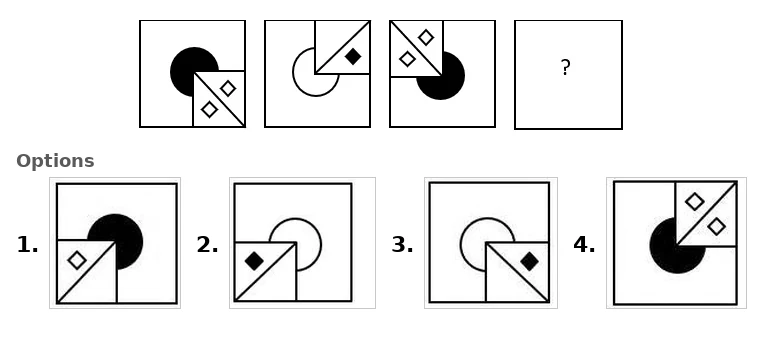
Q22.Identify the figure given in the options that when put in place of the question mark (?) will logically complete the series.
- AFigure 1
- BFigure 2
- CFigure 3
- DFigure 4
Answer: (B) Figure 2
The small square with the diagonal moves one corner anticlockwise each step (bottom-right → top-right → top-left), so it goes to the bottom-left next, with its diagonal alternating as in figures 1 and 2. The circle alternates black and white, and the square alternately holds two hollow diamonds and one black diamond. Figure 4 therefore needs a white circle and a bottom-left square with one black diamond: option 2.
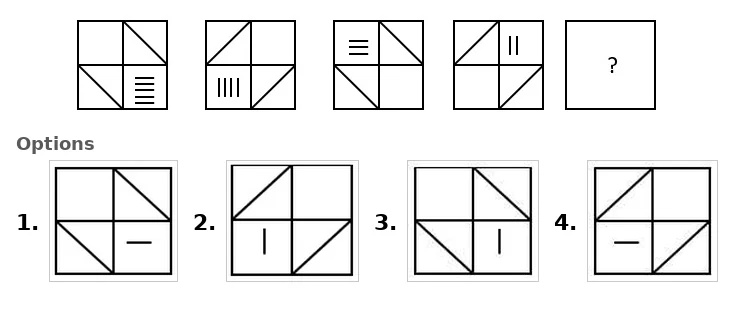
Q23.Select the figure from the options that can replace the question mark (?) and logically complete the series.
- AFigure 1
- BFigure 2
- CFigure 3
- DFigure 4
Answer: (A) Figure 1
The group of parallel lines moves one cell clockwise each step (bottom-right → bottom-left → top-left → top-right) and loses one line each time (5, 4, 3, 2), switching between horizontal and vertical. Next it is 1 horizontal line in the bottom-right cell. The diagonals in figures 1, 3 and 5 are the same (top-right and bottom-left cells). Option 1 matches.
Q24.In a certain code language, ‘WORD’ is coded as ‘7135’ and ‘RISE’ is coded as ‘4658’. What is the code for ‘R’ in the given code language?
- A5
- B6
- C4
- D3
Answer: (A) 5
WORD = 7135 and RISE = 4658. The only common letter is R and the only common digit is 5, so R = 5.
Q25.What should come in place of the question mark (?) in the given series based on the English alphabetical order? BXL, DVN, FTP, ?, JPT
- AGRS
- BHRR
- CGRR
- DHST
Answer: (B) HRR
First letters B, D, F, H, J (+2); second X, V, T, R, P (−2); third L, N, P, R, T (+2). Missing term: HRR.
Q26.A, B, C, D, E, F and G are sitting around a circular table facing the centre (but not necessarily in the same order). Only 3 people are sitting between E and A when counted from the right of E. B is sitting 2nd to the left of A. G is sitting to the immediate left of F. Only 2 people are sitting between B and G when counted from the right of B. C is the immediate neighbour of E. What is the position of D with respect to E?
- A3rd from the right
- B2nd from the right
- C3rd from the left
- D2nd from the left
Answer: (A) 3rd from the right
Seating (facing the centre): A is 4th to the right of E, B is 2nd to the left of A, G is 3rd to the right of B, F is immediately right of G and C sits next to E. The only arrangement left puts D 3rd to the right of E.
Q27.EF26 is related to JK33 in a certain way. In the same way, TU27 is related to YZ34. To which of the following is JK28 related, following the same logic?
- AOP35
- BPO35
- CPO36
- DOP36
Answer: (A) OP35
Letters +5 (E→J, F→K; T→Y, U→Z) and the number +7 (26→33, 27→34). JK28 → OP35.
Q28.Which two numbers should be interchanged to make the following equation correct? (28 × 2) −16 × 6 + 8 × 3 + 5 × 7 = 39 (Note: Interchange should be done of the entire number and not individual digits of a given number.)
- A2 and 3
- B6 and 7
- C8 and 7
- D5 and 3
Answer: (A) 2 and 3
Swap 2 and 3: (28 × 3) − 16 × 6 + 8 × 2 + 5 × 7 = 84 − 96 + 16 + 35 = 39.
Q29.Read the given statement(s) and conclusions carefully. Assuming that the information given in the statement(s) is true, even if it appears to be at variance with commonly known facts, decide which of the given conclusions logically follow(s) from the statement(s). Statements: All pumpkin is mutton. All mutton are fishes. Conclusions: (I) Some fishes are mutton. (II) All pumpkins are fishes.
- ANeither conclusion (I) nor (II) follows.
- BBoth conclusions (I) and (II) follow.
- COnly conclusion (I) follows.
- DOnly conclusion (II) follows.
Answer: (B) Both conclusions (I) and (II) follow.
All pumpkins are mutton and all mutton are fishes, so all pumpkins are fishes (II follows). “All mutton are fishes” also gives “Some fishes are mutton” (I follows). Both follow.
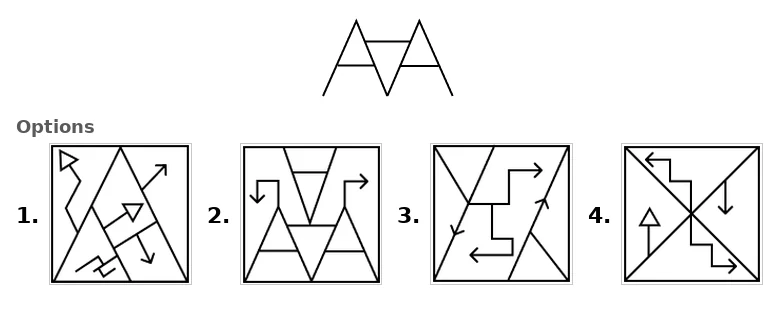
Q30.Select the option figure in which the given figure is embedded as its part (rotation is NOT allowed).
- AFigure 1
- BFigure 2
- CFigure 3
- DFigure 4
Answer: (B) Figure 2
The given figure is two triangles joined by a short horizontal bar (like two letter As side by side). Option 2 contains exactly this shape, upright and unrotated, along its bottom edge.
Q31.3 is related to 15 following a certain logic. Following the same logic, 12 is related to 60. To which of the following is 5 related to, following the same logic? (Note: Operations should be performed on the whole numbers, without breaking down the numbers into its constituent digits. E.g. 13 - Operations on 13 such as adding /subtracting /multiplying etc. to 13 can be performed. Breaking down 13 into 1 and 3 and then performing mathematical operations on 1 and 3 is not allowed.)
- A25
- B32
- C30
- D35
Answer: (A) 25
15 = 3 × 5 and 60 = 12 × 5, so 5 → 5 × 5 = 25.
Q32.In a certain code language, ‘BENT’ is coded as ‘4628’ and ‘EARS’ is coded as ‘5471’.What is the code for ‘E’ in the given code language?
- A6
- B4
- C7
- D5
Answer: (B) 4
BENT = 4628 and EARS = 5471. The only common letter is E and the only common digit is 4, so E = 4.
Q33.In a certain code language, ‘I play football’ is coded as ‘ku ch ta’ and ‘he play cricket’ is coded as ‘al bi ta’. How is ‘play’ coded in the given language?
- Abi
- Bta
- Cku
- Dal
Answer: (B) ta
“play” appears in both sentences and the only common code word is “ta”.
Q34.Seven people S, E, C, T, I, O and N are sitting around a circular table, facing the centre(but not necessarily in the same order). E is sitting second to the left of N, while N is sitting second to the left of S. Only one person is sitting between S and O when counted from the right of S. C is sitting to the immediate right of E, whereas T is sitting to the immediate left of O. Who is sitting to the immediate right of I?
- AT
- BS
- CC
- DO
Answer: (B) S
Facing the centre: N is 2nd to the left of S and E is 2nd to the left of N; O is 2nd to the right of S, T is immediately left of O and C is immediately right of E. This leaves one arrangement, in which S sits immediately to the right of I.
Q35.What will come in the place of ‘?’ in the following equation, if ‘×’ and ‘ ÷ ‘ are interchanged and ‘–’ and ‘+’ are interchanged? 23 ÷ 18 + 150 × 50 – 44 = ?
- A485
- B515
- C455
- D545
Answer: (C) 455
After the swaps: 23 × 18 − 150 ÷ 50 + 44 = 414 − 3 + 44 = 455.
Q36.14 is related to 68 following a certain logic. Following the same logic, 17 is related to 83. To which of the following is 21 related, following the same logic? (NOTE: Operations should be performed on the whole numbers, without breaking down the numbers into their constituent digits. E.g. 13 – Operations on 13 such as adding/subtracting/multiplying to 13 can be performed. Breaking down 13 into 1 and 3 and then performing mathematical operations on 1 and 3 is not allowed.)
- A107
- B101
- C105
- D103
Answer: (D) 103
14 × 5 − 2 = 68 and 17 × 5 − 2 = 83, so 21 × 5 − 2 = 103.
Q37.Read the given statements and conclusions carefully. Assuming that the information given in the statements is true, even if it appears to be at variance with commonly known facts, decide which of the given conclusions logically follow(s) from the statements. Statements: Some plants are rocks. No vegetable is a plant. Conclusions: (I) No vegetable is a rock. (II) Some rocks are plants.
- ABoth conclusions (I) and (II) follow
- BOnly conclusion (II) follows
- COnly conclusion (I) follows
- DNeither conclusion (I) nor (II) follows
Answer: (B) Only conclusion (II) follows
Some plants are rocks, so some rocks are plants (II follows). Vegetables are kept away from plants only; they may or may not be rocks, so I does not follow. Only II follows.
Q38.In a certain code language, ‘LIKE’ is coded as ‘1576’ and ‘LINK’ is coded as ‘6581’. What is the code for ‘E’ in the given code language?
- A1
- B6
- C5
- D7
Answer: (D) 7
LIKE = 1576 and LINK = 6581. L, I and K are common, and so are the digits 1, 5 and 6. The letter left in LIKE is E and the digit left in 1576 is 7, so E = 7 (and N = 8).
Q39.JT79 is related to DN71 in a certain way. In the same way, KU22 is related to EO14. To which of the following is LV71 related, following the same logic?
- APF63
- BPF66
- CFP66
- DFP63
Answer: (D) FP63
Letters −6 (J→D, T→N; K→E, U→O) and the number −8 (79→71, 22→14). LV71 → FP63.
Q40.Select the correct mirror image of the given figure when the mirror is placed at MN as shown below.
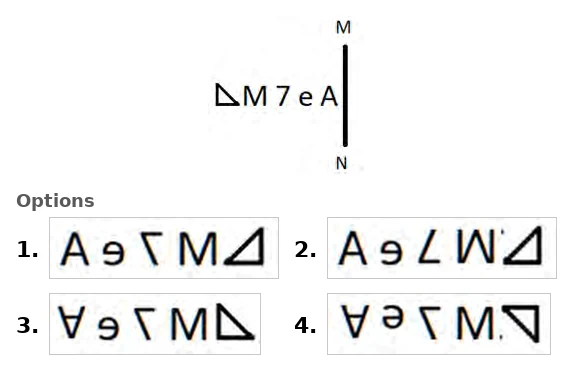
- AFigure 1
- BFigure 2
- CFigure 3
- DFigure 4
Answer: (A) Figure 1
With the mirror MN on the right, the order of the characters reverses (A e 7 M triangle) and each one is flipped left to right: A stays A, e and 7 appear reversed, and the right-angled triangle turns to have its right angle on the other side. Nothing is turned upside down. Option 1 shows this.
General Awareness (Q41–65)
Q41.The liquid water present in oceans, lakes and rivers gets converted to the gaseous form in the presence of sunlight in the water cycle. This step is called:
- APrecipitation
- BEvaporation
- CCondensation
- DMelting
Answer: (B) Evaporation
Evaporation turns liquid water into water vapour using the sun's heat.
Q42.Which of the following statements about nutrients are correct? Statement A: C, H, O, N, P and K are macro nutrients. Statement B: Fe, Mn, Ni, Co and Mo are micronutrients. Statement C: Micronutrients are not essential for our body.
- AOnly statements B and C
- BOnly statements A and C
- CAll statements A, B and C
- DOnly statements A and B
Answer: (D) Only statements A and B
C, H, O, N, P and K are macronutrients and Fe, Mn, Ni, Co and Mo are micronutrients, so A and B are correct. Micronutrients are needed in small amounts but are still essential, so C is wrong.
Q43.What is the usual treatment on repo rates by the Reserve Bank of India in case of a hawkish monetary policy stance?
- AIncreased
- BReduced gradually
- CKept the same
- DReduced sharply by more than 100 bps
Answer: (A) Increased
A hawkish stance aims to control inflation, so the RBI raises (or is ready to raise) the repo rate.
Q44.Who is revered as ‘Karnataka Sangeeta Pitamaha’?
- AGopala Dasa
- BJagannatha Dasa
- CPurandara Dasa
- DVijaya Dasa
Answer: (C) Purandara Dasa
Purandara Dasa (15th–16th century) is called the Karnataka Sangeeta Pitamaha, the father of Carnatic music.
Q45.In cycling, what is a 'peloton'?
- AA cycling technique for climbing hills
- BThe finish line of a race
- CThe starting line of a race
- DA group of riders in a tight pack during a race
Answer: (D) A group of riders in a tight pack during a race
The peloton is the main group of riders bunched together in a road race.
Q46.As per Census of India 2011, which of the following states has the highest percentage of Hindu population in India?
- AUttar Pradesh
- BMadhya Pradesh
- CHimachal Pradesh
- DBihar
Answer: (C) Himachal Pradesh
Census 2011: Himachal Pradesh has the highest share of Hindus, about 95%.
Q47.Which of the following articles of the Constitution of India mentions that every Minister and the Attorney-General of India shall have the right to speak in and participate in the proceedings of either House of Parliament?
- AArticle 88
- BArticle 87
- CArticle 86
- DArticle 89
Answer: (A) Article 88
Article 88: every Minister and the Attorney-General may speak in and take part in the proceedings of either House, but cannot vote there by virtue of this article.
Q48.Below are two chemical equations: Zn (s) + CuSO4 (aq) → ZnSO4 (aq) + Cu (s) Pb (s) + CuCl2 (aq) → PbCl2 (aq) + Cu (s) Why does copper get separated from its compound form in both the cases?
- ACopper compounds break down under high pressure.
- BCopper is more reactive than Zinc and Lead.
- CZinc and Lead are unstable in element form.
- DZinc and Lead are more reactive than Copper.
Answer: (D) Zinc and Lead are more reactive than Copper.
Zinc and lead are more reactive than copper, so they displace copper from its salts (displacement reaction).
Q49.Who among the following is/was a famous proponent of Bharatanatyam?
- ASunanda Nair
- BKalavati Devi
- CRukmini Devi Arundale
- DKumkum Mohanty
Answer: (C) Rukmini Devi Arundale
Rukmini Devi Arundale revived Bharatanatyam and founded Kalakshetra (1936).
Q50.As of July 2023, 137 unique products under 'One District, One Product' scheme has been notified from how many districts?
- A538
- B256
- C713
- D657
Answer: (C) 713
The Ministry of Food Processing Industries notified 137 unique products from 713 districts as ODOP (PIB, 25 July 2023).
Q51.What is the height of the Kanchenjunga peak of Himalaya?
- A8434 metres
- B8798 metres
- C8598 metres
- D8175 metres
Answer: (C) 8598 metres
NCERT lists Kanchenjunga at 8,598 m (other surveys give 8,586 m); SSC keyed 8,598 m.
Q52.Who among the following was India's first cricket team captain?
- ASunil Gavaskar
- BK Srikant
- CNavab Pataudi
- DCK Nayudu
Answer: (D) CK Nayudu
C. K. Nayudu captained India in its first Test match, at Lord's in 1932.
Q53.Swachh Bharat Mission was launched on the birth anniversary of which of the following freedom fighters?
- ASubhash Chandra Bose
- BChandrashekhar Azad
- CBhagat Singh
- DMahatma Gandhi
Answer: (D) Mahatma Gandhi
Swachh Bharat Mission was launched on 2 October 2014, Mahatma Gandhi's birth anniversary.
Q54.Who were the first foreign rulers of northwest India in the post-Mauryan period?
- AKushanas
- BBactrian Greeks
- CSakas
- DParthians
Answer: (B) Bactrian Greeks
After the Mauryas, the Indo-Greeks (Bactrian Greeks) were the first foreign rulers of north-west India, followed by the Sakas, Parthians and Kushanas.
Q55.Bharatanatyam Guru ________ received the Nrithya Seva Ratna award from Indian Fine Arts Akademi, San Diego in 2023.
- ARatikant Mohaptra
- BVidhya Subramanian
- CSailaja
- DHema Rajagopalan
Answer: (D) Hema Rajagopalan
Hema Rajagopalan received the Nrithya Seva Ratna from the Indian Fine Arts Academy of San Diego on 1 April 2023 (Narthaki, highlights 2023).
Q56.As of 2023, what is the number of major public seaports in India?
- A16
- B10
- C12
- D13
Answer: (C) 12
India had 12 major ports in 2023 (Vadhavan was approved as the 13th in 2024).
Q57.Which of the following cell organelles possesses their own DNA and can synthesise protein for their functions?
- AGolgi complex
- BEndoplasmic reticulum
- CCentrosome
- DChloroplast
Answer: (D) Chloroplast
Chloroplasts (like mitochondria) have their own DNA and ribosomes and make some of their own proteins.
Q58.Which author wrote the Hindi novel 'Tamas'?
- ABhisham Sahani
- BYashpal
- CShrilal Shukla
- DPremchand
Answer: (A) Bhisham Sahani
“Tamas” (1974) is by Bhisham Sahni; it won the Sahitya Akademi Award.
Q59.'Promotion of educational and economic interests of Scheduled Castes, Scheduled Tribes and other weaker sections' comes under which Article of Indian constitution?
- AArticle 56
- BArticle 36
- CArticle 46
- DArticle 66
Answer: (C) Article 46
Article 46 (a Directive Principle) asks the State to promote the educational and economic interests of SCs, STs and other weaker sections.
Q60.The training academy for Indian Police Service officers has been named after:
- AJawaharlal Nehru
- BLal Bahadur Shastri
- CSardar Vallabhbhai Patel
- DMahatma Gandhi
Answer: (C) Sardar Vallabhbhai Patel
The Sardar Vallabhbhai Patel National Police Academy in Hyderabad trains IPS officers.
Q61.Which social reformer from South India founded the Self Respect Movement?
- AC Iyodhee Pandithar
- BKandukur Veeresalingam
- CChembeti Sridharalu Naidu
- DEV Ramaswamy Naicker
Answer: (D) EV Ramaswamy Naicker
E. V. Ramasamy (Periyar) started the Self-Respect Movement in 1925.
Q62.In the Great Stupa at Sanchi there are ________ gateways known as ‘Toranas’ at the cardinal points to the compass.
- A4
- B2
- C8
- D6
Answer: (A) 4
The Great Stupa at Sanchi has four toranas facing north, south, east and west.
Q63.In which of the following years was the Census Act enacted and extended to the whole of India?
- A1949
- B1951
- C1948
- D1950
Answer: (C) 1948
The Census Act was passed in 1948 and applies to the whole of India.
Q64.The campaign 'Ek Tareekh, Ek Ghanta, Ek Sath' is associated with which occasion?
- AVivekananda Jayanti
- BSardar Patel Jayanti
- CGandhi Jayanti
- DAmbedkar Jayanti
Answer: (C) Gandhi Jayanti
“Ek Tareekh, Ek Ghanta, Ek Saath” was a one-hour Swachhata Hi Seva cleanliness drive on 1 October 2023, on the eve of Gandhi Jayanti.
Q65.Who among the following has written ‘Gita Govinda’, a Sanskrit epic?
- AKalhan
- BUdayaraja
- CJayadeva
- DRamachandra
Answer: (C) Jayadeva
Jayadeva (12th century) wrote the Gita Govinda.
English Language and Comprehension (Q66–90)
Q66.Select the most appropriate ANTONYM of the given word. Bulging
- ASwelling
- BHanging
- CWeeping
- DContracting
Answer: (D) Contracting
Bulging means swelling outward; the opposite is contracting.
Q67.Select the most appropriate option to fill in the blank. Never ________ ever seen a more disgusting sight.
- Ahave I
- Bhas I
- Cdid I
- DI have
Answer: (A) have I
A negative adverb at the start (“Never”) needs inversion: “Never have I ever seen…”.
Q68.Select the most appropriate option to fill in the blank. Roger applied the __________ in advance as he anticipated an accident.
- Abreak
- Bbroke
- Cbrig
- Dbrake
Answer: (D) brake
You apply the “brake” (stopping device) to a vehicle; “break” is a different word.
Q69.Select the most appropriate synonym of the given word. Blend
- ADisperse
- BBoil
- CDivide
- DMix
Answer: (D) Mix
Blend means to mix things together.
Q70.The sentence below contains errors. Select the option with the correct use of tenses. Your father will waiting for you when you reach home.
- AYour father would waiting for you when you reach home.
- BYour father waiting for you when you reach home.
- CYour father will be waiting for you when you reach home.
- DYour father should waiting for you when you reach home.
Answer: (C) Your father will be waiting for you when you reach home.
Future continuous: will + be + -ing: “Your father will be waiting for you…”.
Q71.Select the most appropriate option to fill in the blank. She was barking up the wrong _______ when she filed a complaint against ragging with the students' union instead of the university administration.
- Adisc
- Bdog
- Cpillar
- Dtree
Answer: (D) tree
“Barking up the wrong tree” means pursuing the wrong course or person.
Q72.Select the most appropriate synonym of the word in bold in the given sentence. The future looks “bleak” for the fishing industry. (The word in bold on the official sheet is shown in quotes.)
- AAmple
- BExpensive
- CFearless
- DDepressing
Answer: (D) Depressing
Bleak means gloomy and without hope; the closest is depressing.
Q73.In the following sentence the underlined part contains as error. Alternatives to the underlined part are given as options. Select the correct alternative. The sky appeared to be “greyest” after the storm. (The underlined part on the official sheet is shown in quotes.)
- Amore grey
- Bgrey
- Cmost grey
- Dgreyer
Answer: (B) grey
With “appeared to be” and no comparison, the plain adjective is needed: “grey”.
Q74.Select the most appropriate option to fill in the blank. Living within our environmental limits is one of the central ______ of sustainable development.
- Aprinciples
- Billuminates
- Cagencies
- Ddemonstrates
Answer: (A) principles
“Central principles of sustainable development”: principles fits the plural noun slot.
Q75.Select the INCORRECTLY spelt word.
- AGracious
- BSpectaculor
- CEnthusiastic
- DReliable
Answer: (B) Spectaculor
The correct spelling is “Spectacular”.
Q76.Select the most appropriate idiom/phrase to fill in the blank. My car _______ on the way to college yesterday.
- Abroke out
- Bbroke in
- Cbroke down
- Dbroke up
Answer: (C) broke down
“Broke down” means stopped working (a car).
Q77.Select the most appropriate option that can substitute the underlined segment in the given sentence. Good nutrition is the “bedrock at child survival”, health and development. (The underlined part on the official sheet is shown in quotes.)
- Abedrock through child survival
- Bbedrock off child survival
- Cbedrock from child survival
- Dbedrock of child survival
Answer: (D) bedrock of child survival
“The bedrock of” something means its foundation.
Q78.Select the appropriate option that can substitute the underlined word in the following sentence to make it grammatically correct. This almirah is made up of “heavier” metal. (The underlined part on the official sheet is shown in quotes.)
- Aheaviest
- Bmost heaviest
- Cheavy
- Dmost heavier
Answer: (C) heavy
No comparison is made, so the positive degree “heavy” is right.
Q79.The following sentence has been split into four segments. Identify the segment that contains an error in phrasal verb. Tara was late for the meeting / but somehow managed / to catch out with / everything she had missed.
- Aeverything she had missed
- BTara was late for the meeting
- Cto catch out with
- Dbut somehow managed
Answer: (C) to catch out with
The phrasal verb is “catch up with” (get up to date), not “catch out with”.
Q80.Select the most appropriate word from the given options that can substitute the word ‘courage’ and make a meaningful sentence. I am not courage enough to take this risk.
- Adiscouraging
- Bdiscourage
- Ccourageous
- Dencourage
Answer: (C) courageous
“am not courageous enough”: an adjective is needed after “am not”.
Q81.Select the option that will improve the underlined part of the given sentence. In case no improvement is needed, select 'No improvement required'. Monika said to her mother that, “I have passed the examination.” (Underlined on the official sheet: Monika said to her mother that, “I have passed)
- AMonika said to her mother, “I have passed
- BMonika said to her mother that, “I am passed
- CNo improvement required
- DMonika said to her mother that, “she has passed
Answer: (A) Monika said to her mother, “I have passed
With direct speech, “that” is dropped: Monika said to her mother, “I have passed the examination.”
Q82.Select the INCORRECTLY spelt word.
- AGourrmet
- BEligible
- CPoignant
- DRelevant
Answer: (A) Gourrmet
The correct spelling is “Gourmet”.
Q83.In the following sentence the underlined part contains as error. Alternatives to the underlined part are given as options. Select the correct alternative. Playing in the field, the young “gayer” students were laughing and giggling. (The underlined part on the official sheet is shown in quotes.)
- Amost gay
- Bgay
- Cgayest
- Dmore gay
Answer: (B) gay
No comparison is made, so the positive “gay” (cheerful) is right.
Q84.Select the most appropriate ANTONYM of the underlined word in the given sentence. I don't prefer to remain alone at home in the evenings because loneliness evokes a sense of “melancholy” and grief within me. (The underlined part on the official sheet is shown in quotes.)
- ACheerfulness
- BReadiness
- CShyness
- DAbsoluteness
Answer: (A) Cheerfulness
Melancholy means deep sadness; the opposite is cheerfulness.
Q85.Select the INCORRECTLY spelt word in the given sentence. Uluru is the world's largest monolith and Australia's recognisable natural icon with an elliptical shape and a circumfarence of around 94 kilometers.
- AMonolith
- BKilometers
- CElliptical
- DCircumfarence
Answer: (D) Circumfarence
The correct spelling is “Circumference”.
- In the following passage, some words have been deleted. Read the passage carefully and select the most appropriate option to fill in each blank. Traditional medicines (TMs) make (1) ______ natural products and are of great importance. Such forms of medicine as traditional Chinese medicine (TCM), Ayurveda, Kampo, traditional Korean medicine (TKM), and Unani (2) ______ natural products and have been (3) ______ all over the world for hundreds or even thousands of years, and they (4) ______ blossomed into orderly-regulated systems of medicine. In their various forms, they may have certain defects, but they (5) ______ still a valuable repository of human knowledge.
Q86.Select the most appropriate option to fill in blank number 1.
- Aused of
- Buses of
- Cused off
- Duse of
Answer: (D) use of
“Make use of natural products”: the noun phrase “use of”.
Q87.Select the most appropriate option to fill in blank number 2.
- Aemploys
- Bemploying
- Cemployed
- Demploy
Answer: (D) employ
Plural subject (TCM, Ayurveda, Kampo, TKM and Unani) takes “employ”.
Q88.Select the most appropriate option to fill in blank number 3.
- Apractises
- Bpractised
- Cpractice
- Dpractices
Answer: (B) practised
“have been practised all over the world”: past participle after “have been”.
Q89.Select the most appropriate option to fill in blank number 4.
- Ahad
- Bhave
- Chas
- Dhave being
Answer: (B) have
“they have blossomed”: present perfect with plural “they”.
Q90.Select the most appropriate option to fill in blank number 5.
- Aam
- Bwas
- Cis
- Dare
Answer: (D) are
Plural “they” takes “are”: they are still a valuable repository.
Practise this paper under exam conditions
90 questions, 90-minute timer, negative marking and a score report.
Attempt online