SSC GD 2025 Question Paper 7 February Shift 1 with Answers
- Exam date
- 7 February 2025
- Shift
- Shift 19:00 AM
SSC uploaded the final answer keys with question paper cum response sheets for Constable (GD) 2025 (CBE held 04.02.2025 to 25.02.2025) on 26.06.2025. Each paper here is one shift's sheet, keyed to SSC's marked answers.
Tip: attempt the paper first, then come back here to check every answer and solution.
General Intelligence and Reasoning (Q1–20)
- Official paper: SSC Constable (GD) Examination 2025, held on 7 February 2025, Shift 1 (9:00 AM to 10:00 AM). Questions and the answer key are as on SSC’s question paper cum response sheet released with the final answer keys (notice dated 26.06.2025). This is the English-medium paper: Parts A to C and Part D English (candidates choose English or Hindi for Part D). Explanations are written by BookOfExams. Pattern (SSC GD 2025 notice, para 12.1): 80 questions, 2 marks each, 60 minutes; −0.25 for a wrong answer.
Q1.In a certain code language, 'A + B' means ‘A is the mother of B’, 'A – B' means ‘A is the brother of B’, 'A × B' means ‘A is the wife of B’ and 'A ÷ B' means ‘A is the father of B’. Based on the above, how is M related to O if ‘K ÷ L × M – N + O’?
- AWife’s father
- BMother’s brother
- CMother’s husband
- DDaughter’s husband
Answer: (B) Mother’s brother
K ÷ L: K is the father of L. L × M: L is the wife of M. M – N: M is the brother of N. N + O: N is the mother of O. So M is the brother of O's mother, i.e. O's mother's brother.
Q2.ILOR is related to UXAD in a certain way based on the English alphabetical order. In the same way, CFIL is related to ORUX. To which of the given options is WZCF related, following the same logic?
- AILOR
- BILUY
- CILMK
- DILWR
Answer: (A) ILOR
Each letter moves 12 places forward: I→U, L→X, O→A, R→D; C→O, F→R, I→U, L→X. Apply +12 to WZCF: W→I, Z→L, C→O, F→R, giving ILOR.
Q3.The position(s) of how many letters will remain unchanged if each of the letters in the word ARMCHAIR is arranged in the reverse English alphabetical order?
- AThree
- BFour
- CTwo
- DOne
Answer: (A) Three
ARMCHAIR in reverse alphabetical order is R R M I H C A A. Comparing position by position with A R M C H A I R, the letters in positions 2 (R), 3 (M) and 5 (H) stay the same: three letters.
Q4.JILT is related to AZCK in a certain way based on the English alphabetical order. In the same way, ZYBJ is related to QPSA. To which of the following options is YXAI related, following the same logic?
- APOZR
- BPRZO
- CPORZ
- DPRDE
Answer: (C) PORZ
Each letter moves 17 places forward (or 9 back): J→A, I→Z, L→C, T→K and Z→Q, Y→P, B→S, J→A. So Y→P, X→O, A→R, I→Z: PORZ.
Q5.In a certain code language, ‘AGED’ is coded as ‘7613’ and ‘EARG’ is coded as '1236’. What is the code for ‘R’ in the given code language?
- A1
- B6
- C3
- D2
Answer: (D) 2
AGED = 7613 and EARG = 1236 share A, E and G, so these letters take the shared digits 1, 3 and 6. D is the only other letter of AGED, so D = 7; R is the only other letter of EARG, so R = 2.
Q6.Select the figure from among the given options that can replace the question mark (?) in the following series.
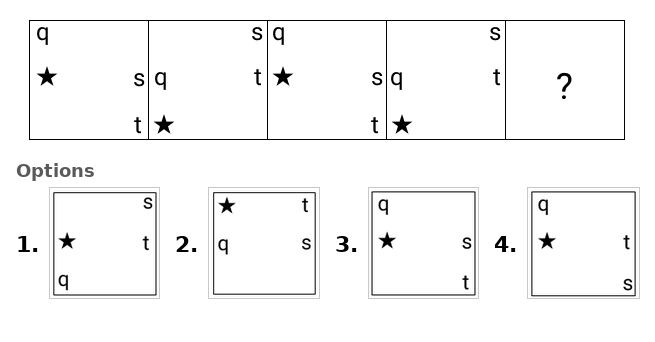
- AFigure 1
- BFigure 2
- CFigure 3
- DFigure 4
Answer: (C) Figure 3
The figures alternate between two arrangements. Figures 1 and 3 are the same (q top left, star middle left, s middle right, t bottom right) and figures 2 and 4 are the same. So the fifth figure repeats figure 1, which is option 3.
Q7.Which two numbers should be interchanged to make the given equation correct? 9 × (34 – 15) + (105 ÷ 7) + 28 + (13 × 4) = 218 (Note: Interchange should be done of entire number and not individual digits of a given number)
- A28 and 15
- B15 and 13
- C34 and 28
- D15 and 7
Answer: (C) 34 and 28
As printed, 9 × 19 + 15 + 28 + 52 = 266. Interchanging 34 and 28 gives 9 × (28 − 15) + 15 + 34 + 52 = 117 + 15 + 34 + 52 = 218. No other listed swap gives 218.
Q8.Select the option that represents the letters that, when sequentially placed from left to right in the blanks below, will complete the letter series. _ D _ L _ F _ O L J
- AFOJD
- BDJOF
- CJDOF
- DOJDF
Answer: (A) FOJD
Filling F, O, J, D gives F D O L J | F D O L J: the block FDOLJ repeats.
Q9.What should come in place of the question mark (?) in the given series? 1001 1000 998 995 991 ?
- A986
- B984
- C987
- D989
Answer: (A) 986
The differences are −1, −2, −3, −4, so the next is −5: 991 − 5 = 986.
Q10.What should come in place of the question mark (?) in the given series? 620 621 624 629 636 ?
- A643
- B645
- C646
- D644
Answer: (B) 645
The differences are +1, +3, +5, +7 (odd numbers), so the next is +9: 636 + 9 = 645.
Q11.Select the Venn diagram that best illustrates the relationship between the following classes. Parrot, Cat, Bird
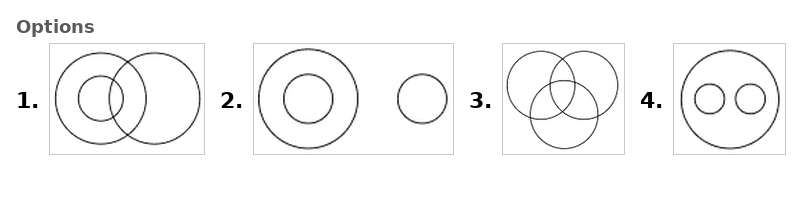
- AFigure 1
- BFigure 2
- CFigure 3
- DFigure 4
Answer: (B) Figure 2
Every parrot is a bird, so the Parrot circle lies inside the Bird circle. Cats are neither birds nor parrots, so Cat is a separate circle: option 2.
Q12.A dice has its faces marked by letters Q, R, U, A, I and L. Two positions of the same dice are given below. Which face is opposite to face Q?
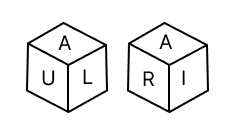
- AR
- BL
- CA
- DU
Answer: (C) A
A is on top in both views. U, L (first view) and R, I (second view) all touch A, so the only face left, Q, is opposite A.
Q13.In a certain code language, 'ZXFGA' is coded as '3' and 'BTGHASQR' is coded as '6'. What is the code for 'YWNERI' in the given language?
- A5
- B6
- C4
- D7
Answer: (C) 4
The code is the number of letters minus 2: ZXFGA has 5 letters → 3, BTGHASQR has 8 → 6. YWNERI has 6 letters → 4.
Q14.Six people, D, E, F, G, H and W, are sitting in a row facing north(but not necessarily in the same order). Only two people sit between W and D. G sits to the immediate left of D. No one sits to the right of H. Only two people sit between H and G. E sits to the immediate left of G. How many people sit between F and E?
- AThree
- BOne
- CFour
- DTwo
Answer: (D) Two
H is at the right end (6th). Two people sit between H and G, so G is 3rd; D is immediately right of G (4th) and E immediately left of G (2nd). Two people between W and D puts W 1st, and F takes the 5th seat: W E G D F H. Between E (2nd) and F (5th) sit G and D: two people.
Q15.Read the given statements and conclusions carefully. Assuming that the information given in the statements is true, even if it appears to be at variance with commonly known facts, decide which of the given conclusion(s) logically follow(s) from the statement(s). Statements: Some taps are soaps. Some taps are creams. Some soaps are oils. Conclusions: (I) Some taps are oils. (II) Some soaps are creams.
- ANeither conclusion (I) nor (II) follows.
- BOnly conclusion (I) follows.
- CBoth conclusions (I) and (II) follow.
- DOnly conclusion (II) follows.
Answer: (A) Neither conclusion (I) nor (II) follows.
Some taps are soaps and some taps are creams, but nothing links soaps with creams, or taps with oils (the oils are only linked to some soaps). Neither conclusion follows.
Q16.Six people, E, F, G, Q, R and S, are sitting in a row facing north (but not necessarily in the same order) . Only two people sit to the right of R. Only two people sit between R and E. Only one person sits between E and F. F sits to the immediate left of R. S sits to the immediate right of Q. How many people sit between Q and G?
- ATwo
- BThree
- COne
- DFour
Answer: (A) Two
Two people sit to the right of R, so R is 4th from the left. F is immediately left of R (3rd). Two people between R and E put E 1st. One person between E and F fits (2nd seat between). Q and S must be adjacent with S right of Q, so they take 5th and 6th, and G takes 2nd: E G F R Q S. Between Q (5th) and G (2nd) sit F and R: two people.
Q17.Based on the English alphabetical order, three of the following four letter-clusters are alike in a certain way and thus form a group. Which letter-cluster DOES NOT belong to that group? (Note: The odd man out is not based on the number of consonants/vowels or their position in the letter-cluster.)
- ATOJ
- BMHC
- CGBW
- DQJE
Answer: (D) QJE
TOJ, MHC and GBW each go back 5 letters at every step (T→O→J, M→H→C, G→B→W). QJE goes back 7 then 5 (Q→J→E), so it is the odd one.
Q18.A dice has its faces marked by letters E, I, L, R, S and U. Two positions of the same dice are shown in the given figures. Which face is opposite to face R?
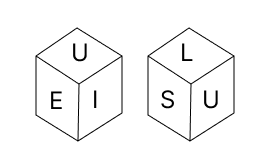
- AL
- BE
- CU
- DS
Answer: (C) U
U appears in both views. In the first, U touches E and I; in the second, U touches L and S. So U touches E, I, L and S, leaving R opposite U.
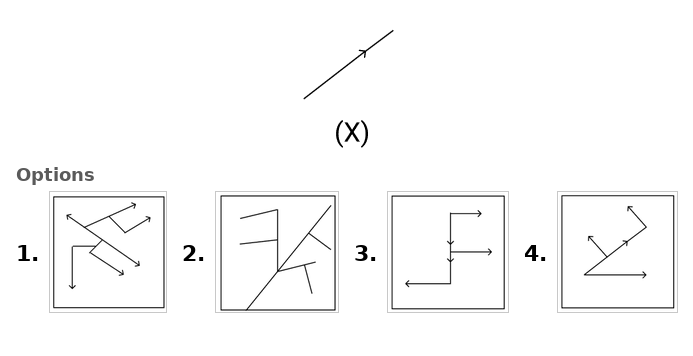
Q19.Select the option in which the given figure (X) is embedded (rotation is NOT allowed).
- AFigure 1
- BFigure 2
- CFigure 3
- DFigure 4
Answer: (D) Figure 4
The straight line with an arrowhead in its middle, slanting the same way as figure (X), appears unchanged inside option 4.
Q20.What should come in place of the question mark (?) in the given series based on the English alphabetical order? AFQ BHR CJS DLT ?
- AFNU
- BFMU
- CENU
- DEOU
Answer: (C) ENU
First letters A, B, C, D → E. Second letters F, H, J, L (+2) → N. Third letters Q, R, S, T → U. Answer: ENU.
General Knowledge and General Awareness (Q21–40)
Q21.In which state is the Halda Festival celebrated?
- AHimachal Pradesh
- BMadhya Pradesh
- CArunachal Pradesh
- DUttar Pradesh
Answer: (A) Himachal Pradesh
Halda is a festival of the Lahaul valley in Himachal Pradesh, celebrated in winter (January–February) with torch processions to drive away evil spirits.
Q22.Which of the following is a correct balanced chemical equation?
- A2C4H10(l) + 12O2(g) → 8CO2(g) + 10H2O
- BC4H10(l) + 13O2(g) → 4CO2(g) + 10H2O
- C2C4H10(l) + 10O2(g) → 8CO2(g) + 10H2O
- D2C4H10(l) + 13O2(g) → 8CO2(g) + 10H2O
Answer: (D) 2C4H10(l) + 13O2(g) → 8CO2(g) + 10H2O
Butane combustion: 2C4H10 + 13O2 → 8CO2 + 10H2O. Check: C 8 = 8; H 20 = 20; O 26 = 16 + 10. The other options do not balance oxygen.
Q23.Which Directive Principle advocates the organisation of village panchayats for self- government?
- AArticle 42
- BArticle 40
- CArticle 44
- DArticle 46
Answer: (B) Article 40
Article 40 (a Directive Principle) asks the State to organise village panchayats and give them the powers needed to function as units of self-government.
Q24.The oceanic crust is mostly made up of different types of basalt which extends how many kilometres beneath the ocean floor?
- A10-17 km
- B15-22 km
- C2-5 km
- D5-10 km
Answer: (D) 5-10 km
The oceanic crust is made mostly of basalt and gabbro and is about 5–10 km thick, much thinner than the continental crust (about 30–50 km).
Q25.Which of the following teams did Tamil Nadu defeat in the final to win the men's title in the 71st Senior National Basketball Championship 2022?
- AHimachal Pradesh
- BWest Bengal
- CPunjab
- DGujarat
Answer: (C) Punjab
Tamil Nadu beat defending champions Punjab 87–69 in the men's final of the 71st Senior National Basketball Championship in Chennai on 10 April 2022.
Q26.Which of the following ministries introduced the Oilfields (Regulation and Development) Amendment Bill, 2024, in the parliament?
- AMinistry of Civil Aviation
- BMinistry of Petroleum and Natural Gas
- CMinistry of Coal
- DMinistry of New and Renewable Energy
Answer: (B) Ministry of Petroleum and Natural Gas
The Oilfields (Regulation and Development) Amendment Bill, 2024 was introduced in the Rajya Sabha by the Ministry of Petroleum and Natural Gas (Minister Hardeep Singh Puri).
Q27.Which of the following sectors was given the highest priority in the First Five-Year Plan?
- ADefense
- BAgriculture
- CHeavy industries
- DInfrastructure
Answer: (B) Agriculture
The First Five-Year Plan (1951–56), based on the Harrod-Domar model, gave the highest priority to agriculture, including irrigation and power projects.
Q28.Which characteristic pottery became a hallmark of early Iron Age settlements in northern India?
- APainted Grey Ware
- BNorthern Black Polished Ware
- CBlack-and-Red Ware
- DRed Polished Ware
Answer: (A) Painted Grey Ware
Painted Grey Ware is the characteristic pottery of the early Iron Age (about 1200–600 BCE) in the Ganga-Yamuna doab and the upper Ganga plain.
Q29.According to the Census of India 2011, which of the following state has the least population?
- AMizoram
- BTripura
- CManipur
- DAssam
Answer: (A) Mizoram
Census 2011 population: Mizoram about 10.97 lakh, Tripura 36.7 lakh, Manipur 28.6 lakh and Assam 3.12 crore. Mizoram is the least populous of the four.
Q30.When natural resources are unlimited, the populations grow very rapidly; this accelerating pattern of increasing population size is called:
- APopulation Explosion
- BCarrying Capacity
- CExponential Growth
- DLogistic Growth
Answer: (C) Exponential Growth
With unlimited resources a population grows at an accelerating rate (J-shaped curve, dN/dt = rN). This is exponential growth; logistic growth applies when resources are limited.
Q31.Which group was formed in 1919 to support the Khilafat Movement and strengthen the Hindu-Muslim unity?
- AAll India Muslim League
- BIndian National Congress
- CKhilafat Committee
- DHindu Mahasabha
Answer: (C) Khilafat Committee
The Khilafat Committee was formed in 1919 (by the Ali brothers, Maulana Azad and others) to support the Khilafat Movement, which Gandhi joined to build Hindu-Muslim unity.
Q32.Jagjit Singh was associated with which of the following fields of music?
- AJazz
- BGhazal
- CPop
- DClassical
Answer: (B) Ghazal
Jagjit Singh, known as the 'Ghazal King', popularised the ghazal; he received the Padma Bhushan in 2003.
Q33.In which of the following states did the Indian classical dance Bharatanatyam originate?
- ATamil Nadu
- BKerala
- CUttar Pradesh
- DKarnataka
Answer: (A) Tamil Nadu
Bharatanatyam originated in the temples of Tamil Nadu and developed from the Sadir dance of the devadasis.
Q34.Which of the following is NOT considered a state executive?
- AChief Justice of High Court
- BGovernor
- CCouncil of Ministers
- DChief Minister
Answer: (A) Chief Justice of High Court
The state executive consists of the Governor, the Chief Minister, the Council of Ministers and the Advocate General. The Chief Justice of the High Court belongs to the judiciary.
Q35.In which position did India finish in the Para Asian Games event in 2023?
- A4th
- B9th
- C6th
- D5th
Answer: (D) 5th
India finished 5th in the medal table at the Hangzhou Asian Para Games (October 2023) with 111 medals (29 gold, 31 silver, 51 bronze).
Q36.Which of the following dancers won the Sangeet Natak Akademi Award for Chhau dance in 2018?
- ASurupa Sen
- BRadha Sridhar
- CTapan Kumar Pattanayak
- DPasumurthy Ramalinga Sastry
Answer: (C) Tapan Kumar Pattanayak
Tapan Kumar Pattanayak received the Sangeet Natak Akademi Award for Chhau (Mayurbhanj Chhau) for the year 2018.
Q37.Who was appointed as the new Chairperson of the Union Public Service Commission on 1 August 2024?
- APreeti Sudan
- BManaj Upamanyu
- CMohan Madhavan
- DRavi Upadhyay
Answer: (A) Preeti Sudan
Preeti Sudan, former Union Health Secretary, took charge as Chairperson of the UPSC on 1 August 2024.
Q38.How many five-year plans were covered during 1951–1990?
- A9
- B8
- C6
- D7
Answer: (D) 7
Between 1951 and 1990 India completed the First to Seventh Five-Year Plans (the Seventh ran 1985–90), i.e. 7 plans. 1966–69 and 1990–92 were plan holidays/annual plans.
Q39.In which year was the PM Gati Shakti National Master Plan launched?
- A2022
- B2023
- C2020
- D2021
Answer: (D) 2021
PM Gati Shakti National Master Plan for multimodal connectivity was launched by the Prime Minister on 13 October 2021.
Q40.How many priorities were adopted in the Union Budget for the financial year 2023-24?
- A9
- B7
- C5
- D12
Answer: (B) 7
The Union Budget 2023-24 adopted seven priorities, called 'Saptarishi': inclusive development, reaching the last mile, infrastructure and investment, unleashing the potential, green growth, youth power and the financial sector.
Elementary Mathematics (Q41–60)
Q41.The average of thirteen numbers is 57. The average of first three numbers is 48, and that of the next seven numbers is 58. The 11th number is two times the 12th number and 12th number is 3 less than the 13th number. What is the average of the 11th and 13th numbers?
- A18
- B72
- C27
- D36
Answer: (B) 72
Sum of 13 numbers = 13 × 57 = 741. First three = 144, next seven = 406, so the last three add to 191. Let the 12th be a: 11th = 2a, 13th = a + 3. Then 4a + 3 = 191, a = 47. 11th = 94, 13th = 50; their average = 144 ÷ 2 = 72.
Q42.The mean proportional between 68 and 272 is:
- A114
- B136
- C126
- D124
Answer: (B) 136
Mean proportional = √(68 × 272) = √18496 = 136.
Q43.The LCM of 40, 20, 120 and 335 is:
- A8101
- B8040
- C8003
- D7991
Answer: (B) 8040
40 = 2³ × 5, 20 = 2² × 5, 120 = 2³ × 3 × 5, 335 = 5 × 67. LCM = 2³ × 3 × 5 × 67 = 8040.
Q44.The average age of 59 students of a class is 22 years. If the age of the teacher is also included, the average age of the whole group becomes 23 years. The age (in years) of the teacher is:
- A81
- B83
- C84
- D82
Answer: (D) 82
Total age of 59 students = 59 × 22 = 1298. With the teacher, 60 × 23 = 1380. Teacher's age = 1380 − 1298 = 82 years.
Q45.Two trains having lengths of 150 m and 350 m are running at speeds of 60 km/h and 120 km/h, respectively, in the same direction. The time taken (in minutes) by the faster train, coming from behind, to completely cross the other train is:
- A2
- B1.2
- C3.5
- D0.5
Answer: (D) 0.5
Relative speed = 120 − 60 = 60 km/h = 50/3 m/s. Distance = 150 + 350 = 500 m. Time = 500 ÷ (50/3) = 30 s = 0.5 minute.
Q46.What is the correct descending order of the ratios 17 : 42, 19 : 21, 1 : 7, 11 : 13, 23 : 26?
- A23 : 26, 19 : 21, 11 : 13, 17 : 42, 1 : 7
- B19 : 21, 23 : 26, 11 : 13, 1 : 7, 17 : 42
- C19 : 21, 11 : 13, 23 : 26, 17 : 42, 1 : 7
- D19 : 21, 23 : 26, 11 : 13, 17 : 42, 1 : 7
Answer: (D) 19 : 21, 23 : 26, 11 : 13, 17 : 42, 1 : 7
As decimals: 19/21 = 0.905, 23/26 = 0.885, 11/13 = 0.846, 17/42 = 0.405, 1/7 = 0.143. Descending: 19:21, 23:26, 11:13, 17:42, 1:7.
Q47.What is the smallest number which when divided by 64 and 80 leaves remainder 9 in each case?
- A337
- B329
- C320
- D311
Answer: (B) 329
LCM of 64 and 80 = 320. The smallest number leaving remainder 9 in each case is 320 + 9 = 329.
Q48.In a circular race of 800 m length, Ram and Mohan start at speeds of 25 m/sec and 40 m/sec, respectively, at the same time from the same point. After how much time will they meet for the first time at the starting point, when running in the same direction?
- A136 seconds
- B120 seconds
- C152 seconds
- D160 seconds
Answer: (D) 160 seconds
Ram takes 800/25 = 32 s per lap and Mohan 800/40 = 20 s. They are together at the start after LCM(32, 20) = 160 seconds.
Q49.Find the value of [(18 × 19) × {8 ÷ 4 × (16 − 12)/2}]
- A1349
- B1368
- C1382
- D1353
Answer: (B) 1368
Bracket first: (16 − 12)/2 = 2, so {8 ÷ 4 × 2} = 2 × 2 = 4. Then (18 × 19) × 4 = 342 × 4 = 1368.
Q50.The price of fuel decreases by 35%, 10% and 30% in three successive months, but increases by 65% in the fourth month. What is the percentage increase/decrease in the price of fuel in the fourth month as compared to its original price?
- ADecreases by 33.75%
- BDecreases by 32.43%
- CIncreases by 31.14%
- DIncreases by 32.84%
Answer: (B) Decreases by 32.43%
Final price = 0.65 × 0.90 × 0.70 × 1.65 = 0.675675 of the original, i.e. a decrease of about 32.43%.
Q51.If 2% of x = 324, then x is equal to:
- A16200
- B32400
- C16300
- D32500
Answer: (A) 16200
2% of x = 324 → x = 324 × 100 ÷ 2 = 16200.
Q52.Find the volume of a hemisphere whose diameter is 7 cm. (Take π = 22/7) (Rounded up to two decimal places)
- A89.83 cm3
- B94.83 cm3
- C99.83 cm3
- D84.83 cm3
Answer: (A) 89.83 cm3
Radius = 3.5 cm. Volume = (2/3)πr³ = (2/3) × (22/7) × 42.875 = 89.83 cm³.
Q53.400 chickooes were bought at ₹1260 per hundred and were sold at a profit of ₹860. Find the selling price (in ₹) per dozen of chickooes.
- A167
- B177
- C187
- D192
Answer: (B) 177
Cost = 4 × ₹1260 = ₹5040. Selling price = 5040 + 860 = ₹5900 for 400, i.e. ₹14.75 each. Per dozen = 14.75 × 12 = ₹177.
Q54.When difference between compound and simple interest for three years is ₹183 at 5% interest per annum, the principal is ₹______
- A24420
- B23425
- C24000
- D25200
Answer: (C) 24000
For 3 years, CI − SI = P[(1.05)³ − 1 − 0.15] = P × 0.007625. So P = 183 ÷ 0.007625 = ₹24000.
Q55.Evaluate: 16 + 8 ÷ 4 - 2 × 3
- A11
- B12
- C15
- D14
Answer: (B) 12
BODMAS: 8 ÷ 4 = 2 and 2 × 3 = 6, so 16 + 2 − 6 = 12.
Q56.Abhishek and Deepanshi undertake to do a piece of work for ₹1,000. Abhishek alone can do it in 5 days and Deepanshi alone can do it in 10 days. With the help of Chitransh, they finish it in 2 days. How much should Chitransh be paid for his contribution?
- A₹200
- B₹500
- C₹300
- D₹400
Answer: (D) ₹400
In 2 days Abhishek does 2/5 of the work and Deepanshi 2/10 = 1/5, together 3/5. Chitransh does the remaining 2/5, so he gets 2/5 × ₹1000 = ₹400.
Q57.Govind invested some money in HDFC at 4% per annum rate of interest. What would be the corresponding simple interest (in ₹) if after 2 years, Govind got ₹178.5 as compound interest, considering annual compounding?
- A175
- B185
- C170
- D190
Answer: (A) 175
CI for 2 years at 4% = P × (1.04² − 1) = 0.0816P = 178.5, so P = ₹2187.50. SI for 2 years = 2187.5 × 0.08 = ₹175.
Q58.A man sold an article for ₹216, there by gaining 20%. The cost of the article (in ₹) was:
- A172
- B180
- C270
- D260
Answer: (B) 180
Cost = 216 ÷ 1.20 = ₹180.
Q59.A washing machine is marked at ₹30,000. A customer gets two successive discounts of 20% and 10%. What is the final price (in ₹) that the customer has to pay?
- A23,400
- B22,800
- C22,900
- D21,600
Answer: (D) 21,600
30000 × 0.80 × 0.90 = ₹21,600.
Q60.Mukund invests a sum of ₹5400 and Sachin invests a sum of ₹9400 at the same rate of simple interest per annum. If, at the end of 5 years, Sachin gets ₹960 more interest than Mukund, then find the rate of interest per annum (in percentage).
- A3.8
- B6.8
- C2.8
- D4.8
Answer: (D) 4.8
The difference in principal is 9400 − 5400 = ₹4000. Extra interest 960 = 4000 × R × 5 ÷ 100, so R = 960 ÷ 200 = 4.8%.
English (Q61–80)
Q61.Select the most appropriate ANTONYM of the given word. Offer
- AOpen
- BHurt
- CSelect
- DWithhold
Answer: (D) Withhold
To offer is to present something for acceptance; the opposite is to withhold (keep it back).
Q62.Rectify the sentence by selecting the correctly spelt word from the options. Despite the insistence of her colleague, Sheela’s response to the request to collaborate on the project was laanguid.
- ALanguied
- BLangued
- CLanguid
- DLangud
Answer: (C) Languid
The correct spelling is 'languid' (lacking energy, slow).
Q63.Select the INCORRECTLY spelt word.
- AElicit
- BQuarentine
- CPractice
- DConcentrate
Answer: (B) Quarentine
The correct spelling is 'quarantine'. Elicit, practice and concentrate are spelt correctly.
Q64.Select the most appropriate idiom that can replace the underlined segment in the given sentence. A ‘false and selfish friend’ will never be by your side in times of difficulty. (The underlined segment is shown in quotes.)
- Apast master
- Bfair weather friend
- Cgreat hand
- Dgood samaritan
Answer: (B) fair weather friend
A fair-weather friend is one who stays only in good times and leaves when you are in trouble, which matches 'a false and selfish friend'.
Q65.Select the most appropriate ANTONYM of the given word. Abscond
- AEndure
- BFlee
- CHide
- DWithdraw
Answer: (A) Endure
Abscond means to run away secretly, usually to avoid something. Flee, hide and withdraw are close to it in meaning; SSC's key takes endure (stay and face it) as the opposite.
Q66.The given sentence is divided into four segments. Select the option that has the segment with an adverbial usage error. Oliver told Mia, “Seldom than walking, she prefers to take the city bus.”
- Ashe prefers to
- B“Seldom than walking,
- COliver told Mia,
- Dtake the city bus.”
Answer: (B) “Seldom than walking,
'Seldom than walking' is wrong: the comparison needs 'Rather than walking, she prefers to take the city bus.' The error is in the segment with 'Seldom'.
Q67.Select the most appropriate synonym of the given word. Persiflage
- ACriticism
- BSeriousness
- CBanter
- DArgument
Answer: (C) Banter
Persiflage means light, teasing talk, i.e. banter.
Q68.Select the most appropriate idiom that can substitute the underlined segment in the given sentence. She didn’t want to ‘upset anyone’ at work, so she carefully navigated the office politics. (The underlined segment is shown in quotes.)
- Ascratch anyone's heads
- Bbite the bullet
- Cstep on anyone's toes
- Dsteal the show
Answer: (C) step on anyone's toes
To step on someone's toes is to offend or upset them, which replaces 'upset anyone'.
Q69.Select the most appropriate option to fill in the blank and make the sentence meaningful. By showing _______ united strength, we may scare the opposition.
- Aan
- Bany
- Ca
- Dno
Answer: (C) a
'United strength' is a singular countable idea after 'showing', and 'united' begins with a consonant (y) sound, so the article is 'a'.
Q70.Select the most appropriate option that can substitute the underlined segment in the given sentence and rectify it. If no correction is needed, select ‘No correction required’. The road was ‘repairing’ by the workers. (The underlined segment is shown in quotes.)
- Arepairs
- Brepaired
- Cbeen repaired
- DNo correction required
Answer: (B) repaired
The road cannot repair itself; the sentence is passive: 'The road was repaired by the workers.'
Q71.Select the most appropriate collocation to fill in the blank. I was running late so I only had time for a __________ shower.
- Aquick
- Bluxurious
- Crelaxed
- Dlong
Answer: (A) quick
With little time you take a quick shower; 'quick shower' is the natural collocation.
Q72.Select the most appropriate ANTONYM of the given word. Frugal
- APrudent
- BRight
- CProdigal
- DSparing
Answer: (C) Prodigal
Frugal means careful and sparing with money; its antonym is prodigal (wastefully extravagant). Prudent and sparing are near-synonyms.
Q73.The given sentence is divided into four segments. Select the option that has the segment with an adverbial usage error. Evelyn clearly / packed her / suitcase for / the trip to Malaysia.
- Apacked her
- Bthe trip to Malaysia
- CEvelyn clearly
- Dsuitcase for
Answer: (C) Evelyn clearly
'Clearly' does not fit the act of packing; an adverb of manner such as 'carefully' or 'neatly' is needed. The error is in 'Evelyn clearly'.
Q74.Select the most appropriate option that can substitute the underlined segment in the given sentence. The COVID-19 pandemic led to trade disruptions worldwide, but the agricultural and food sector ‘prove to more resilient’ than other sectors of the economy. (The underlined segment is shown in quotes.)
- Aproved to be more resilient
- Bproving to be more resilient
- Cproved to been more resilient
- Dprove to be more resilient
Answer: (A) proved to be more resilient
The sentence is in the past and 'prove' needs the infinitive 'to be': 'the agricultural and food sector proved to be more resilient'.
Q75.Select the most appropriate synonym of the given word. Frivolous
- AMomentous
- BEventful
- CSubstantial
- DTrivial
Answer: (D) Trivial
Frivolous means not serious or of little importance, i.e. trivial.
- In the following passage, some words have been deleted. Read the passage carefully and select the most appropriate option to fill in each blank. The worst days of any summer are the rainy ones. We spend all year looking forward to (1)_____ weather and long, hot days. All of winter, with its dreary grey days and (2)_____ cold, we dream of those (3)_____ days at the beach, laying on the sand and (4)_____ in the (5)_____ and burning sun. And then, summer comes, and it rains.
Q76.Select the most appropriate option to fill in blank number 1.
- Amean
- Bcold
- Ccool
- Dugly
Answer: (C) cool
People look forward to pleasant summer weather; 'cool weather' fits the contrast with 'long, hot days' better than mean, cold or ugly.
Q77.Select the most appropriate option to fill in blank number 2.
- Abitter
- Bwarm
- Cloving
- Dsweet
Answer: (A) bitter
Winter's cold is described with a harsh adjective: 'bitter cold'.
Q78.Select the most appropriate option to fill in blank number 3.
- Adefinite
- Bconfined
- Cendless
- Drestricted
Answer: (C) endless
We dream of summer days that seem to go on forever: 'endless days at the beach'.
Q79.Select the most appropriate option to fill in blank number 4.
- Adry
- Bwalking
- Csoaking
- Darid
Answer: (C) soaking
Lying on the sand and 'soaking in' the sun means absorbing its warmth.
Q80.Select the most appropriate option to fill in blank number 5.
- Asolemn
- Bbright
- Cdull
- Dunpleasant
Answer: (B) bright
The sun at the beach is 'bright and burning'; solemn, dull and unpleasant do not fit.
Practise this paper under exam conditions
80 questions, 60-minute timer, negative marking and a score report.
Attempt online